Lying between the Yangtze and Huaihe rivers in southern China, Anhui has historically been a meeting point of regional cultures. Opened in 1956, the Anhui Provincial Museum houses more than 310,000 cultural relics, including such prized treasures as the Bronze Tallies of Lord Qi of E, Jian (Water/Ice Container) of King Guang of Wu, Giant Zhu Ke Ding (a cooking cauldron and also a ritual item), Gold-Rimmed Agate Bowl, and Carved Marbled Lacquer Box with Cloud Patterns Made by Zhang Cheng,.
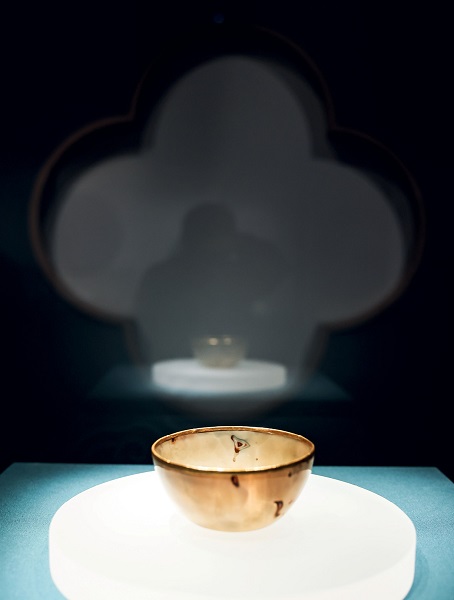
Song Dynasty Gold-Rimmed Agate Bowl on display at the Anhui Museum.
A Millennia-Old Tax-Exempt Pass
Two thousand years ago, the State of Chu occupied a large portion of Anhui. The area around present-day Shouxian County, in particular, was for centuries a political, economic, and cultural center of Chu. Among the Anhui Museum’s rich collection of Chu relics are the iconic Bronze Tallies of Lord Qi of E.
This group of bamboo-slip-shaped bronze tallies are engraved with inscriptions in gold, providing an invaluable record and insight into the rules for transportation, commerce, and taxation during the Warring States Period (475-221 B.C.).
The inscriptions show that King Huai of Chu presented the tallies to Qi, a feudal lord governing an area called E, as a pass granting him passage and tax exemptions when transporting goods. The tallies can be categorized into two types used respectively for land and water transportation. The writings specify the number of vehicles and boats allowed, the period of validity, the areas through which they could pass, and prohibited goods. The boat tally allowed up to 150 vessels, while the vehicle tally allowed up to 50 vehicles, with each valid for one year.
Take the carriage tally for example. According to the inscriptions, materials used to make bows and arrows, such as bronze and leather, were military supplies under state control. While the tally-passes granted tax-free carriage, this exemption did not extend to military goods: overland transport of such items was expressly barred under the land-pass provisions, and even licensed carriages were restricted to the waterway-pass routes which implemented closed, checkpoint-by-checkpoint oversight. The inscriptions also record rivers, roads, and the names of places that existed in the State of Chu, offering a glimpse of the transportation network back then.
More than 2,300 years ago, the State of Chu was a land of plenty with active domestic trade. Chu established many checkpoints on major roads in cities and towns. These checkpoints were used not only to maintain order and provide military defenses, but also to collect commercial taxes and inspect goods for violations. By granting tax exemptions and offering incentive policies, the state encouraged merchants to trade in less-developed areas, thereby stimulating regional economic development.
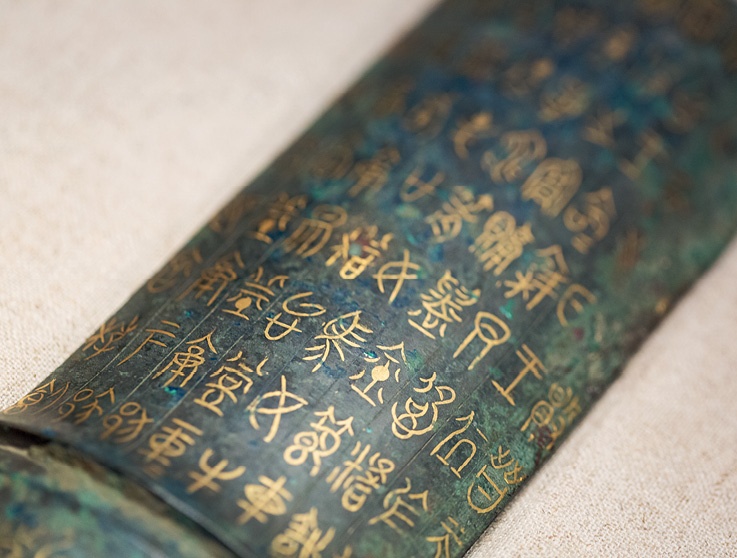
A close-up look at the gold inscription on the iconic Bronze Tallies of Lord Qi of E, dating back over a thousand years.
Giant Zhu Ke Ding
The 1.1-meter-tall Giant Zhu Ke Ding weighs approximately 400 kilograms and has a diameter of 87 centimeters. The artifact is decorated with elaborate patterns, while there are inscriptions cast on its rim and legs, reading “安邦” (“bringing stability to the state”).
The significance of the Giant Zhu Ke Ding was intensified by its encounters during contemporary times. Shortly after being unearthed from a tomb of a Chu king in Anhui in 1933, this item was evacuated together with other relics from the Palace Museum, transported from the east to northwest China during the War of Resistance against Japanese Aggression before eventually being brought back to Anhui postwar.
In 2014, the National Memorial Ding was erected at the square of the Memorial Hall of the Victims in Nanjing Massacre by Japanese Invaders in Nanjing, capital of east China’s Jiangsu Province, to commemorate the victims of the Nanjing Massacre. This very piece was modeled on the Giant Zhu Ke Ding. In this way, a bronze ding created more than 2,000 years ago acquired new cultural significance in the modern era.
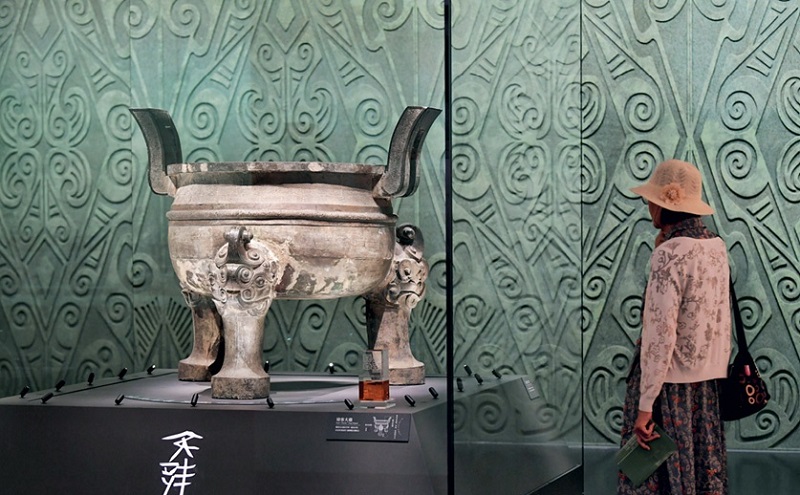
A lady admires the Giant Zhu Ke Ding at a newly-opened gallery of the Anhui Museum on May 18, 2026.
An Ancient Fridge
The Jian (Water/Ice Container) of King Guang of Wu is another treasured bronze artifact from the Spring and Autumn Period (770-476 B.C.) at the Anhui Museum. Two such vessels were discovered in the tomb of Marquis Zhao of Cai, one now housed at the Anhui Museum, and the other at the National Museum.
Unearthed alongside the Jian were a bronze wine container and a ladle placed inside it, forming a set of bronze vessels. During hot summer months, people could place ice between the Jian and the container to keep the wine cool. In winter, the ice could be replaced with hot water to warm up the wine. For this reason, the vessel is regarded as one of the earliest “refrigerators” and wine heaters in ancient China.
Eight lines of 52 characters are cast inside the belly of the Jian. The inscription records that King Guang of Wu, known as King Helü of Wu, had the vessel made for his daughter Shu Ji when she married, as a dowry used for ritual ceremonies. It provides important historical evidence for the study of relations between the states of Wu and Cai during the Spring and Autumn Period.
Lacquer Masterpiece
The Anhui Museum’s treasures extend beyond its collection of bronze artifacts. Lacquerware is another highlight, and Carved Marbled Lacquer Box with Cloud Patterns Made by Zhang Cheng is a showstopper.
The round box is about 6 centimeters high and 14.5 centimeters in diameter, with the three-character inscription “张成造” (“Made by Zhang Cheng”) carved along the edge of its base. Zhang was a renowned Yuan Dynasty (1206-1368) lacquer-carving artist whose works have been highly coveted but only a few are still in existence.
The typical lacquering technique involved requires repeatedly applying layers of lacquer in different colors to the body of an object. Once the lacquer layers reached a certain thickness, artists began to carve decorative patterns into them, revealing layers of different shades of red and black. Even after the passing of centuries, the lacquer surface remains smooth and lustrous, with its marbled patterns still clearly visible.
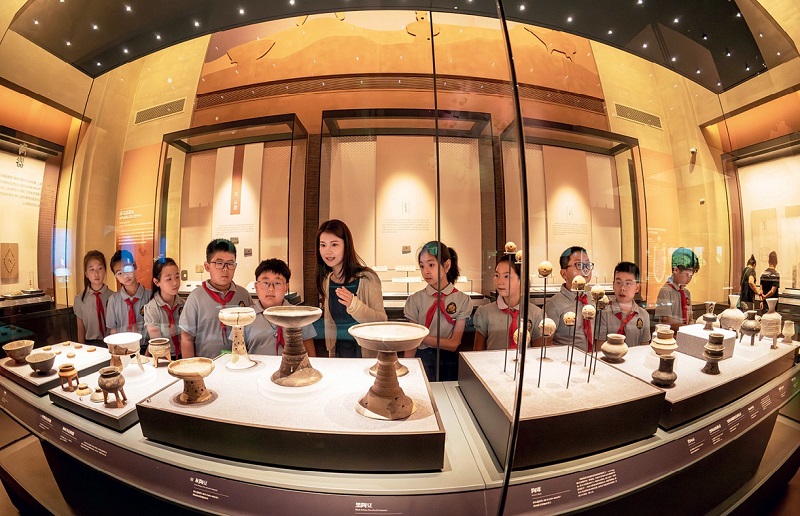
A group of students from the Hefei Shuanggang Elementary School visit the Anhui Museum accompanied by their teacher on May 15, 2026.
Joy of Song
An artifact often recounts not only history but also a way of life in a particular era. The Gold-rimmed Agate Bowl in the Anhui Museum offers a glimpse into the everyday life of people living in the Song Dynasty (960-1279). Made of agate, the bowl has a band of gold fitted around its rim. It is 6.4 centimeters high and 13.14 centimeters in diameter. The orange-yellowish agate is characterized by natural dark-red patterns, while the bowl wall is exceptionally thin, measuring just about 0.2 centimeters at its thinnest point.
Agate is relatively brittle, making it difficult to fashion into a thin-walled vessel. Firmly fitting a gold rim around its edge requires an even higher level of craftsmanship. The Song Dynasty, which was blessed with a period of economic and cultural prosperity, was known for its aesthetics of elegance. Drinking wine, enjoying tea, and gathering for refined social activities became important parts of social life at that time. The agate bowl, an exquisitely designed household vessel, reflects the Song people’s pursuit of elegance and refined aesthetics.
Public Outreach
In recent years, museums have increasingly resorted to using public education as a means of imparting traditions and history. At the Anhui Museum, a wide range of activities have been designed to cater to people of all ages, such as the Youth Poetry Competition and Chongyang Festival events for the elderly. Through guided tours, interaction, and hands-on experiences, these programs bring artifacts to life beyond the display cases. At the same time, in response to the preference towards and interaction of younger audiences with social and digital media, the museum has opened social media accounts and explored the use of short videos, artificial intelligence, and other technologies to tell the story of Anhui’s history.
Technology is also transforming the way people experience museums. The museum has also launched an XR digital experience hall. Its XR immersive exhibition, “The Eternal Splendor of the Tang Dynasty (618-907),” features Tang culture, national treasures, and Silk Road history, allowing visitors to explore historical scenes by virtual immersion.