In recent years, concerts, music festivals, and football matches have been staged one by one across China, and traveling to another city for live events has become increasingly popular among ticket holders. Alongside this trend, the “ticket-stub economy” has emerged as a new driver of consumption.
By presenting tickets or stubs from concerts, sporting events, exhibitions, scenic spots, and transportation services, consumers can unlock discounts, reward points, and redeemable rewards across a wide range of spending scenarios, including dining, accommodation, transportation, sightseeing, entertainment, and shopping. In this way, a single ticket can connect an entire consumption chain spanning multiple sectors, making it a powerful lever for stimulating urban consumption.
Industry experts say that the growing popularity of the “ticket-stub economy” reflects a deeper shift in consumer behavior and is generating considerable economic momentum.
Concert Tickets Boost Business Districts
As night falls, Beijing’s National Stadium, the iconic Bird’s Nest, comes alive with dazzling lights and thundering music almost every weekend and on many weeknights as well. Tens of thousands of fans wave glow sticks, immersed in the electric atmosphere of live concerts.
Traveling to another city to watch a live performance has become a new lifestyle trend among young people. Zhou, a fan from Zhengzhou (about 700 kilometers from Beijing), took an early-morning high-speed train to the capital to see a concert at the Bird’s Nest, and booked his return ticket for the following afternoon. After the show, he met up with some old friends at a late-night eatery, then spent the next morning cycling along Beijing’s Central Axis sightseeing route. “It was such a fulfilling weekend,” he said. “The trip was about much more than just the concert.”
During the first half of the year, the Bird’s Nest maintained a packed performance schedule, hosting 38 large-scale concerts with audiences exceeding 10,000 people each. Nearly 1.9 million concertgoers attended, up 35 percent and 23 percent respectively from the same period last year.
Performances of all sizes across the city have been drawing crowds. In the first half of the year, Beijing’s box-office revenue from performances rose 20.9 percent year on year, while revenue from the sports industry and air transportation increased 12.8 percent and 10.6 percent, respectively.
Concerts, sporting events, and exhibitions are attracting more visitors to Beijing and encouraging them to experience the city more deeply. During the Dragon Boat Festival holiday in June this year, Beijing staged 1,136 commercial performances across 280 productions, welcomed nearly 8.5 million tourists, and generated nearly RMB 11.4 billion in tourism spending.
“In the performance industry, the period from after the Spring Festival to May is usually considered the off-season,” said Zhang Haijun, executive president of the Beijing Performing Arts and Entertainment Association. “But Beijing’s market remains booming even during this traditional off-season.”
Tickets have also evolved from simple admission passes into “city consumption passports.” Inside the Bird’s Nest, integrated concert-and-dining services allow audiences to enjoy performances and food in one place. Outside the venue, more than 100 nearby businesses have launched special promotions for ticket holders, linking concerts with dining, tourism, and accommodations in a seamless consumption loop.
The impact has extended far beyond the venue. Fans from around the country now travel to Beijing specifically for major concerts, and shopping districts are creating immersive themed experiences to capture this foot traffic. During Taiwan band Mayday’s concert series in May of 2026, the STAYREAL pop-up store at THE NEW mall welcomed a record-breaking 70,000 visitors in a single day, while overall sales surged 250 percent year on year. During the Chinese singer Zhang Jie’s concerts in March and April 2026, THE BOX mall created dedicated fan-support spaces that boosted foot traffic by 16 percent month on month.
Through the integration of immersive spaces, commercial services, and emotional experiences, concert-driven foot traffic is increasingly being converted into broader commercial vitality across the city.
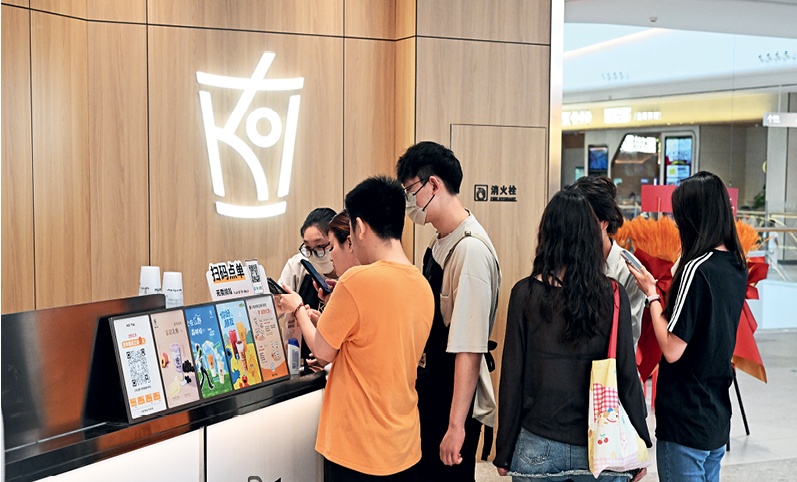
Local residents receive dining discounts with their movie ticket stubs at Paradise Walk, a shopping center in Shanghai, where participating restaurants offer moviegoers a 12 percent discount.
Coffee Fair Tickets Spark New Experiences
At the 2026 Guangzhou Coffee Culture Fair, held in Guangzhou, Guangdong Province, in May 2026, visitors explored a wide range of new coffee experiences. An RMB 8 admission ticket served not only as an entry pass for sampling different coffees, but also as a key to unlocking discounts across the city’s shopping and dining districts.
During the May Day holiday, coffee lovers Ying and her friend arrived at the fair early to sample creative specialty coffees. They benefited from ticket-holder perks right inside the venue: after paying a combined RMB 16 for admission, they bought two specialty coffee drinks for RMB 71 by using coupons. “The ticket itself already comes with discounts,” they said. “After the promotions, each specialty drink costs only RMB 35.5. This price is very reasonable compared with boutique coffee shops elsewhere.”
The fair tickets also unlocked benefits at shopping malls across Guangzhou. After reviewing the promotional offers, the pair visited Guangzhou International Grand City, a landmark one-stop complex in Zhujiang New Town, where they redeemed a gift package worth RMB 120, including RMB 100 in dining vouchers and RMB 20 in beverage coupons. They later used the beverage coupons at a tea shop, effectively getting their drinks for free. “If customers spend RMB 200 and use these coupons, they only need to pay RMB 100 in the end. It’s essentially a 50 percent discount,” a mall employee explained.
A mini-program launched alongside the fair allows tourists to browse the city’s event calendar and enter ticket giveaways for performances and exhibitions. Users who upload their fair tickets can also enjoy exclusive discounts at nearly 30 boutique coffee shops.
Held during the May Day holiday, the 2026 Guangzhou Coffee Culture Fair aimed to establish a new integrated cultural, commercial, tourism, and lifestyle IP for the city. It demonstrated strong market appeal, drawing more than 37,000 visitors on May 2 alone.
One notable feature of the fair’s ticket-linkage model is its ability to trigger rapid, full-chain consumption within a short period of time. It seamlessly connected the coffee consumption at the main venue during the day with shopping in nearby commercial districts, and extended into nighttime consumption hubs such as Zhujiang New Town and Beijing Road.
Sports Tickets Generate Ripple Effects
The 2026 Northeast China City Football League, popularly dubbed the “Northeast Super League,” kicked off on May 23, 2026, in Shenyang, Changchun, Harbin, and Hohhot. Running through October 2026, the tournament aimed to promote football development in Northeast China while integrating sports, tourism, culture, and commerce across the region.
“I traveled all the way from Harbin to Shenyang to cheer for my hometown team,” said one fan surnamed Zhou. “With my RMB 19.9 e-ticket, I got hotel discounts, 10 percent off at a nearby barbecue restaurant after the game, and free entry to the Shenyang Imperial Palace the following day. Altogether I saved nearly RMB 200. The trip was absolutely worth it.”
Local businesses are also seeing tangible benefits. Data show that during the league’s opening week, online searches for “Shenyang barbecue” jumped 156 percent year on year, while bookings for Harbin scenic attractions surged 119 percent. A Shenyang barbecue restaurant owner said that since the tournament began, more than 30 percent of his customers have come in using ticket discounts, and customer volume has doubled on weekends.
A staff member of the Liaoning branch of China UMS Payment noted that after obtaining tickets, fans can access the official service platform via the UnionPay app and upload their tickets for instant verification. Once verified, they receive exclusive promotional packages that are automatically redeemed when they pay with UnionPay.
In Liaoning Province, more than 4,300 merchants have joined the service platform, which offers ticket-based promotions at over 40 tourist attractions. In Jilin Province, the league’s consumer packages now cover 129 themed travel routes, with 17 scenic sites waiving first-entry admission fees. Meanwhile, in Heilongjiang Province, highly localized promotions such as “one-cent noodles” have boosted revenues at participating restaurants by as much as nearly 93.5 percent.
Beyond the “Northeast Super League,” other sporting events, such as marathons and e-sports tournaments, have also expanded ticket-linked benefits. In Anshun, Guizhou Province, marathon runners can upload registration confirmations to receive exclusive coupon packages covering dining, hotels, and shopping, encouraging spending during the event. In Hangzhou, Zhejiang Province, e-sports competitions have launched themed promotions in partnerships with more than 100 merchants in commercial districts.
Gao Zhengyang, a research fellow at Suning Bank, said that the essence of the “ticket-stub economy” lies in extending consumption from single purchases to chain experiences.
“A ticket represents more than access to a cultural or sporting event,” Gao said. “It identifies a verified group of consumers with strong spending intent. As proof of real-world participation, tickets solve the inefficiencies of traditional coupon distribution by reducing the waste of broad, untargeted promotions, enabling a much more precise conversion of consumer volume.” 
The article is based on reports from media outlets including China Consumer News, Beijing Daily, and Guangzhou Daily.