In the beautiful coastal city of Qingdao in east China’s Shandong Province, a centennial brewery has evolved from providing “a glass of beer” for customers to cultivating “an entire ecosystem.”
The months of autumn arrive later in Qingdao than in inland cities. When in Qingdao, no one can resist a glass of fresh draft beer. The dense, creamy head of Tsingtao Beer, honed over a century, has long since become a part of the fabric of the city’s culture and daily life.
Yet in this coastal metropolis in east China, beer is far more than just a refreshing drink.
Outside the Tsingtao Beer Museum – though the peak tourist season of summer has already passed – a queue of visitors is stretched for more than 100 meters, while crowds of visitors jostle for space inside. The beer tasting hall and outdoor terraces are also packed to capacity. Many visitors, glasses in hand, sample brews while they browse Tsingtao’s expanding range of merchandise. Preliminary statistics by the museum show that the average visitor dwell time exceeds three hours.
What is it here that attracts visitors so much that they are reluctant to leave? How did a century-old factory transform into a must-visit tourism hotspot? Come with me, and I will tell you that story.
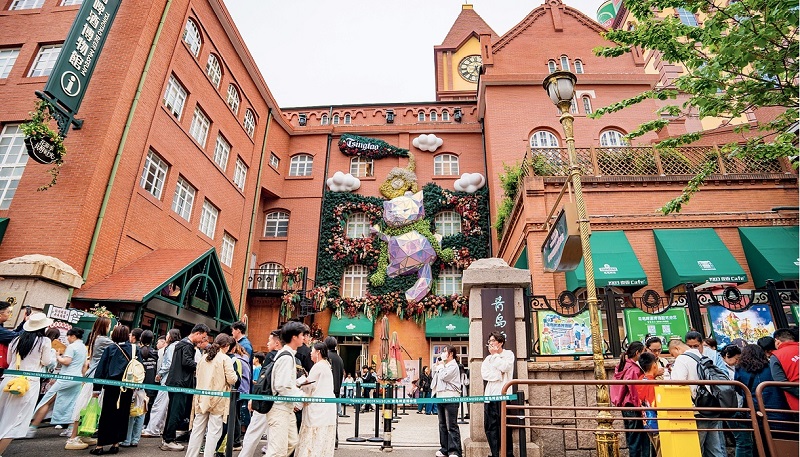
The Tsingtao Beer Museum, located at No. 56 Dengzhou Road, the original 1903 Tsingtao Brewery site and birthplace of Chinese industrial beer, welcomes visitors on May 1, 2026. It is China’s first professional beer museum, as well as one of the world’s five leading beer museums.
Time Folded in a Centennial Brewery
Stepping into the Tsingtao Beer Museum feels like experiencing a “fold in time and space.”
Nestled within the still-operational old factory at No. 56 Dengzhou Road, the museum was officially opened to the public in 2003 to commemorate Tsingtao Beer’s centennial. Dated to the 1903 German-built brewery, it holds the distinction of being China’s first museum dedicated to beer. It has been recognized as a National Industrial Heritage Site, a National First-Class Museum, a National Cultural Industry Demonstration Base, and a National Demonstration Base for Industrial Tourism.
Building A houses vintage equipment and artifacts which chronicle over a century of Tsingtao’s history. Building B, adjacent to the active production floor, features glass-enclosed walkways where visitors can witness the entire brewing and bottling process. Here, century-old mashing tuns and fermentation tanks stand in silent dialogue with modern intelligent production lines.
The heart of the museum is the beer tasting area. Tasting fresh beer, brewed that very day, draws crowds of domestic and international visitors. People gather, clink glasses, chatter, and laugh together – evoking the convivial atmosphere of a century past. During peak seasons, staff wash thousands of glasses daily.
“Our research shows that many industrial tourism sites are suffering from the ‘photo taking, quick exit, low spending’ trap,” noted Jin Yu, marketing director of Tsingtao Beer International Tourism Development Co.
Traditional industrial tours often rely on a simplistic “viewing + tasting” model, but Tsingtao Beer Museum found something new. Instead of static displays, it enriches visitors’ journey based on their preferences, transforming a brief stop into a deep dive.
For young people, interactive theater experiences like The Awakening Brewer allow them to role-play as apprentice brewers or private investigators in 1913, solving mysteries within the factory. Evening visitors also get to enjoy The Golden Night, a slow-paced nighttime tour of the old factory’s charm.
Tech integration is another highlight. VR/AR technology powers a Ninkasi (the Sumerian goddess of beer) voyage exhibition. Meanwhile, the museum also sells pastries, tea beverages, and ice cream.
“We have created immersive theater and night tours alongside upgraded exhibits to ensure visitors seeking atmosphere or photo ops can find their niche,” Jin added.
The museum’s cultural and creative store is also equally popular. From limited-edition beers and snacks to skincare products like hand cream and facial masks, few visitors leave empty-handed.
Besides, it has also incubated two local IPs – the “Han Dou Tian Tuan” (Cute Bean Squad) and “Ha Jiu Ya” (Beer-Drinking Duck) – both of which have spawned nearly 1,000 exclusive merchandise items. Beer bread, beer ice cream, and specialty tea drinks are available at every turn.
These thoughtful touches have quietly extended the average visitor dwell time from a rushed glance to a leisurely three-hour exploration. Visitors no longer just taste and go; they linger, play, and immerse themselves.
Wang Rongjing, a visitor from Zhejiang Province, just completed the exclusive “one-by-one” tasting experience, sampling six distinct flavors – pure draft, white beer, pilsner, unfiltered original, IPA, and stout – in one sitting. “Here visitors can see a century of history, play immersive games, and enjoy the atmosphere during night tours. You can easily spend half a day here, wandering around and relaxing,” she said.
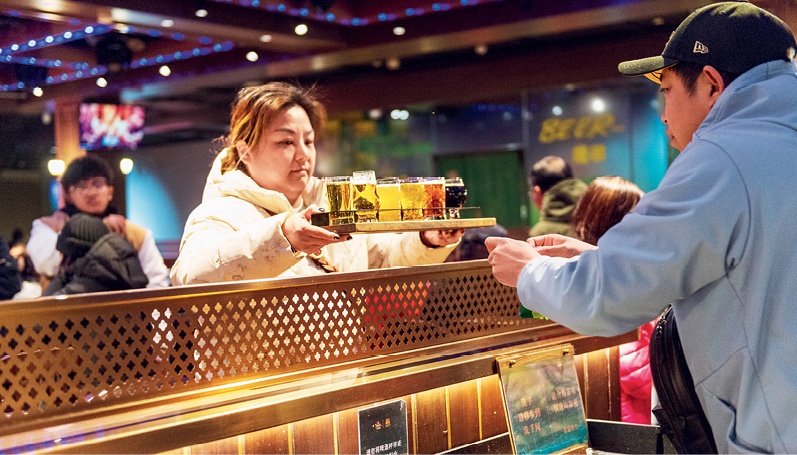
Visitors sample freshly drawn beer inside the museum galleries.
More than a Glass of Beer
Industrial tourism is now emerging as a significant growth engine for the cultural and tourism sector. In 2025, the revenue of domestic industrial tourism reached RMB 120 billion, a year-on-year increase of 10 percent. Research forecasts the industry will see an average annual growth rate of 18 percent, with the market poised to surpass RMB 300 billion by the year 2029. By the end of 2025, China had designated 264 National Industrial Heritage sites and nearly 500 provincial sites.
Yang Jinsong, a researcher at the China Tourism Academy, noted that the value of industrial heritage tourism lies in its role as a witness to a particular past era, a vessel for collective memory, and a showcase for industrial aesthetics. The focus of development, he emphasized, lies in crafting narratives that contemporary visitors can relate to.
Immersive experiences are rapidly gaining traction. From Beijing’s 798 Art Zone to Shanghai’s M50 Creative Park, and from Jingdezhen’s Taoxichuan Ceramic Art Avenue to Chengdu’s Eastern Suburb Memory industrial park, the revitalization of industrial heritage is evolving from mere spatial renovation to cultural rebuilding.
This shift reflects a profound transformation in China’s tourism consumption. According to the China Domestic Tourism Development Annual Report 2025 released by the China Tourism Academy, domestic tourism has entered a new cycle of growth, characterized by shorter durations, higher frequency, and premium quality. The focus of the tourism economy is evolving from exhibition to experience and emotional engagement.
Since its opening, the Tsingtao Beer Museum has welcomed a total of 19 million visits, maintaining double-digit revenue growth for several years in a row. During the past year alone, it received nearly 2.5 million visitors. With relaxed visa policies, international tourists – particularly from the Republic of Korea and Southeast Asian countries – are increasingly visible. During the first half of this year, the number of foreign visitors rose by over 20 percent year on year.
Yet this is only the beginning. The real potential lies in how the vibrancy sparked by a single glass of beer will spill over into the industrial chain, expanding into an entire ecosystem.
The Tsingtao Beer Festival has developed from a local event into a national celebration extending across nearly 100 cities. The brand’s footprint now includes over 230 TSINGTAO1903 bars in more than 60 cities. In rural areas, initiatives such as the theme guesthouses in villages not far from Qingdao are driving rural revitalization.
Meanwhile, the Time Coast Resort Hotel in Qingdao West Coast New Area has become an Internet sensation. It features beer-themed rooms, beer-infused bath amenities, and beer spas. Some rooms even boast “beer faucets” dispensing fresh craft beer on demand, with many dubbing it a true “brew-tel” on social media platforms.
“From ‘tasting a glass’ to ‘exploring the museum’ to ‘staying overnight’ – our success lies in safeguarding our industrial legacy, innovating, and delivering authentic experiences to sustainably build popularity,” Jin explained.
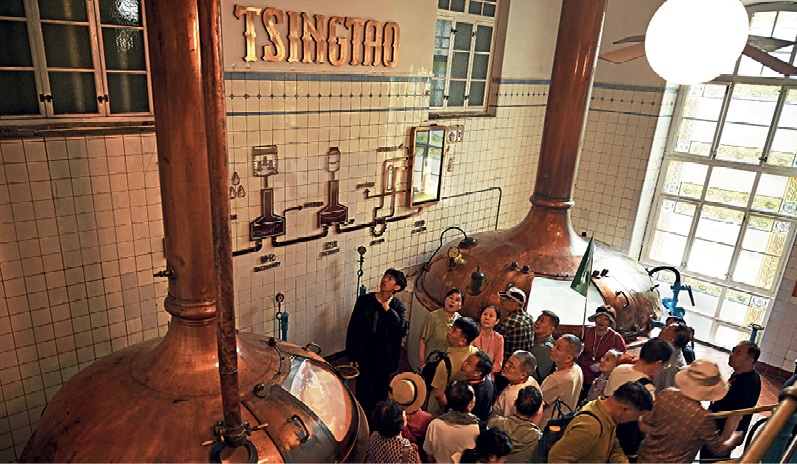
The museum is buzzing with visitors on July 2, 2026. Established within the surviving 1903 brewery buildings, the site traces the century-plus evolution of China’s beer industry alongside the full brewing process from grain to glass.
Profound Implications of the “Spillover”
The “spillover” effect of a single glass of beer is creating significance that extends far beyond the cultural tourism sector, particularly against the backdrop of China’s broader tourism consumption transformation.
Dai Bin, president of the China Tourism Academy, said, “Meeting the public’s demand for cultural tourism requires not only the creative transformation and innovative development of fine traditional culture, but also the use of new quality productive forces to create new spaces, new scenarios, and new content for the industry.”
From VR/AR exhibitions and immersive theater to beer-themed guesthouses and beer faucets, Qingdao is using a “beer+” model to accelerate the development of new quality productive forces.
The centennial brewery is pioneering development pathways for the integration of advanced manufacturing with modern services. It is quietly expanding into an ecosystem which encompasses beer brewing, healthy beverages, cultural tourism, smart logistics, digital technology, and biotechnology. This seeks to answer pivotal questions of our era: How can traditional industries expand their boundaries? How can old industrial cities be transformed and thrive?
With a bold leap, in the field of curating lifestyles for consumers, traditional manufacturers can also take a significant share in the market, and sometimes even a lion’s share as in the case of the Tsingtao Beer Museum. 
WANG ZHE is a reporter with China Report.