“Where language fails, music becomes the bridge – its sound shortens the distance between cultures and hearts.”
Stepping through the entrance of the World Dulcimer Family Museum on a Saturday afternoon in the August of 2026, visitors were immediately greeted by the soft sound of adults and children singing. Encouraged by a young female teacher, the children take the stage to sing one by one – some shy, others boldly expressive.
“This is one of the museum’s free public courses. We hold classes like this every three months, to attract people of all ages to experience the charm of traditional folk music. The young lady teaching sight-singing today is an expert on traditional Chinese music and also assistant curator of our museum,” Liu Yuening, the museum’s founder, told China Today.
The museum, founded in November 2024, sits in Baxiandong (Eight Immortals Cave) Village in Changping District, on the northern outskirts of Beijing. It is said to be the first museum in the world dedicated to a systematic presentation of the global history and culture of the dulcimer, a musical instrument with wire strings stretched over a flat sounding board.
Surrounded by rolling green mountains and a short walk from the clear waters of the Ming Imperial Tombs Reservoir, this red-brick building seems wrapped in tranquility.
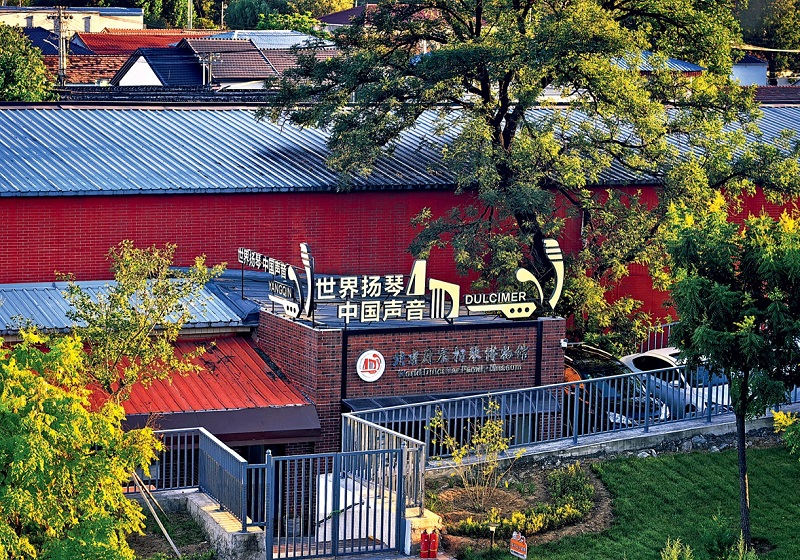
The World Dulcimer Family Museum, the first of its kind in the world, sits in the beautiful Baxiandong (Eight Immortals Cave) Village in Changping District, on the northern outskirts of Beijing. Courtesy of Liu Yuening
A Life in Strings
Dulcimer, or yangqin in Chinese, was introduced to China some 400 years ago during the Ming Dynasty (1368-1644), and was then quickly integrated with Chinese musical traditions, becoming an essential component of Chinese musical accompaniment and driving the development of folk narrative singing. As those art forms flourished, so did the instrument’s reach and reputation.
During a performance, the dulcimer is placed on a stand, and the player holds a pair of bamboo mallets – one in each hand – striking the over 100 strings on both sides. The two hands work in tandem yet remain independent, producing a tone that masterfully blends strength and gentleness, as a piano does. Many musicians have said the dulcimer is one of the most demanding traditional musical instruments to master.
Now at 60, Liu recalled that she began learning the instrument at the age of nine, embarking on a lifelong journey ever since. She has since devoted her life entirely to performing, promoting, and developing the yangqin, with remarkable results. She is a professor at the Central Conservatory of Music in Beijing, a yangqin performer, and a social activist renowned both at home and abroad.
Over the years, as a revered professor in yangqin education and an envoy of Sino-foreign cultural exchange, Liu has traveled the world. “The Chinese yangqin has developed a distinctive system of its own. One day when I was a visiting scholar, it suddenly came to me that our yangqin music deserves to be heard on the global stage, and embraced by international audiences,” she said. This has become an enduring aspiration to her ever since.
Liu was not the first person to bring the Chinese yangqin onto the world stage, but she is one of the pioneers to have systematically introduced the instrument to European higher-education music institutions, fostered dialogue with Hungarian and Iranian dulcimer traditions, and brought it to the platforms of Confucius Institutes and high-level China-U.S. academic exchanges.
In 2006, she became the first Chinese musician to hold a solo yangqin concert at the Liszt Ferenc Academy of Music in Hungary. In 2008, she founded the Jasmine Ensemble; and in 2018, together with yangqin performer and composer Chen Yunyun, she established the Beijing Junior Jasmine Ensemble, bringing the yangqin to foreign primary and secondary schools and youth groups for the visually impaired.
In terms of the internationalization and pedagogical development of the contemporary yangqin, she stands among the foremost pioneers in China.
“When performing classic pieces abroad, you can tell that people can feel the charm of the Chinese yangqin even though they know little about Chinese culture. Where language fails, music becomes the bridge – its sound shortens the distance between cultures and hearts,” Liu said.
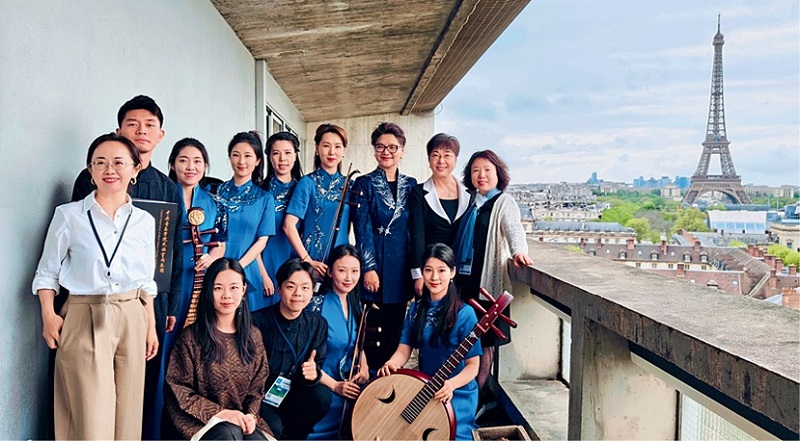
Professor Liu Yuening (first from right), then director of the Music Confucius Institute at the Central Conservatory of Music (CCOM), leads the CCOM Chinese Chamber Ensemble on a music tour of Europe, presenting beautiful Chinese music at UNESCO Headquarters in France on April 15, 2024.
 A World Instrument, a Natural Meeting Place
For Liu, the dulcimer is inherently a world instrument, and therefore a natural platform for cultural exchange.
“The global dulcimer family comprises four major branches: the Iranian santur, the Indian santoor, the European cimbalom, and the Chinese yangqin. These systems differ not only in playing techniques and musical style; they also reflect the distinct cultural identities and historical backgrounds of their regions,” Liu said.
Since the museum opened on November 30, 2024, Liu has put more effort into global exchange. In January and August 2026, two training sessions were rolled out, bringing musicians from around the world together, and moving the museum’s work beyond pure exchange toward deep, pedagogy-driven engagement.
“A four-pillar model – lectures, instruction, performance, and research – creates a closed-loop learning ecosystem. We aspire to serve as a global incubator for dulcimer artists and a bridge for international collaboration, positioning China at the center of a worldwide network for dulcimer artistry and cultural transmission, ” Liu said.
Now, the curriculum is fully developed, encompassing four major dulcimer traditions across eight regions – Iran, Europe, China, the Republic of Korea, India, Vietnam, Mongolia, and Malaysia – and six distinct instrument forms, including the Mongolian and Malaysian variants within the Chinese yangqin lineage.
At the closing concert of the August session, participants took to the stage in the newly built music square in the village. Czech and Hungarian folk songs rang out on cimbalom, Iranian songs on Santur, India’s Raga Yaman, pieces from the Republic of Korea, and Chinese classics, were performed by musicians from countries across Europe and Asia.
In the tranquil surroundings, the exquisite melodies of different schools of dulcimer seemed to blend into nature itself.
“In the museum, there are four large European dulcimers, which is quite a rare sight even on a global scale,” said Matěj Cíp, a Czech cimbalom player, who was a teacher in the summer training session.
“While studying dulcimer in the United States, I met a friend from Guizhou, China, who sparked my interest in the Chinese yangqin. I began learning Chinese and came to China in 2021 on a scholarship to learn the instrument with Professor Liu,” Cip said. At the training session, he played the Czech folk song I Lost My Apron joined by other Czech participants who sang along.
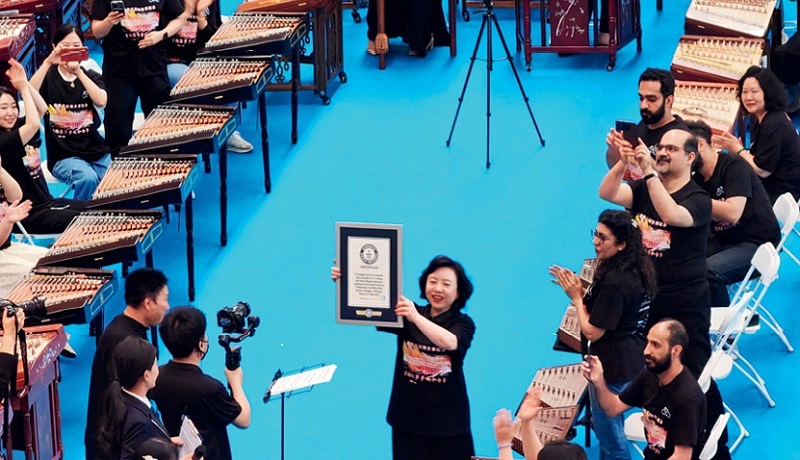
A total of 425 performers from 12 countries and regions achieved the Guinness World Record for being the largest dulcimer ensemble – the first category created for the instrument in Qingdao, east China’s Shandong Province on May 3, 2024. The photograph shows Professor Liu Yuening (center), lead organizer of the challenge, holding the Guinness World Records certificate.
Taking Concerts Outdoors
To those who know her, Liu is always full of energy, and constantly on the move.
Despite a tight schedule, she takes particular delight in nurturing young students. She follows their progress closely, noting which child has become braver and more willing to express themselves, and patiently communicates with their parents.
“I hope that through the museum’s public welfare courses, we can bring traditional instruments to the countryside where resources are often limited. Our public welfare curriculum is rich and varied. Alongside free open classes, we offer systematic training courses in folk instruments such as the dulcimer, zhongruan, bamboo flute, and pipa. Our faculty is excellent – graduate and doctoral students from the Central Conservatory of Music have joined this initiative – and it costs only RMB 100 per person per hour, which means highly professional teaching at a very low cost,” Liu said.
She hopes to plant a seed of music in the hearts of more children, so that they may feel the beauty of life through music.
In addition, she also stages open-air concerts. From late August 29 to October 24, 2026, Liu’s museum curated a Mountainside Music Season, presenting “art without borders” across six sessions themed on Tang and Song dynasty poetry recitals, ink-wash jazz, Indian dance rhythms, and Mid-Autumn string ensembles, drawing hundreds of attendees each.
Just steps away, the World Dulcimer Family Museum welcomed a steady stream of visitors exploring its special exhibition on European dulcimers. Meanwhile, roadside cultural markets and snack stands buzzed with energy.
“For a whole afternoon, visitors can have a vibrant cultural and culinary gathering! We moved the city’s music hall outdoors, offering the public intimate access to world-class art, and allowing them to relax in the mountain breeze,” Liu said.