“The hope of the China-U.S. relationship lies in our people, and its future lies with the young. I am glad to announce an invitation for 100,000 young Americans to visit China for exchanges and study in the coming five years.” This invitation was extended by President Xi Jinping in September 2026 during his state visit to the U.S. It follows his announcement in San Francisco in November 2023 to “invite 50,000 young Americans to China on exchange and study programs in the next five years,” further strengthening the momentum of China-U.S. youth exchanges.
From “50,000 in five years” to “100,000 in five years,” what has grown is not just the number, but the concrete actions to expand youth exchanges and use youthful enthusiasm to support China-U.S. relations.
In September this year, an exchange event focusing on China-U.S. youth innovation and entrepreneurship was held at the AI North Latitude Hub in Beijing’s Zhongguancun, China’s Silicon Valley. More than 60 young people from the technology, art, education, and health sectors of both countries gathered together. Among them were an R&D vice president from the medicine company Eli Lilly, a Harvard-educated entrepreneur, an AI engineer deeply grounded in traditional folk music, and an interdisciplinary artist from Harlem, New York. They talked about code, algorithms, colors, and musical notes, as well as one key question: how can technology rebuild trust between people?
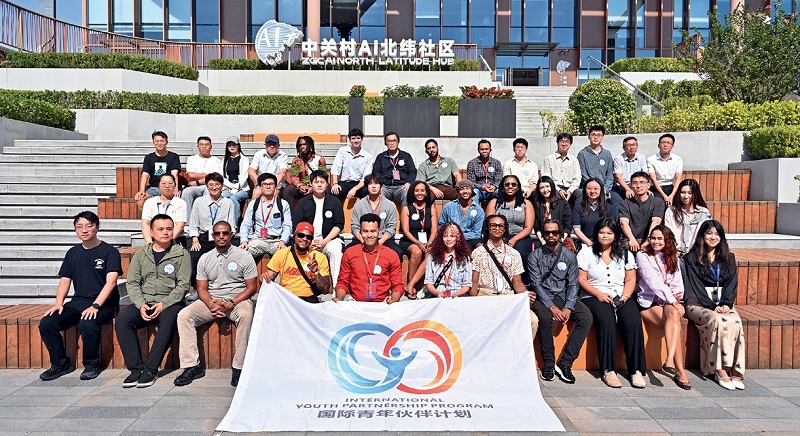
Young people pose for a group photo at the AI North Latitude Hub in Beijing’s Zhongguancun, known as China’s Silicon Valley, after attending an exchange event on China-U.S. youth innovation and entrepreneurship on September 4, 2026.
Young Entrepreneurs Flock to China’s Silicon Valley
The AI North Latitude Hub serves as a window into China’s youth innovation ecosystem. Its first-phase 60,000-square-meter industrial space has brought together more than 120 sci-tech companies covering AI healthcare, large language models, and AI agents, with entrepreneurs under the age of 35 accounting for over half of the total. The community has also pioneered an AI-powered One-Person Company (OPC) service program, enabling an OPC to connect with global resources.
This inclusive ecosystem has nurtured many young entrepreneurs, like Chen Ye, founder of Yanhuo Education Technology, who previously served as a state-sponsored Chinese language teacher in the U.K. and is now pursuing a Ph.D. at Beijing Language and Culture University (BLCU). She introduced her self-developed Chinese learning system WordFlow, as well as the AI Chinese-learning product Longado (Awakened Dragon) at the event.
“Do any of you have friends who want to learn Chinese?” Chen asked the participants. Half of the American contingent raised their hands. These young Americans rarely have access to Chinese-learning products, and they showed keen interest in Longado, which is built on the philosophy of “to teach is to learn.” Two participants working in finance and law in New York promised to recommend it to friends back home. Chen had also produced a 3D-printed figurine of the Longado language-partner, equipped with Near Field Communication (NFC) technology for interaction – with a simple tap on phones, the content pops up, making on-site trials lively and fun.
“I came with the expectation of simply getting my product seen, but I ended up not only receiving rare firsthand feedback, but also secured several concrete collaborations,” Chen told China Today.
While AI companies race to outdo one another in parameters and computing power, Yan Jin, a Harvard University mathematics graduate and founder & CEO of Lewei Technology, offered a distinctly different approach. He led his team to develop loviPeer, an AI emotional companionship robot. Fluffy and pleasantly round, the robot has mimetic eyes and is capable of more than 20 expressions. It can distinguish different family members through voiceprint recognition and remember users’ preferences and past conversations through its “global memory” capability.
“The core of AI competition over the next decade will shift from how much intelligence a product possesses to whether trust can be built,” Yan said. The human longing for companionship is universal, he said, but cultural differences determine different product forms. Asian users tend to be reserved and introspective, so AI more often plays the role of a “growth companion,” tutoring homework, and providing inter-generational care. European and American users are more outgoing and direct, expecting AI to be a “presence companion” that listens well and dares to express itself, as well as being a creative partner.
This kind of deep insight into cultural logic, rather than simple language translation, is what true localization means. Yan’s remarks struck a strong chord with the American participants: in scenarios such as mental health and family education, young people from both countries believe there is natural room for cooperation.
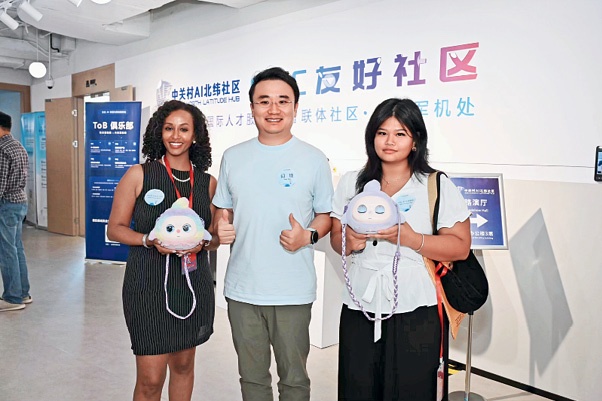
Yan Jin (center), founder and CEO of Lewei Technology, takes a photo with participants holding loviPeer, an AI emotional-companionship robot, at the exchange event.
Art and Language Bonds Across Cultures
If AI is the technological carrier, art is the language that directly transcends culture. Hubert Jason Wallace is an interdisciplinary artist based in Harlem, New York, whose work spans painting, textiles, photography, and public art, with a core focus on the interplay among public spaces, identity, and cultural visual language. During the exchange, he shared how art serves as a bond for communities: “When you place a work in a public space, it no longer belongs solely to the artist – it becomes part of the community.”
Wallace’s ongoing Echo Reciprocity project uses 3D printing technology and recycled materials to make seats “grow” out of natural rock like plants. He admitted that the design was inspired in part by the rockery imitating mountain forms that he saw while visiting China – a reminder, he said, of the profound resonance between East and West in the aesthetics of nature.
“Through these projects, I hope to convey a core idea: art is not merely about visual beauty, it is a functional social tool. It can bring people together, change lives, and promote dialogue,” Wallace told China Today.
He added that China and the U.S. enjoy a broad space for cooperation in art and social responsibility, and that he looks forward to working with Chinese partners to explore how art, in different cultural contexts, can inspire harmonious coexistence between people and the environment, and among people themselves.
The exchange also gave rise to cross-disciplinary collaboration. Wallace has long been exploring the application of new technologies such as AI, adaptive learning, and virtual reality in artistic creation. Moved by the dragon imagery in Chen Ye’s product, he submitted a concept proposal integrating education, creativity, and technology, exploring how the dragon figure could evolve into a more immersive way of learning Chinese.
Chen said her biggest takeaway was the importance of language. “The sticking point in deep exchanges among youth from different countries is often language. In the short term, one-on-one translation tools tailored to vertical scenarios would make communication far more effective; in the long term, demand for Chinese-learning software will only become more essential,” Chen mentioned. She said she will continue to strengthen core technology development and university-industry cooperation with BLCU, iterating the product into a truly professional, efficient, and fun Chinese-learning tool that can be widely used around the world.
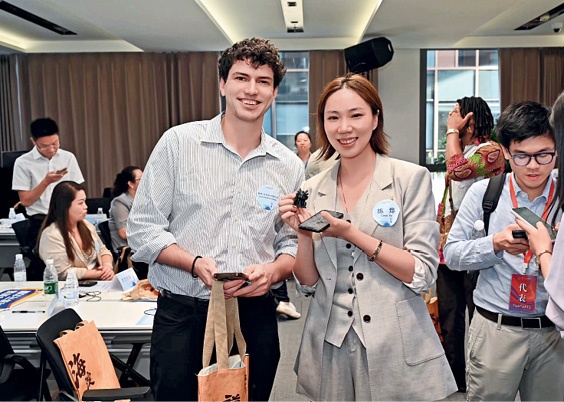
Chen Ye (right), founder of Yanhuo Education Technology, presents Longado, the company’s AI-powered Chinese-learning product, at the event.
From “Solo Acts” to a “Symphony”
The China-U.S. event featured multiple segments, including project roadshows, open networking, and site visits. During the networking session, Chinese and American participants held face-to-face discussions on topics such as AI implementation, culture-technology integration, the overseas expansion of education products, market development, and investment and financing matchmaking. Some Chinese startups reached preliminary agreements with U.S. representatives on arts-integration innovation and overseas market collaboration.
Li Ludongchen, a young Chinese-American, and Wang Yubo, founder of Shengxu Intelligence, hit it off like old friends at first meeting. Li is a pianist long engaged in artist management and performance production; Wang, an AI engineer with more than 20 years of training in Chinese folk music, uses vision-based large models to ease the hassle of converting staff notation into numbered musical notation from taking half a day to under one minute. The two discussed how to use AI to revitalize traditional Chinese folk music and promote its crossover performances in European and American markets.
Deng Xiao, R&D vice president at Eli Lilly, held in-depth exchanges with Chinese AI healthcare entrepreneurs. This Chinese-American scientist, who has been deeply engaged in U.S. industry for more than a decade, is familiar with the research and industrial development processes of both countries, and keenly aware of the enormous potential of the life-and-health field in global cooperation. He was deeply impressed by the efficient iteration capabilities of young Chinese entrepreneurs.
Young people from both countries are proving through concrete action that, despite the distance between them, their passion for innovation and exchanges remains strong.