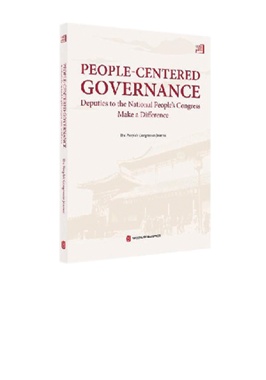
People-Centered Governance: Deputies to the National People’s Congress Make a Difference
Written by the Editorial Team of The People’s
Congresses Journal
Paperback, 157 pages
Published by Foreign Languages Press
How does a political system with more than 2.77 million deputies at five levels – national, provincial, municipal, county, and township – stay connected to the daily lives of ordinary people? That is the question at the heart of People-Centered Governance: Deputies to the National People’s Congress Make a Difference. Rather than answering it in theory, the book recounts the personal stories of 33 community-level deputies to the National People’s Congress (NPC), China’s national legislature. Published in the six official languages of the United Nations (Chinese, English, French, Spanish, Russian, and Arabic), the book invites global readers to move beyond institutional abstractions and encounter the human side of Chinese democracy.
The context pertains to the people’s congress system of China. Deputies are democratically elected and come from all walks of life; nearly 95 percent of those at the county and township levels are directly elected by voters. Unlike career politicians in many other countries, Chinese deputies keep their original jobs after election. They continue to live and work among the people, acting as the “capillaries” of China’s governance system and turning public opinion into formal proposals through legal procedures. The system’s effectiveness comes precisely from this deep-rootedness in the people.
The research behind the book is impressive. Over nearly two years, multimedia journalists from The People’s Congresses Journal traveled to more than 500 counties and districts across 31 provincial-level regions, interviewing 495 community-level deputies. From this wealth of material, 33 stories were selected, each offering a window into how a deputy carries out the principle “the people are the masters of the country”.
Several profiles stand out. Shen Jilan, the late NPC deputy whose service spanned 13 consecutive terms over 66 years, championed the inclusion of “equal pay for equal work between men and women” in China’s Constitution, devoted her life to rural development, and witnessed the birth and evolution of the people’s congress system.
Wang Yongcheng, the first visually impaired NPC deputy, has become a powerful advocate for more than 85 million people with disabilities nationwide. Physician Song Zhaopu spent more than a decade providing free treatment to over 3,200 children with cerebral palsy, while teaching foreign students about traditional Chinese medicine and bringing its benefits to the wider world. Port worker Cheng Weidong invented a towing method known for improved speed, accuracy, and stability, raising efficiency by 16.7 percent, and led his team to more than 200 technical innovations.
Then there was Lu Man. Committed to training new farmers, she has organized over 400 vocational sessions benefiting more than 20,000 trainees – a concrete contribution to rural revitalization.
Together, these dedicated people show how deputies act as representatives, role models, and problem-solvers in their communities.
The book is enriched by commentary from scholars and other deputies. Zheng Yongnian, a renowned professor at The Chinese University of Hong Kong, Shenzhen, notes that the whole-process people’s democracy, China’s framework for participatory governance, is designed to solve the problems people actually face, turning grievances and hopes into laws and policies that respond to popular expectations.
Zhang Weiwei, director of the China Institute of Fudan University, argues that Chinese democracy goes beyond the notion that “democracy equals elections.” It embeds democratic practice throughout the policy cycle, from formulation and implementation to feedback on results. Deputies, he writes, are not career politicians but trusted confidants of the people.
The most moving part is the testimony of Ma Huijuan, a farmer-writer from the Ningxia Hui Autonomous Region, and herself a deputy to the 14th NPC. Her journey from the loess fields to the Great Hall of the People shows that whole-process people’s democracy is not rhetoric but the accumulated practice of grassroots deputies.
Rather than relying on abstract theory, the book is based on tangible details, such as training sessions counted, children receiving medical care, and innovations patented, putting a real human face to every profile.
Its multilingual presentation signals a clear ambition: to make this narrative suitable for international readers who may know China’s legislature only from headlines. It invites them, in Zhang Weiwei’s words, to “re-examine what true democracy means and how good governance can be achieved.”