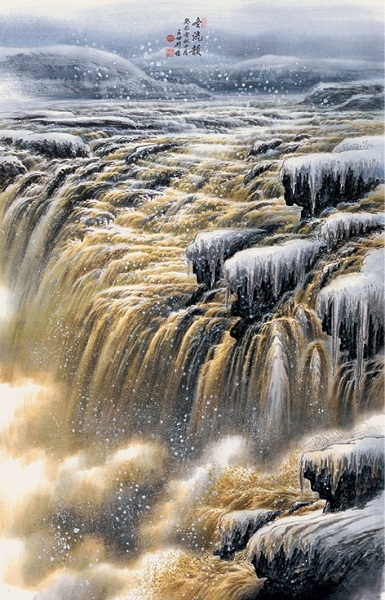
Ice Tapestry (2017), 70cm x 46cm, Wang Shili
Since the beginning of the 20th century, Chinese painters have untiringly explored the space between tradition and modernity, and between Chinese and Western art. While endeavoring to preserve the cultural roots of the Chinese spirit through traditional ink-and-brush practice, they have also borrowed the approaches to form, space, and color found in Western painting to give their works stronger realistic expressions.
During the process, Chinese artists have grappled with two major questions: how to convey the grandeur of spectacular scenes without losing the texture of its individual components, and how to incorporate the profiling experience of Western art into the ink-and-brush techniques of Chinese painting without eroding the latter’s emotional expressiveness.
It is in the search for answers to these questions that Wang Shili, now 61, has built his career.
A native of Shenyang in northeast China’s Liaoning Province, Wang earned his degree in Chinese painting from the Central Academy of Fine Arts. He is now a member of the prestigious China Artists Association and of its river and mountain painting section.
Between tradition and innovation, Wang has carved out a path of his own: drawing on fundamental brush-and-ink skills to depict Chinese landscapes, he adopts a broader vision to express their might and magnificence.
One of his representative subjects is the Hukou Waterfall located on the Yellow River. In his works, countless torrents converge and surge forward, carrying sand, mud, and rocks in their path. Smashing through gorges and swerving over boulders, the waters churn and roar until they finally plunge into a thundering cascade. To capture this inexorable momentum, Wang deliberately exaggerates the expanse, drop, and speed of the flow to heighten the visual impact.
In recognition of his longstanding dedication to depicting the Yellow River and Hukou, Wang was appointed as the cultural ambassador of the waterfall by the scenic resort’s administration in Linfen City, Shanxi Province, in 2006. He is also renowned for Forging the Soul of a Great River, a 200-meter scroll depicting the Yellow River.
The vitality of Wang’s landscape painting, however, lies not only in his rendering of stunning rivers and cataracts but also in his portrayal of their surroundings – from woods, valleys, and hills down to the gnarled branches and dense foliage that grow among them.
His works Spring, Summer, Autumn and Winter (Summer), Myriad Trees over Peaks, and Clouds and Water – Changing Atmosphere depict the verdant mountains in midsummer; while Golden Trees, Wordless Life, and Spring, Summer, Autumn and Winter (Autumn), by contrast, present the rich layers of autumnal forests.
In Wang’s paintings, mountains and rivers normally take up almost the entire picture, interspersed with areas of blank space to create breathing space. This preserves the restraint and nuance of Chinese painting within a monumental composition, allowing the artist to dwell on explicit details without weakening the atmospheric effect.
This pursuit of both grandiosity and subtlety is the essence of Wang’s landscape painting. In his rendering of sweeping vistas of mountains and rivers, he never overlooks an individual leaf, rock, or wave. Through realistic sketching he captures the feeling of nature, and through artistic interpretation he imbues that feeling with new meaning.