More young people from around the world are heading to China not merely for a short-term experience, but to study, live, and plan their futures.
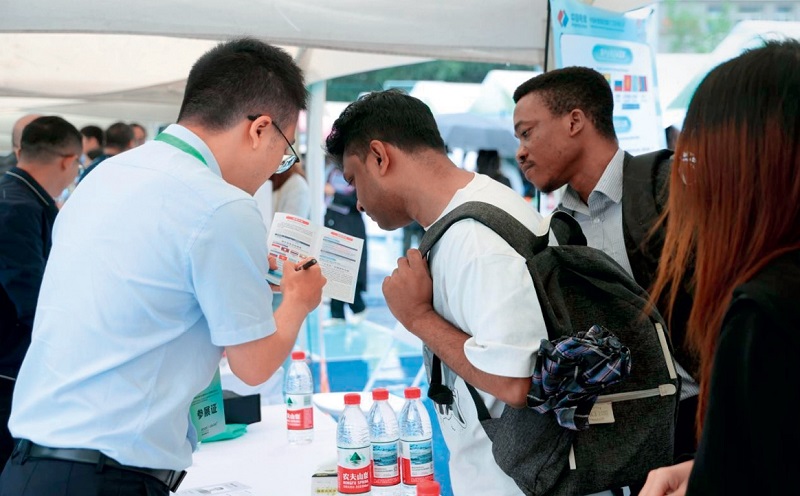
More than 3,000 young people from 110 countries attend a job fair for international students at Beijing Foreign Studies University in Beijing on June 6, 2026.
In June 2026, more than 3,000 young people from 110 countries attended a job fair for international students at Beijing Foreign Studies University (BFSU) in Beijing. Speaking fluent Chinese and clutching résumés bearing the names of leading Chinese institutions such as Beijing Institute of Technology, China Foreign Affairs University (CFAU), and Beihang University, many of them shared the same goal: to live and work in China. Currently, youth from around the world are coming to China in increasing numbers, not just for short-term visits to experience the culture, but to study, live, and plan their futures.
Studying in China
For this young mobile cohort, studying in China has become a top choice. Wang Daquan, director of the Chinese Service Center for Scholarly Exchange, said that during the 2024-2025 academic year, 380,000 international students from 191 countries and regions studied in China, clearly demonstrating the diversity of entrants. Graduate students accounted for 35 percent of the total, while engineering ranked as the most popular field of study.
This influx reflected a major change. In the past, studying in China was often associated with short-term language programs or cultural exchange experiences. Today, however, more than half of the international students entering the country are pursuing degree programs, with engineering overtaking language studies as the leading discipline. This shows that China is no longer viewed simply as a place for cultural exploration, but as a destination for education, skill acquisition, and career development.
Several factors have driven this change. In recent years, the overall quality of China’s higher education has risen, with many Chinese universities gaining global recognition in engineering, science and technology, medicine, and business. This is particularly attractive to students from other developing countries, who can access cutting-edge education at a fraction of the cost of studying in Western countries.
At the same time, China’s scholarship system has expanded. Government departments, universities, and companies now offer a wide range of scholarships, creating a multi-layered support network for international students.
In addition to the education system, China has become a land of opportunity. As the country’s global economic influence continues to grow, proficiency in Chinese, familiarity with China’s society, and a degree from a Chinese university increasingly translate into tangible career advantages.
Li Hai, Party secretary of BFSU, said that his university offers programs in 101 languages, covering the official languages of 183 countries that have diplomatic relations with China. It aims to cultivate globally minded professionals with linguistic ability, academic expertise, and cross-cultural competence. Universities like BFSU have become important bridges connecting China with the rest of the world.
Studying in China is now no longer a regional trend driven by geographic proximity, but a genuinely global phenomenon. Increasing numbers of overseas families and youth now regard China as a high-quality study destination, reflecting growing confidence in the country’s future.
Staying in China
For many international students, studying in China is only the beginning. Their next choice is building a future here.
According to Yang Dan, director-general of the Department of International Cooperation and Exchanges of the Ministry of Education, embracing opportunities in China and realizing their dreams is the main reason international students no longer see China as a stopover, but rather as a place to pursue careers and aspirations.
This shift is grounded in reality. China is the world’s largest manufacturing nation, the second-largest consumer market, and the leading country in global trade in goods. International students who speak Chinese and understand the country’s business environment possess unique advantages. They can work for Chinese companies at home or their operations abroad, or return to their home countries.
Dong Le, director of the Country Research Division of the Overseas Economic Cooperation Department at the China International Engineering Consulting Corporation, said that Chinese companies “going global” are in urgent need of professionals who understand the Chinese language, culture, business environment, and local markets. International students educated in China fit this profile.
The growing desire for international young people to stay in China is not only driven by economics, but also reflects a strong sense of personal connection with China.
Olivier Sim, a Canadian student who graduated from CFAU, submitted résumés to several companies at the fair. “I fell in love with China immediately on my arrival,” he recalled, “People are friendly and welcoming. It’s very safe, life is convenient, and I feel comfortable here.” He is optimistic about China’s future, hoping to find a job and settle down in the country.
When international students choose where to live, they consider far more than salaries. Livability, social atmosphere, and future prospects all matter. China’s public safety, advanced infrastructure, and highly convenient digital lifestyle have become major attractions for them. At the same time, the friendliness of Chinese people and the increasing internationalization of major cities make staying in China a natural choice.
The large numbers of international students expressing the desire to work and live in China are effectively casting a vote of confidence through their own lived experiences. At a time when rhetoric about countries “decoupling” and “de-risking” continues to circulate globally, these young people offer a more grounded perspective. They have lived in China, come to understand it, and remain optimistic about its future, which drives their willingness to tie their own futures to China’s development.
Embracing the World
Wang believes because China embraces openness and inclusiveness, and remains committed to cultivating global talent and sharing development opportunities with the world, it has become an attractive destination for international students. “This is not mere diplomatic language, but is reflected in concrete policies and practical measures.”
China has expanded scholarship coverage, aligned academic programs more closely with industrial needs, and improved career services and policy support for international students. Openness is being translated from an abstract principle into practical measures.
“At the job fair, we set up booths for policy consultation, career guidance, and résumé coaching to provide assistance for international students who wish to stay,” Wang said.
As for global education, some traditional destinations have tightened immigration and visa policies in recent years. In contrast, China continues to expand educational openness and accelerate efforts to build itself into a globally influential education hub.
Yang Dan said that the Ministry of Education will continue aligning talent development with national strategies and business needs, improve the mechanisms linking employers with international talent, and create new models for global talent cultivation and shared opportunities. China does not view international students simply as labor resources, but as partners in international cooperation and shared development, he said.
Meanwhile, Wang Xiaomei, general manager of China International Intellectech Group, said that talent recruitment and job matching mechanisms should move beyond temporary events to become permanent, institutionalized platforms that connect global talent with China’s development needs.
Ultimately, a country’s ability to attract talent stems from its overall strength and cultural appeal. When young people decide where to study, work, and live, they are choosing the future they believe in. The most powerful form of attraction has never been self-promotion. It is about keeping the door open, allowing people from around the world to experience a country for themselves, and then letting them make their own choices.