During the “two sessions” in March 2026, the high-quality development and international promotion of traditional Chinese medicine (TCM) emerged as a trending topic of discussion. Tommy Li, a Hong Kong deputy to the 14th National People’s Congress (NPC) and president of the Federation of the Hong Kong Chinese Medicine Practitioners and Chinese Medicines Traders Association, has dedicated decades to the development of the TCM industry.
He has worked for industrial integration between the Chinese mainland and Hong Kong, building cooperative ties with resource-rich provinces such as Yunnan and Jilin. Li has also made great efforts to help China maintain greater voice in TCM standards, allowing the 5,000-year-old national treasure to shine anew in the new era.
He explained that under the beneficial policies in the Guangdong-Hong Kong-Macao Greater Bay Area, the combination of the mainland’s abundant resources and Hong Kong’s international networks is expanding TCM’s global influence.
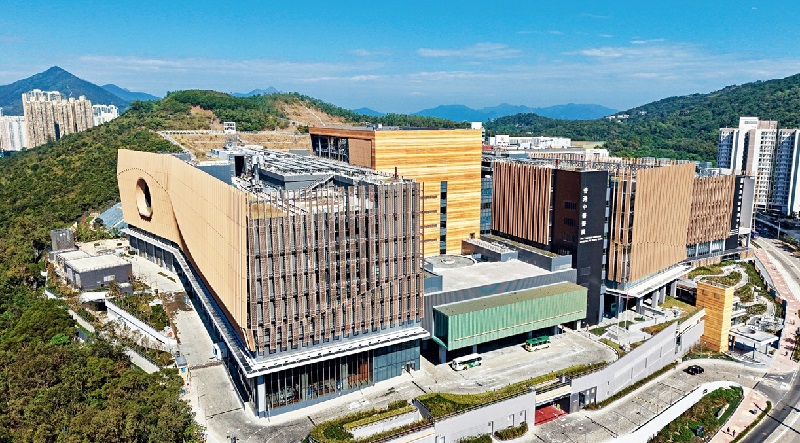
The Chinese Medicine Hospital of Hong Kong officially opens on December 11, 2025.
A Hong Kong-Based Industry
In 2025, Hong Kong’s TCM industry achieved two major milestones: the official opening of the Chinese Medicine Hospital of Hong Kong, the city’s first TCM hospital, and the inauguration of the permanent premises of the Government Chinese Medicines Testing Institute (GCMTI). Li was buoyed by these developments: “This marks a new stage in Hong Kong’s TCM development, which is the result of the support of the central government and the efforts of Hong Kong.”
In terms of policy, a five-year plan (2020-2025) to establish the Guangdong-Hong Kong-Macao Greater Bay Area as a hub for TCM calls for the alignment of TCM standards, resource sharing, and expertise exchange across the three regions. Meanwhile, the HK $1 billion development fund managed by Hong Kong’s Chinese Medicine Development Committee has given significant impetus to industry upgrading. Initially capitalized at HK $500 million, the fund aims to support TCM technology, personnel training, and research investment, boosting the development of TCM in Hong Kong.
Li said that the development of TCM in Hong Kong depends on government support, industrial cooperation, and scientific research. Many universities in Hong Kong have established TCM schools, attracting experts and scholars from around the world. These schools rigorously screen applicants and provide comprehensive training, cultivating high-quality talent. “We regularly invite domestic and foreign experts to deliver lectures. We also attach great importance to in-service training, in order to ensure that Hong Kong’s TCM practitioners maintain both professionalism and an international perspective,” Li said.
The abundant TCM resources on the mainland provide solid support for the secotr’s development in Hong Kong. The mainland’s huge raw material supply and processing capacity compensate for the limitations of Hong Kong, such as limited space, dense population, and higher costs. “Hong Kong can tap into the mainland’s resources to promote TCM products to the world, while the mainland can leverage Hong Kong’s international networks to expand overseas markets. This complementary approach yields benefits for both sides,” he said.
Currently, under the favorable policies in the Guangdong-Hong Kong-Macao Greater Bay Area, TCM cooperation between Hong Kong and the mainland has expanded to cover the entire industry chain from research, production, and testing to overseas operation. Li said that Hong Kong is home to a large number of international testing institutions. The GCMTI in particular boasts advanced testing facilities and internationally accredited testing systems. Its test results are globally recognized, serving as a passport for TCM products entering international markets.
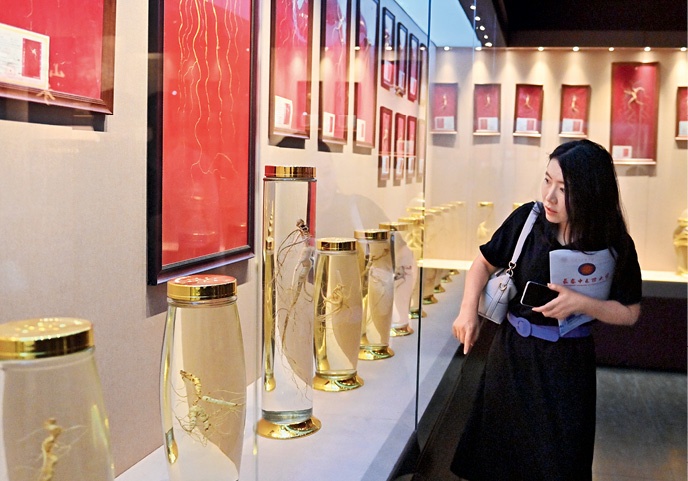
A member of a delegation of renowned scholars and young leaders from Hong Kong and Macao visits the Jilin Provincial Museum of Traditional Chinese Medicine in Changchun on July 3, 2025.
Chinese Standards
Standardization is essential for global promotion of TCM. At present, Hong Kong has established a robust regulatory system for medicinal herbs and patent medicines. The Hong Kong Chinese Materia Medica Standards (HKCMMS), widely known in the industry as the “Hong Kong standards,” has emerged as an important reference for international TCM standards, distinguished by their scientific rigor and global orientation. “The key to global recognition of the Hong Kong Standards lies in their compilation,” Li explained. “The international expert committee comprises specialists from abroad, Hong Kong, and the mainland. By incorporating diverse perspectives into the standard-setting process, the resulting principles, methodologies, and parameters carry greater credibility on the world stage.”
This practice meets the requirements set by a National Administration of TCM standardization action plan (2024-2026), which emphasizes the promotion of the internationalization of TCM standards. Li has focused on advancing Chinese standards that meet international needs and facilitate their international adoption. “TCM represents a treasured heritage of Chinese civilization. It is our responsibility to set the standards,” he said.
To promote the standards, Li suggests first having a unity of TCM standards across the Greater Bay Area, then progressively expand the Chinese standards among the international community. Hong Kong, relying on years of research on TCM in the Lingnan region (primarily Guangdong, Guangxi, and Hainan) and the technical capabilities of its testing centers, has already collaborated with official mainland institutions to conduct joint research on Lingnan standards. The findings are expected to be elevated to national and international standards.
In addition, Hong Kong’s testing technology is important for internationalization of TCM standards. Li said that the region’s testing range and standards align closely with international market requirements. Therefore, Chinese patent medicines registered in Hong Kong are more easily recognized by international markets. “By working together, the mainland and Hong Kong can integrate their testing standards to facilitate smoother global access for TCM products,” he said.
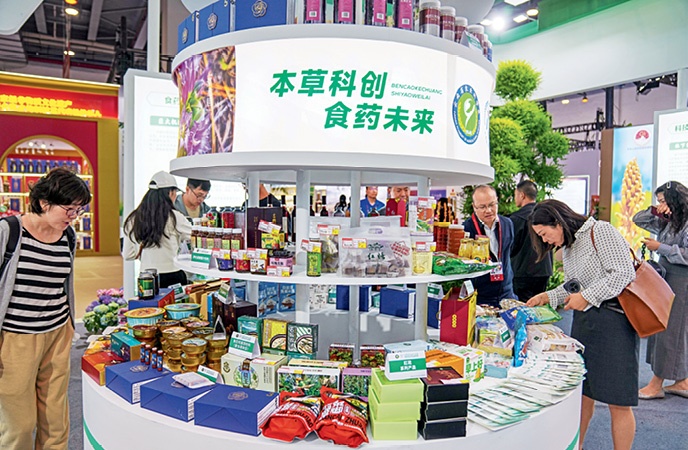
Visitors walk around the Traditional Chinese Medicine Industry Pavilion of the 9th China-South Asia Exposition along with the 29th China Kunming Import & Export Fair in Kunming, south China’s Yunnan Province on June 22, 2025.
Going Global
At a TCM conference co-hosted by Hong Kong and Yunnan, Li created a social media group chat platform for entrepreneurs from both regions. This group included company representatives, government officials, sales professionals, and research experts. “Communication is the foundation of cooperation. It cannot only depend on formal meetings. We need to create opportunities for people to interact and build deeper connections, so as to solve the problems through cooperation,” he said. The group chat platform has now become a vital communication link among industry insiders of the two regions. Hong Kong companies share their overseas experience, while those from Yunnan provide resource information, helping streamline the cooperation and minimize unnecessary setbacks.
This is a clear example of the complementary TCM cooperation between the mainland and Hong Kong. “The mainland’s TCM industry can reach the world through Hong Kong, whose international connections and networks can help accelerate TCM’s globalization,” Li explained.
Hong Kong’s resources are also fully accessible to the mainland in terms of talent cultivation and scientific research. Li hopes that research institutions, universities, and enterprises on the mainland can cooperate with Hong Kong’s institutions to jointly establish training centers, carry out scientific research, and share funding and research outcomes.
As a Hong Kong deputy to the NPC, Li has prioritized the policy needs of the TCM industry and the practical challenges faced by enterprises, bringing public voices and concerns to this year’s “two sessions.” “The central government has always been people-centered. The difficulties enterprises encounter are the problems we most need to address,” he said. “I hope to propose more supportive policies so that the two regions (mainland and Hong Kong) can build a stronger synergy in areas such as TCM standards, talent cultivation, and overseas business, enabling the TCM industry to advance more steadily and further.”
Li has always been a champion of integrated TCM development. He believes that with the national policy support and close collaboration between the mainland and Hong Kong, TCM, a symbol of Chinese culture, will be embraced by more people in the new era. This vision rests on the strong backing of the central government, the integration of the Greater Bay Area, and the dedication and perseverance of TCM practitioners in preserving tradition, driving innovation, and pushing forward with determination.