Chinese industrial city Wuhan aims to find the next growth engine in cutting-edge fields during 2026 to 2030.
In a bid to transform itself, Wuhan, an industrial city in central China, has integrated the digital intelligence economy into its 2026-2030 development plan. This strategic move aims to identify cutting-edge growth fields such as artificial intelligence and brain-computer interface.
The Power of Time
The rise of Wuhan, along with China’s future industries, might best be measured by two figures: US $3 and 65,000 channels.
“Twenty years ago, high-end laser equipment was almost entirely reliant on imports. Even the screws used for reinforcement cost US $3 each; you had to buy them, whether you needed them or not,” said Ma Xinqiang, chairman of HGTECH and a deputy to the 14th National People’s Congress.
Over the past two decades, HGTECH has maintained remarkable consistency in this endeavor – investing in R&D at an average annual growth rate of over 20 percent. It is this determination that enables the company to complete the laser welding of a new-energy vehicle body in just 43 seconds, driving foreign product prices down by 40 percent and elevating China’s laser industry to world leading status.
After reaching the forefront of the international infrared field, Huang Li, chairman of Wuhan Neuracom Technology Development Co., Ltd., turned his attention to a new frontier: the future of the human brain. Five years ago, when most people had no comprehension of what brain-computer interface was, Huang was already busy with researching the field.
“The key to charting these paths lies in accurately aligning with the national strategic needs,” said Huang, also a deputy to the 14th National People’s Congress.
Today, the 65,000-channel brain-computer interface chip not only ranks among the top globally in terms of channel count, but more importantly, clinical validation work based on the 2,048-channel version is steadily progressing. This indicates that this sci-fi technology is advancing into reality at an astonishing rate, aiming to cure what was once considered impossible.
These two tech entrepreneurs from Wuhan have, through decades of perseverance, written a vivid footnote to the future of this industry. It is no longer some ethereal concept, but a long term reality that requires foresight, strategic determination, and a willingness to endure solitude.
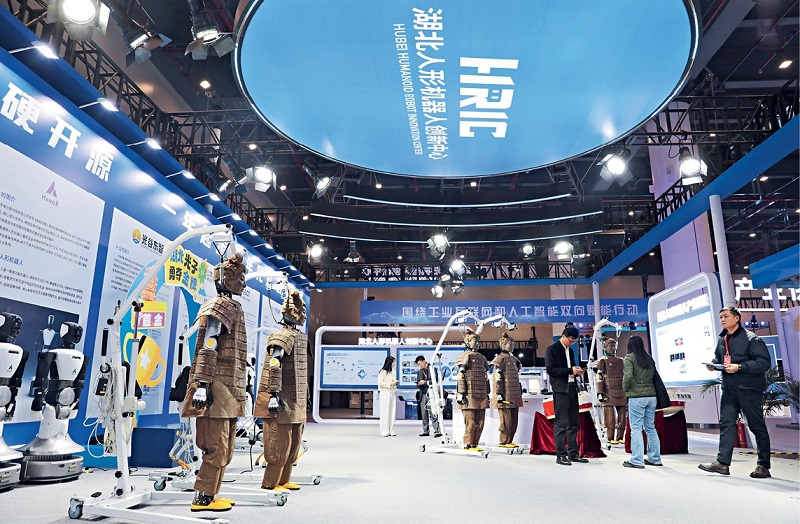
Humanoid robots are on display during the 2025 China 5G + Industrial Internet Conference in Wuhan, Hubei Province, on November 22, 2025.
Code of Integration
Ma envisages an industrial blueprint built on the convergence of photonics and automotive technology.
Wuhan stands as the world’s largest fiber optic cable manufacturing base and also the headquarters of Dongfeng Motor Corporation. When light meets automobile, a chemical reaction takes place – fiber optics installed in vehicles enable autonomous driving systems with transmission speeds of 10 gigabits per second, while automotive-grade chips provide intelligent vehicles with smarter “brains.”
This integration represents Wuhan’s distinctive advantage. It is neither an Internet-dependent city nor a traditional industrial manufacturing hub. Here, the boundaries between the digital and real economies are being broken down.
In Huang’s view, this convergence is giving rise to an entirely new industry model. He refers to it as the superimposed effect of fundamental technology and advanced algorithms.
“Infrared serves as the fundamental technology that allows machines to see in the dark; AI functions as the ‘brain’ that enables machines not merely to see, but also to comprehend what they see,” said Huang. His GDU Tech can autonomously operate thousands of drones guided by AI, generating massive datasets daily that are automatically analyzed to support public security, urban management, and environmental protection. This transformation means Neuracom has evolved beyond device manufacturing to become a data service provider for urban governance.
In addition, Huang’s Zhenyou Technology Company is working to dispel the cold, mechanical perception of humanoid robots. By surmounting challenges in highly flexible joints and bionic skin, combined with AI-powered multimodal perception, Zhenyou aims to enable robots to operate not only on factory floors but also in homes, offering companionship and elderly care.
This, in essence, is Wuhan’s distinctive path: eschewing the grandiose showcasing of large language models in favor of deep, sustained investment in fundamental technologies, and then integrating these innovations with vast industrial systems and real-world public needs.
Patience and Tolerance
Future industries are undeniably exciting, yet whether it is brain-computer interface or embodied intelligence, they face a common hurdle: protracted development cycles, substantial capital requirements, and scant prospect of near-term returns.
So while other regions vie for these sectors, what gives Wuhan’s entrepreneurs the confidence to pour significant resources into technologies that often seem far-fetched? The answer lies in both mechanism and mindset in the government’s approach as much as its policies.
During the state-owned assets and enterprises reform in 2021, Wuhan backed HGTECH to participate in state fund operations by establishing Runjunda, a partnership enterprise. This restructuring propelled the company's sales from over RMB 6 billion to RMB 10 billion.
“Mechanism innovation is no mere ornament; it is the key to breaking the deadlock,” Ma said, adding that for enterprises to serve as true market operators, management must be granted full autonomy.
This “breaking the deadlock” philosophy is now extending from enterprises to government itself.
In 2026, Wuhan unveiled a new intelligent digital economy action plan, explicitly proposing mechanism for future industrial investment growth and risk sharing. “The essence of innovation is not fearing failure,” said Huang. “Capital should not pursue only risk-free short-term returns, but a fault-tolerant mechanism must also be established.”
According to Huang, the greatest strength of private enterprises lies in their willingness to bear the costs of innovation and experimentation. Even if only one out of 10 initiatives succeeds, it could transform the entire industry. This spirit of bold trial and error demands patience from capital and, above all, tolerance from policy.
From nurturing single-person startups to envisioning a vast ecosystem of sensors, Wuhan is striving to build an environment where large enterprises stand as pillars, while small and medium-sized enterprises flourish everywhere.
Only by cultivating the soil can a fruitful future be realized.
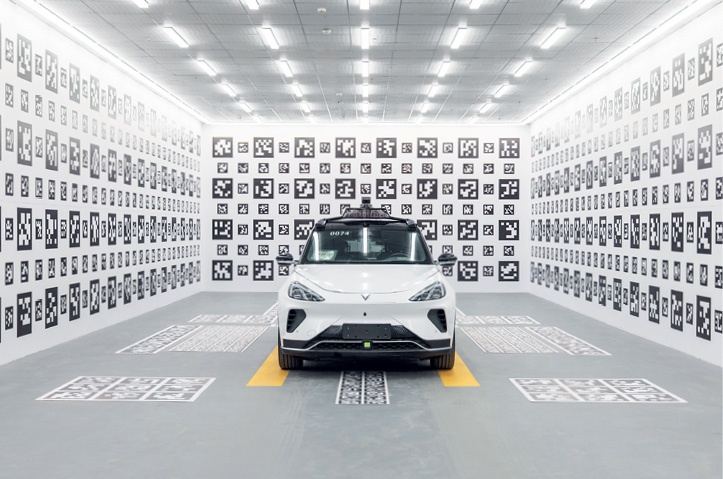
The fifth-generation Baidu autonomous driving car Apollo Moon is undergoing calibration operations at Baidu’s calibration center in Wuhan on September 5, 2023.

People First
Technological heights must be scaled, yet humanity must remain their foundation.
In the next five years, China will accelerate equipment upgrades in elderly care institutions, and support the establishment of at least one comprehensive childcare service center in each prefecture-level city.
This aligns precisely with Huang’s vision of “technology for good.”
In Huang’s view, truly disruptive products ultimately should find their way into millions of households. He envisions his robots playing a vital role in smart eldercare and medical rehabilitation, taking on tasks that exceed human capability or prove difficult to accomplish.
Ma, similarly, champions youth skills development and entrepreneurship. “Young people stand at the peak of innovative creativity; their potential shapes the future of technological progress.” He advocates for a tiered, categorized talent evaluation system that allows young visionaries not merely to survive, but to flourish in Wuhan.
When discussing future industries, people look beyond GDP and industrial scale. They ask what intelligent companions will stand by them in old age, and what technological environment will nurture the next generation.
The 15th Five-Year Plan commences in 2026. China has identified six cutting-edge future industries, including brain-computer interface, embodied intelligence, and quantum technology. Wuhan is undergoing a profound transformation. Through their respective endeavors, Huang and Ma arrive at a shared conviction: the future is not something to await; it is built, step by step, once you have the vision to see it.
“The essence of innovation lies in the courage to explore,” Huang reflected. “Bravery to confront challenges, patience to endure solitude, and mechanisms that protect those who dare to innovate – these mean the future has already arrived.”
On its path to becoming a national pacesetter in the digital intelligence economy, Wuhan’s story may well stand as a vivid microcosm of China’s role in this global technological race.