Over the past few decades, a hilltop Yi ethnic village in Sichuan Province has been transformed from an isolated and impoverished village to a modern and prosperous community.
At this year’s “two sessions,” Zheng Chunwang, a national lawmaker, submitted two proposals: one on improving the elderly care service system in rural areas, and the other one on accelerating the renovation of unsafe rural housing.
He sat down with China Today for an interview donned in a traditional Yi vest, after finishing up a group discussion. He is the Party chief of Gulu Village and a deputy to the National People’s Congress (NPC), China’s top legislature.
“A few years ago, I was obsessed with figuring out how to attract talent and tourists to Gulu Village,” said Zheng. “But during the past two years, what I cared more about has been how to help villagers have better lives in broader aspects.”
“When the premier mentioned improving rural elderly care and increasing subsidies for disabled elderly people in the government work report, his words truly resonated with me,” Zheng said.

Cable service is now available in the Gulu Village, making it much easier for people to travel to and from the hilltop village.
Smooth Connection
The story of Gulu Village always revolves around “hills.”
It sits on cliffs in the Dadu River Grand Canyon in Ya’an City, southwest China’s Sichuan Province. It was known as “the Cliff Village” or “Ladder Village” as villagers once had to climb vines just to leave the village, and a single trip down the mountain could take the better part of a day.
In the past, many saw the mountains surrounding the village as the root cause of poverty. Zheng disagrees with this view. “We cannot move mountains, but we can think outside the box,” he believes.
In 2002, when he was first elected a village official, the very first thing he did was making plans for constructing new roads. At that time, the idea was simple: improve transportation so that residents could go out and goods could come in.
When roads were built, a new problem emerged – people still would not stay.
“The village still lacked access to information beyond the hills,” Zheng recalled. “Back then, young people left the village to find jobs elsewhere, the elderly stayed in the old houses, and tourists came, took a quick look, and left. That’s when I realized that constructing roads was only the first step, and information connection is the key.”
In 2023, one incident deeply struck him.
A young man in the village wanted to sell cured meat through livestreaming. Holding his phone, he ran up and down hills in search of a phone signal. In the end, he had to climb onto the highest rock on a hilltop, barely receiving a lagging connection that kept cutting out. The young man exhausted himself for the streaming endeavor, and only received a few orders as a result.
That same year, as a newly elected deputy to the NPC, Zheng brought the issue to the “two sessions” and submitted a proposal on strengthening rural Internet network coverage. What he did not expect was that with the support of the Ministry of Industry and Information Technology, China’s three major telecom operators soon came to the village and conducted a field investigation. In 2024, full 4G and 5G coverage was achieved throughout the village.
“Now, villagers can sell their farm produce while sitting in their homes, and tourists can simply scan a code to make payments. Our cured meat is now shipped to places across the country after orders are placed online,” Zheng said proudly.

A group of students pose for a photograph with their teachers at the local elementary school in Gulu Village.
 Original Style
With roads built and the Internet connectivity ensured, the village began to see more visitors.
Last year, Gulu Village’s tourism revenue exceeded RMB 12 million. This figure may seem insignificant for a big city, but for a remote Yi ethnic village with only a few hundred residents, it is a phenomenal amount.
However, Zheng did not let this number go to his head.
When planning for tourism industry in the village, some advised him to build artificial attractions. But Zheng turned down the suggestion. “Tourists travel such a long way here to see a real Yi village and experience authentic Yi life, not to look at artificial scenery.”
The key realization was that “being authentic” does not have to mean “not being tourist friendly.”
Mouth-watering tuotuo meat – a signature local dish – is cooked in the traditional way, and served with refined plating in a clean kitchen. Ganggan alcohol, another local specialty, retains its characteristic taste, but can be packed in smaller bottles making it easier for visitors to take home as souvenirs. The Yi songs and dances still use old melodies, and a troupe comprised of amateur artists from the village has been organized. Instead of performing on stage in a formal theater, they perform surrounded by tourists sitting around them in a circle and clapping along with the rhythm.
And of course, villagers welcome visitors in the Yi tradition – with sincerity, warmth, and heartfelt hospitality.
“What many tourists want here is not standardized hotel service, but the feeling of visiting a Yi family’s home as a guest, and being immersed in local culture,” said Zheng. In his view, as long as the authenticity of village life is preserved, visitors will come and would like to visit again. This is the core compelling attraction of rural tourism, he believed.
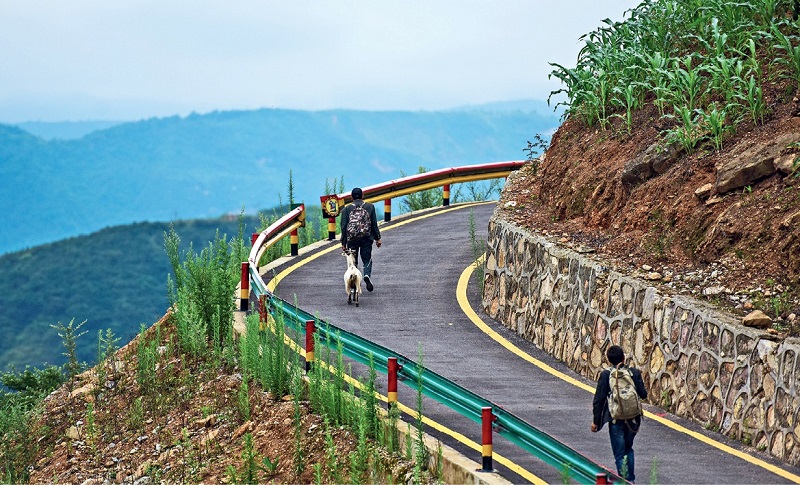
Gulu residents travel on the first public road built leading to the village.
.jpg) No One Left Behind
No One Left Behind “Our mission is to ensure that everyone enjoys a better life,” Zheng said.
Though the village’s tourism revenue of RMB 12 million last year does look impressive, Zheng has some concerns: the families who can run homestays or sell local specialties are those with young people and moderate savings. But what about the older villagers in their 70s and 80s? What about those who want to renovate their old houses but cannot afford it? Can they also benefit from the village development?
He said positive economic numbers would mean little if many elderly villagers were still living in dilapidated houses.
That is why this year he brought the two proposals to the “two sessions.” “For Gulu Village, I hope the next headline will no longer be about the number of tourists flocking in, but a greater sense of happiness the villagers are enjoying,” he said.
“When every villager – be they a young person running a homestay or an elderly resident sitting in the sun enjoying a normal day – truly feels that a better life lies ahead, we can truly say that our dream of building a happy village has come true.”