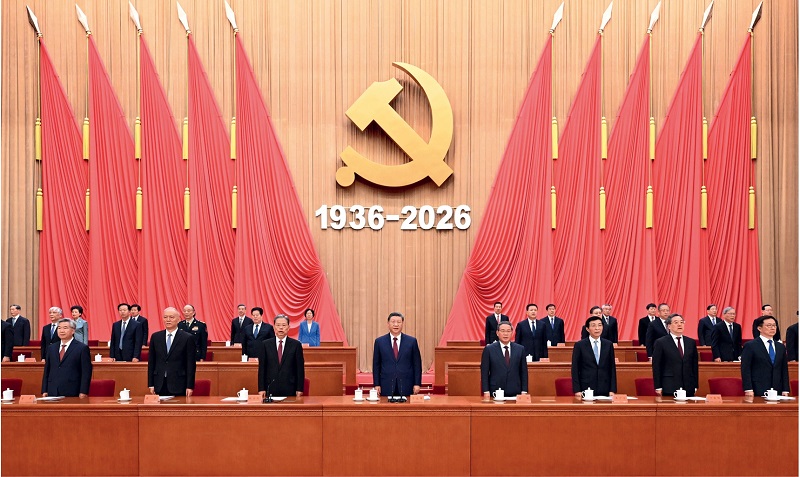
A gathering commemorating the 90th anniversary of the victory of the Red Army’s Long March was held in Beijing on October 22, 2026. During his address at the event, Chinese President Xi Jinping said, “This earth-shattering revolutionary feat holds great significance in the history of our Party, country, and military, and has a profound impact on our path toward the rejuvenation of the Chinese nation.”
From October 1934 to October 1936, the Red Army, under the leadership of the Communist Party of China (CPC), undertook an epic strategic shift to break through the Kuomintang (KMT)’s encirclement and safeguard its revolutionary forces. Covering some 12,500 kilometers across more than 10 provinces, the troops crossed swift-flowing rivers, scaled snow-capped mountains, and trudged through treacherous marshlands, enduring relentless pursuit, fierce fighting, and extreme hardship.
The Long March culminated in the convergence of the major Red Army forces in northwestern China in October 1936. Its victory enabled the CPC to overcome a grave crisis, maintain its revolutionary power, and establish a foundation for future advances in the struggle for national independence and the people’s liberation.
A Test of Conviction
The Battle of the Xiangjiang River in late 1934 was one of the bloodiest engagements of the Long March. As the Central Red Army fought to break through the encirclement of KMT forces and cross the river, it suffered major losses, its ranks falling from more than 86,000 to just over 30,000.
The 34th Division, tasked with covering the main force’s rear, was cut off and decimated. Its commander, Chen Shuxiang, was captured after being gravely wounded. On the march to the enemy headquarters, he tore open his abdominal wound and severed his own intestines, taking his life rather than become a prisoner of war. Dying at the age of 29, he fulfilled his vow to shed the last drop of blood for the revolution.
During his inspection tour to Guangxi Zhuang Autonomous Region in April 2021, Xi visited the Memorial Museum of the Battle of the Xiangjiang River. Pausing before a painting of Chen’s death on the battlefield, Xi exclaimed, “How heroic! Chen Shuxiang is a typical example of those who sacrificed their lives.”
Xi called the battle a life-or-death moment for the Chinese revolution, pointing out how the Red Army’s courage to face death and press forward stemmed from its ideals and convictions. “Why did the Chinese revolution succeed? The secret is that the revolutionary ideal is higher than the sky,” he said, stressing the importance of persevering through the hardest times to achieve ongoing victories.
Chen’s story was only one among countless tragedies along the Long March. The four Red Army forces set out with a combined strength of 206,000 soldiers, with a further 17,000 joining them along the way. By the time the march ended, only 57,000 – merely a quarter – remained. It is estimated that at least 166,000 soldiers had been killed or gone missing. Behind this epic journey lay countless lives lost to fierce battles and extreme hardship, as well as an unwavering commitment to the revolutionary cause.
These sacrifices made during the Long March demonstrated that firm convictions are more than abstract ideals: they can inspire extraordinary courage and sustain people through even the most daunting challenges. In his address, Xi reiterated that the great victory of the Red Army’s Long March was won through firm revolutionary conviction, adding that troops with noble ideals and firm beliefs are invincible.
Noting that throughout the march, in the face of extraordinary hardships, the Party and the Red Army stood firm in their beliefs, Xi pointed out that they demonstrated a noble revolutionary spirit marked by indomitable perseverance, an unstoppable determination to advance, heroic combat, and a readiness to lay down their lives for the cause.
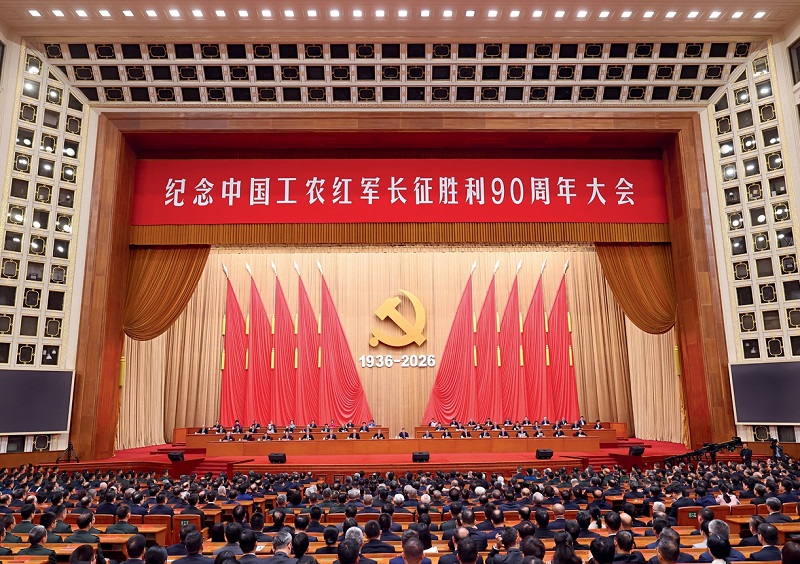
A gathering commemorating the 90th anniversary of the victory of the Red Army’s Long March is held at the Great Hall of the People in Beijing on October 22, 2026.
Close Ties with the People
In his speech at the ceremony marking the 80th anniversary of the victory of the Long March in 2016, Xi described the march as the history of deep bonds between the Red Army and the people. He recalled how three female Red Army soldiers sought shelter in the home of Xu Jiexiu, an elderly villager in Shazhou Village, central China’s Hunan Province, in 1934. Before leaving, they cut their only quilt in half and left half with Xu. Xu later said: “Who are the Communist Party members? The people who have only one quilt, but give half to the people. They are the Communist Party members.”
This generosity clearly illustrates Xi’s point. Despite their own hardship, the soldiers shared what little they had with local families. In turn, the Red Army also relied on ordinary villagers for food, shelter, and other forms of support along the way. The Red Army’s care for the people and the people’s support for the troops reinforced one another, helping sustain the march through extraordinary hardships.
Xi revisited the story in September 2020, during an inspection tour of Hunan, at the “Warmth of a Half Quilt” exhibition hall in Shazhou Village. He said the story embodied the Party’s original aspirations and its commitment to serving the people. Even when facing severe shortages of food and clothing and life-or-death challenges, the Red Army remained concerned about ordinary people’s well-being. Xi emphasized that the army belongs to the people and that the bond between the Party and the people is like sharing a single quilt.
Another story offers a glimpse into this relationship. In October 1935, when the Central Red Army reached Wuqi Town in northwest China’s Shaanxi Province, soldiers stationed in the nearby Daoshuiwan Village borrowed a large water vat from local resident Zhang Xianjie to cook their meals. When the vat cracked from the heat of the cooking fire, they compensated Zhang with two silver dollars – a sum that, at the time, far exceeded the value of the vat itself, upholding their iron discipline of never taking so much as a needle or thread from the people.
Later known as the “Red Army pot,” the vessel bears witness not only to the hardships of the march but also to the soldiers’ strict code of discipline and respect for local people. Their insistence on making amends shows that respect for the people was expressed not only through acts of sacrifice, but also through everyday conduct.
As Xi said in his 90th anniversary address, the great victory of the Red Army’s Long March was achieved with the support of the people. According to Xi, wherever the Party and the Red Army went, they respected the people’s interests and property, winning the people’s support and hearts through their actions.
The half quilt and the Red Army pot tell this larger story in personal terms: trust was earned through care, discipline, and shared hardship. The Long March was therefore not simply a test of military endurance; it was also a testament to the strength of the bond between the Red Army and the people.
The Long March for a New Era
Xi pointed out in the address that the great spirit of the Long March demonstrates the power of loyalty, truth, justice, and unity. “It will always be a precious treasure and powerful driving force to inspire us to overcome difficulties and forge ahead courageously,” said Xi.
The challenges facing China today are different from those confronting the Red Army back then, but the need for resolve remains. The Long March spirit of putting people first, persevering through adversity, and striving for a better future continues to guide the country’s drive toward modernization and national rejuvenation. In China’s former revolutionary base areas, this legacy is visible not only in memorials but also in efforts to improve people’s livelihoods.
In Shazhou Village, where the “half-quilt” story unfolded, the Long March spirit lives on beyond memorial halls. It can be seen in the orchards that dot the village, the family-run guesthouses that welcome visitors, and the steady stream of tourists drawn by its revolutionary history. Once remote and impoverished, Shazhou has developed specialty fruit cultivation alongside red tourism, giving residents more opportunities to earn a living locally. In 2025, the village welcomed 1.42 million visitors, while per capita income exceeded RMB 26,000.
Such rural revitalization is one front in today’s Long March. The broader journey also calls for sustained economic growth, technological breakthroughs, and a greener model of development.
China’s economy grew by 5 percent in 2025, with GDP surpassing RMB 140 trillion for the first time. In technology, China has led the world in new-energy vehicle production and sales for 11 consecutive years, while DeepSeek has brought Chinese-developed artificial intelligence into the global spotlight.
The green transition is another front in this journey. China has built what is currently the world’s largest renewable energy system. Renewable energy accounted for more than 60 percent of the country’s total installed power generation capacity, while renewable sources supplied nearly four in every 10 kilowatt-hours consumed nationwide.
These achievements are more than isolated milestones. They point to a broader test of the new Long March: whether economic growth can become more innovation-driven, development more sustainable, and the benefits of progress more widely shared. Across rural revitalization, technological advances, and the energy transition, the spirit of the Long March finds expression in the resolve to tackle difficult problems, overcome bottlenecks, and translate long-term aspirations into tangible improvements in people’s lives.
As Xi noted in his address, the road of the Long March continues to extend. “On our new journey, we are now committed to realizing the Second Centenary Goal of building China into a great modern socialist country in all respects and advancing the rejuvenation of the Chinese nation on all fronts through a Chinese path to modernization,” he said.
“Only by remembering history can we create a brighter future,” said Xi. The Long March is not only a road for China to retrace, but a legacy to carry forward. Its enduring relevance lies in the determination to face new challenges, press ahead despite setbacks, and turn the aspirations of national rejuvenation into a better future for the people.