A Frankfurt reading exchange highlighted how the fifth volume of Xi Jinping: The Governance of China offers German readers insights into China’s development path, governance philosophy, and opportunities for bilateral cooperation.
A reading exchange event for the German edition of the fifth volume of Xi Jinping: The Governance of China was recently held in Frankfurt, Germany. Under the theme “Dialogue Among Civilizations and Practical Cooperation: New Practices in China-Germany Cooperation in the New Era,” the event brought together representatives from the government, academic, business, and cultural communities of both countries. Participants held in-depth exchanges on key topics addressed in the book, including Chinese modernization, the global initiatives, and the building of a community with a shared future for humanity. They also explored new pathways and opportunities for practical China-Germany cooperation. Attendees agreed that the fifth volume of Xi Jinping: The Governance of China opens a window for German readers to gain a deeper understanding of China’s development path and policy thinking, while injecting fresh impetus into mutual learning between the two civilizations.
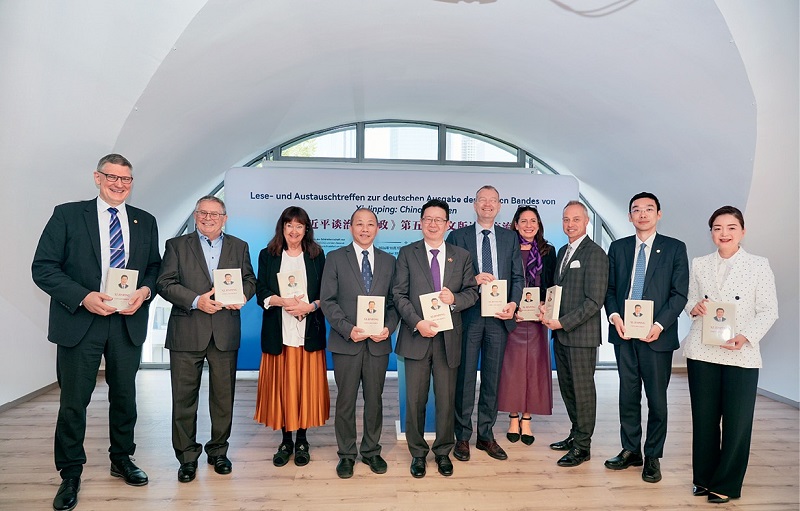
Chinese side presents the German edition of the fifth volume of Xi Jinping: The Governance of China to representatives of the local guests in Frankfurt, Germany.
The Key to Understanding the Real China
In 2014, Frankfurt hosted the launch ceremony for the multilingual editions of Xi Jinping: The Governance of China. In 2025, the city also hosted a promotional event for the English edition of the fifth volume. This reading exchange event for the German edition of the fifth volume not only carries forward this deep intellectual connection, but also adds a contemporary dimension to cross-border exchanges and mutual learning.
This event was held under the guidance of China International Communications Group (CICG) and the Chinese Consulate General in Frankfurt, and was organized by the China International Book Trading Corporation. Xie Gang, vice president of CICG, said that the fifth volume of Xi Jinping: The Governance of China presents the latest achievements of Xi Jinping Thought on Socialism with Chinese Characteristics for a New Era, providing an authoritative resource for readers in Germany and across Europe to understand Chinese modernization. China and Germany, he said, can draw on the wisdom contained in the book to explore new models of exchanges and mutual learning among civilizations; build on their complementary industrial strengths to deepen practical cooperation in fields such as smart manufacturing and green energy; and uphold multilateralism to further consolidate their all-round strategic partnership. As the two countries work together to expand two-way opening up and share global responsibilities, he added, they will inject the positive energy of cooperation and development into Europe’s prosperity and stability, and into world peace and development.
Helga Zepp-LaRouche, founder and chairwoman of Germany’s Schiller Institute, described the achievements of Chinese modernization as remarkable. China, she noted, has not only risen to become a world leading economy but has also made historic strides in fields such as deep-space exploration and innovation in key and core technologies. The key to China’s success, in her view, lies in the philosophical foundations and governance wisdom of Xi Jinping Thought on Socialism with Chinese Characteristics for a New Era. “A close reading of the fifth volume of Xi Jinping: The Governance of China makes it clear that China’s development has always been oriented toward improving the well-being of its people. Studying this authoritative work is the best way to understand the China miracle and the logic behind China’s governance,” she said.
Cord Eberspächer, a German historian and professor at the University of Bonn, said the publication of the German edition of the fifth volume will contribute to deepening German society’s understanding of China. “This work systematically presents China’s policy direction, governance logic, and international positioning, serving as an authoritative guide for German readers seeking to understand China’s development path and governance philosophy,” he said. In his view, the so-called “China shock” narrative “is rooted in the outside world’s lack of willingness and effort to proactively and deeply understand China. Reading this book is precisely the key to objectively seeing and understanding the real China.”
Waldemar Peltz, a tenured professor at Leipzig University in Germany, said that the fifth volume of Xi Jinping: The Governance of China not only helps the foreign observers better understand China but also conveys China’s willingness to enhance mutual trust and deepen cooperation. He expressed the hope that more Germans would study the book, allow their misunderstandings to be broken down, and gain more insights into China.

The Sino-German Ecopark in Qingdao, east China’s Shandong Province, features clear waters, green banks, and picturesque scenery on July 29, 2025. A cooperation project between the Chinese and German governments, the ecopark has used technology as its brush and nature as its canvas for over a decade to create a model of green development.
Injecting Certainty and Stability into a Turbulent World
In recent years, the vision of building a community with a shared future for humanity has been written into major resolutions of the United Nations General Assembly on many occasions, and the global initiatives have received widespread response and support from the international community. The relevant discussions in the fifth volume of Xi Jinping: The Governance of China sparked lively discussions among the participants.
Huang Yiyang, Chinese consul general in Frankfurt, said, “As China embarks on the 15th Five-Year Plan (2026-2030) period, it is vigorously developing new quality productive forces, advancing its green transition, and steadily expanding high-standard opening-up. China’s global initiatives contribute Chinese wisdom to helping all countries tackle common challenges. Mutual learning among civilizations and practical cooperation are an important foundation for the steady and sustained development of China-Germany relations. “We welcome our German friends to use reading as a bridge to deepen mutual learning among civilizations and enhance mutual understanding,” he said.
Michael Merz, mayor of the German town of Ransbach-Baumbach, said that studying Xi Jinping: The Governance of China had given him a deeper understanding of how China has explored the path to Chinese modernization and what has made it successful. “Openness breeds boundless opportunities, and cooperation is the way to forge a future. Amid today’s turbulent and changing international landscape, upholding true multilateralism is especially crucial. The Global Development Initiative, the Global Security Initiative, the Global Civilization Initiative, and the Global Governance Initiative proposed by President Xi Jinping inject certainty and stability into a world of turbulence and change,” he said. He stressed that China is a trustworthy key partner to move forward with hand in hand, and that a stable and vibrant China-Germany relationship will surely provide strong impetus for safeguarding world peace, stability, and prosperity.
“Building a community with a shared future for humanity is the core concept of Xi Jinping Thought on Diplomacy. As President Xi Jinping has profoundly observed, facts have shown once again that amidst the raging torrents of a global crisis, countries are not riding separately in some 190 small boats, but rather are all together in a giant ship on which our shared destiny hinges. This highly insightful metaphor for our times clarifies the direction of humanity’s future development,” said Helga Zepp-LaRouche.
Facing the intertwined tests of the era, she added, breaking free from the shackles of zero-sum thinking and the Cold War mentality, and placing the common interests of humanity above all else, is a historical necessity for the survival, development, and progress of civilization. The four global initiatives, she noted, hold strong appeal for the international community, especially the Global South, inspiring them to pursue an independent and mutually beneficial new path to modernization.
Cord Eberspächer said that the fifth volume of Xi Jinping: The Governance of China keeps its finger on the pulse of the times. He took artificial intelligence as an example: the book addresses not only AI technological innovation and its industrial applications, but also offers profound insights into AI’s long-term impact on the global governance landscape. In November 2024, at the 19th G20 Summit in Rio de Janeiro, President Xi Jinping delivered an important speech on working together to build a fair and equitable global governance system, setting out China’s proposals and actions for strengthening international AI governance and cooperation, a demonstration of a far-reaching global vision.

A German Ph.D. student (first from right) and a Chinese Ph.D. (second from right) visit Yunmeng County Museum in Xiaogan City of central China’s Hubei Province on January 29, 2025, during the Chinese New Year.
China-Germany Practical Cooperation Benefits the World
China and Germany are both major economies in the world, and their relationship not only concerns the well-being of their peoples but also bears far-reaching implications for Europe and the world at large. Attendees agreed that mutual respect, mutual benefit and win-win cooperation, open dialogue, and joint efforts to address global challenges are the cornerstones of the sound and stable development of China-Germany relations.
Elma Stumpf, chairman of the China Network in Baden-Württemberg, said that studying Xi Jinping: The Governance of China helps readers comprehend China’s commitment to openness, cooperation, and inclusive development that benefits all. “China-Germany economic and trade cooperation is grounded in mutual respect and mutual benefit, and its significance extends beyond the bilateral relationship. The China Network in Baden-Württemberg stands ready to help enterprises from both countries grow steadily in each other’s markets, enhancing the well-being of both peoples through practical cooperation,” he said.
Martina Güttler, coordinator for Chinese affairs in Königstein, Germany, noted that German and Chinese businesses have clear complementary strengths in economic and trade cooperation. Germany boasts a deep reservoir of technological expertise and well-established quality standards, while China demonstrates strong innovative vitality in areas such as digitalization, smart manufacturing, and green, low-carbon development. Youth exchanges, she said, are the cornerstone of future relations. Young people of the two countries should view their objective differences candidly, fully respect each other’s concerns, and overcome prejudice to build trust through regular interactions, forging a solid bond for long-term China-Germany cooperation through vibrant people-to-people ties.
Citing his town’s ceramics industry exchanges with China, Michael Merz shared examples of people-to-people cooperation. “Through ceramics, Ransbach-Baumbach and Dehua County in Quanzhou, Fujian Province, have formally established a friendship relations; together with Guangxi, we held a ceramics industry promotion event to explore new opportunities under high-quality Belt and Road cooperation; and we actively participate in the China-Europe scholars exchange network, working to deeply integrate Europe’s traditional fine craftsmanship with China’s flourishing innovation and creativity.”
Germany’s current strategic priorities in technological innovation and digital transformation, he noted, are highly aligned with the high-quality development direction anchored in China’s 15th Five-Year Plan, leaving enormous room for cooperation, especially in intelligent technologies, green transition, and cross-sector industrial integration. “Whether it is upgrading traditional pillar industries or jointly opening up new tracks for the future, China-Germany practical cooperation will continue to benefit the world.”
 LIU ZHONGHUA & GUO ZIYUN are reporters with People’s Daily.