What the fifth plenary session of the 20th CPC Central Committee reveals about Party self-governance, political continuity, and the challenge of long-term governance
Between October 26 and 29, 2026, the 20th Central Committee of the Communist Party of China (CPC) convened its fifth plenary session in Beijing. General Secretary Xi Jinping delivered an important speech and gave explanatory remarks on the draft document later adopted by the session – the Resolution of the Central Committee of the Communist Party of China on Certain Major Issues concerning Persevering with Full and Rigorous Party Self-Governance.
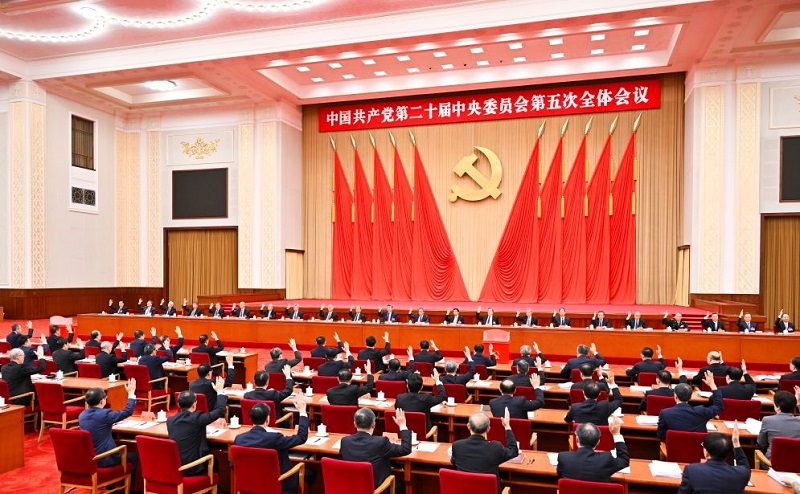
The fifth plenary session of the 20th Communist Party of China (CPC) Central Committee is presided over by the Political Bureau of the CPC Central Committee in Beijing, capital of China. The 20th CPC Central Committee held its fifth plenary session in Beijing from Oct. 26 to Oct. 29, 2026. (Xinhua/Yue Yuewei)
Traditionally, fifth plenums focus on the five-year plans. This time, although it coincided with the start of the 15th Five-Year Plan (2026-2030), the central theme was about the Party itself: internal discipline, organizational cohesion, leadership quality, and Party governance. The message was clear: a country’s ability to modernize is inseparable from the ability of the party leading it to govern itself effectively.
To outside observers this may look like an internal matter. I would argue the opposite. We live at a moment when political institutions of every ideological orientation are losing credibility – parties hollowed out, citizens convinced in advance that power will be abused, public office increasingly treated as a private asset. In that context, the largest political organization on earth, which leads more than 1.4 billion people, devoted its top-level meeting to a single question: how does a ruling party keep itself fit to govern? That question is not parochial. It is one of the defining questions of our age, and no political organization can afford to ignore the answer the CPC is attempting to give.
The Resolution does not stand in isolation. Together with Xi Jinping’s speeches commemorating the 105th anniversary of the Party’s founding and the 90th anniversary of the victory of the Long March, it shares one strategic thread: strengthening the Party so that it can guarantee its historical, ideological and organizational continuity, and remain the force leading Chinese people to realize socialist modernization.
Party Building, an Indispensable Prerequisite for Chinese Modernization
Chinese modernization must coordinate high-quality development, technological innovation, productive transformation, national security, ecological sustainability, social wellbeing, and political stability. Steering this in a country of over 1.4 billion people requires an efficient political guarantee. Full and rigorous Party self-governance is an indispensable prerequisite for achieving this goal.
Xi Jinping has summarized this logic with a traditional Chinese saying: “It takes a good blacksmith to make good tools.” To forge iron, the blacksmith must himself be strong. A Party leading a nation through complex economic, technological, social, and geopolitical situations must be internally solid; it cannot afford complacency, bureaucratization, or detachment from the people.
The resolution sets out principles to be followed in persevering with full and rigorous Party self-governance: serving the Party’s missions and tasks; taking strengthening the Party politically as the overarching principle; exercising rigorous governance across the board; adopting a problem-oriented approach; upholding fundamental principles and breaking new ground; adhering to a top-down approach; and running the Party according to regulations.
On that basis it makes interconnected deployments, including strictly practicing democratic centralism; cultivating high-caliber officials capable of shouldering the mission of national rejuvenation; building a well-knit organizational system characterized by cross-level alignment and effective implementation; taking firm and coordinated action against corruption; running the Party with systems and regulations; and refining Party and state oversight systems, among others.
These are not technical administrative adjustments. They are the political guarantees that allow the goals of the 15th Five-Year Plan – high-quality development, stronger domestic demand, industrial and technological modernization, deeper reforms, higher-standard opening up, better public services – to be executed effectively and in the interest of the people.
That claim is not abstract; it can be read off the landscape. In just a few decades, China has built the world’s largest high-speed rail network; completed major national projects such as the South-to-North Water Diversion Project and the west-to-east power and gas transmission networks, which transport water and energy across a continent-sized country; connected the Pearl River Estuary through the Hong Kong–Zhuhai–Macao Bridge; and established the BeiDou satellite navigation system and the Tiangong space station. It has also achieved something unprecedented for a country of comparable scale: lifting 98.99 million rural residents out of poverty in less than a decade.
What these have in common is what in China is called pooling resources to accomplish major undertakings – the ability to concentrate resources behind long-term national priorities and hold to them across leadership transitions and external shocks. That capacity is not self-generating. It depends on an organization that can set a direction, hold cadres to it nationwide, and correct them when they drift. It depends, in other words, on exactly the discipline, cohesion and organizational reach that this plenary session was convened to strengthen. Without it, the plans would remain plans.
A Century of Self-Governance: the Secret of the CPC’s Continuity
The CPC is 105 years old this year. It is the only major governing party I know that treats its own history as a manual for self-correction rather than a monument to be admired. The Resolution is explicit about why: the key to the Party’s victories lies in its pursuit of the high ideal of communism, its dedication to the lasting greatness of the Chinese nation, and its commitment to the happiness of the Chinese people and national rejuvenation. In every period – revolution, development, reform, and the new era opened by the 18th CPC National Congress – it has prioritized self-governance, upheld truth, corrected errors, and grown stronger by resolving its own problems with the people's support.
Marking the 90th anniversary of the Long March, Xi Jinping has drawn the parallel: building a modern socialist China is a "new Long March." It is prolonged and complex, and it demands determination, strict discipline, adaptability and collective confidence. The original Long March was survived not by superior resources but by unity of purpose and conscious discipline.
Here the CPC has made what I consider its most original contribution to Marxist political thought. Confronted with the oldest question in governance – how to escape the historical cycle of rise and fall – it has found two answers: the people's oversight over government and the Party's self-reform. In the language of the Resolution, these are the CPC's unique discoveries, and they mark out its place in the history of Marxist parties.
That deserves the attention of anyone on the left. It means legitimacy rests not on economic performance alone, nor on electoral arithmetic, but on a permanent, institutionalized capacity to criticize, correct and renew oneself. A party that can only grow cannot necessarily last. One that can also repair itself can.
Since the 18th National Congress in 2012, the CPC Central Committee with Xi Jinping at its core has acted on that conviction with considerable political courage. It confronted weak, hollowed-out and watered-down leadership, and lax, superficial, and effective self-supervision and self-governance, with the most stringent measures. Long-unchecked unhealthy tendencies were curbed, deep-seated problems remedied, serious hidden dangers removed. Discipline inspection and supervisory organs nationwide have filed 8.105 million cases and disciplined 7.922 million people since 2012 – figures that give scale to what is meant by "zero tolerance."
Out of this practice was born Xi Jinping Thought on Party Building. It answers a question no Marxist party had fully answered before: what kind of long-term governing Marxist party should be built, and how? Its "Fourteen Upholds" range from upholding Party leadership and the centralized, unified leadership of the Central Committee, to exercising full and rigorous Party self-governance, to building a contingent of high-calibre officials and enforcing strict Party discipline.This thought represents a major achievement in advancing the Party's theoretical innovation through the integration of the basic tenets of Marxism with China's specific realities and its fine traditional culture. The result crystallizes the practical experience and wisdom of the Party and the people.
What the Global Left Can Learn
Why does this matter beyond China? We live amid global governance challenges: political division, public trust deficits, and organizational slack. In Europe and elsewhere, left-wing, socialist, communist, and progressive forces often suffer fragmentation, loss of a clear social base, and an inability to connect long-term strategy with daily concerns. The CPC’s experience offers references worth studying.
First, a people-centered foundation. The Party's mission – seeking happiness for the people and rejuvenation for the nation – is not an abstraction. Rigorous self-governance is what preserves the bond with the people and ensures that public power serves the public good rather than private interest.
Second, organizational cohesion through democratic centralism and conscious discipline. By combining inner-Party democracy and deliberation with unity of action, and rooting discipline in ideological conviction rather than fear, the CPC offers an alternative to bureaucratic rigidity and the centrifugal tendencies that weaken many parties.
Third, the relentless fight against corruption. Treating corruption as a political threat to legitimacy and maintaining permanent zero tolerance, the CPC shows that a party of the popular classes cannot claim historic legitimacy while tolerating the private appropriation of public power.
Fourth, the creative application of Marxism. The CPC integrates Marxist principles with China’s historical, cultural, and social specificities and adapts them to new conditions. Dogmatic imitation has never been a path to revolution; theoretical innovation is key to continuity.
Underlying all is the spirit of self-reform. A revolutionary organization that aspires to govern over long periods must avoid bureaucratization, complacency, and detachment from real needs. It must examine its limitations, correct errors, and renew itself continuously. The “new Long March” reminds us that social transformation is not a single heroic episode, but a permanent collective task.
At a time marked by political polarization, declining public trust, and institutional fatigue, this may be China’s most significant contribution: not a model to be mechanically copied, but evidence that a governing party can choose to hold itself accountable to its own standards – and endure that test.
______________
JOSÉ LUIS CENTELLA is President of the Communist Party of Spain.