After lying dormant for many years, the thesis of “clash of civilizations” has reemerged as a focal point of public debate worldwide. It is resurfacing in election slogans, in politicians’ speeches, in spats on social media platforms, and between the lines of strategic reports. Instead of being brought up as a complete theory, it has quietly infiltrated everyday international discourse as fragmented phrases, public sentiment, and political rhetoric.
When speaking at the Munich Security Conference in February this year, U.S. Secretary of State Marco Rubio emphasized, “An alliance based on the recognition that we, the West, have inherited together … is the very foundation of the transatlantic bond.” This way of defining international relations from the perspective of civilizational identity has once again drawn international attention to the “clash of civilizations” narrative.
Similarly, the latest edition of the U.S. National Security Strategy, released in December 2025, depicts Europe as facing “the real and more stark prospect of civilizational erasure.” This framing of social changes within allies as civilizational crisis is rarely seen in diplomatic strategy documents. Behind it lies the diehard logic advocated by Samuel P. Huntington in his book, The Clash of Civilizations, which redraws the boundary between friends and foes by defining “who we are.”
What causes this resurgence of the “clash of civilizations” narrative? Is it the product of a short-term political cycle, competition for public opinion, or identity politics? Or is it the symptom of a deeper structural crisis in the existing model of governance?
The answer is: both. When the benefits of growth are no longer shared by all, when risks spill across national borders, and when ordinary people feel that their lives are being dictated by forces abroad, there emerges the imperative to find a political explanation. And the “clash of civilizations” narrative conveniently offers a low-hanging fruit option – it packages structural problems as cultural ones.
The danger of this narrative is that it may become a self-fulfilling prophecy. In many cases, a prophecy comes true not because it is correct, but because enough people believe it is inevitable and act accordingly. In the end, a relationship that could have entered cooperation is pushed toward confrontation.
The solution lies not in argument but in engagement and communication.
For more than 70 years, the China International Communications Group (CICG), to which China Today is affiliated, has been committed to the mission of explaining China to the world and helping it understand the world. In recent years, we have come to a deeper understanding that people-to-people exchange is not a frill of global governance but its foundation. However well-designed the policies may be, they are difficult to implement without a basic level of mutual understanding; however grand the cooperation initiatives may be, they cannot endure without the support of public opinion. For the specific mechanisms of global governance to function, they need the trust of people all over the world. And trust can only be earned through inter-personal contact and exchange.
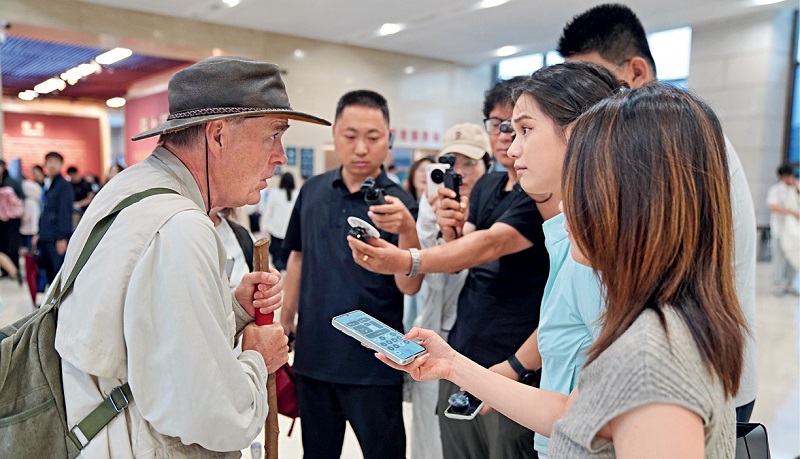
David Ferguson, honorary chief English editor of the Foreign Languages Press and recipient of the Chinese Government Friendship Award, talks with media outlets at the Yan'an Revolutionary Memorial Hall on July 21, 2026.
From Civilizations to Individuals
Over the past years, CICG has established a number of platforms for regular people-to-people exchange, aiming to present the broad, abstract concept of “civilization” through concrete dialogue and exchange among individual people.
We have sought to make young people the interlocutors, not merely audiences. At the end of 2020, we launched the Global Young Leaders Dialogue project, organizing young people from overseas to visit various parts of China. But exchange cannot stop at “taking a look.” In May 2024, we established our first overseas Global Youth Mutual Learning Center at the University of Oxford, elevating exchange from short-term visits to joint research.
In September 2024, the New Zealand-China Youth Dialogue on Cultural Exchange was held in Auckland, under the theme “New Technologies Promote Mutual Learning and Innovation Among Civilizations.” At the event, the two sides announced the launch of the New Era of Voices: Global Youth Communication Initiative.
In August 2025, the second Youth Dialogue on Promoting China-U.S. People-to-People Exchanges was held at the University of San Francisco. Nearly 50 young Chinese and American scholars held substantive discussions under the theme “Seeking Peaceful Coexistence in a Multipolar World.” At these events, young people raised questions, had debates, and sought answers together, thereby enhancing mutual learning and understanding.
The China Today Salon is another CICG endeavor for cultural exchange that has been recognized as a national key project for international cultural trade. These “salons” have been established in places in and out of China, including Cairo, Madrid, Jingdezhen, Hengqin, Shenyang, Lhasa, and Beijing’s Yizhuang and Sanlitun.
On July 27, 2025, the 50th anniversary of the establishment of China-EU diplomatic relations, the event "Gathering at the China Today Salon – Bridge of Peace: The Dialogue Between Greater Bay Area and European Youth Leaders” was held in Hengqin, Zhuhai City, Guangdong Province. Focusing on the theme “Lasting Peace by Youth, Brighter Future via Technology,” more than 40 young representatives from a dozen European countries exchanged views with young people from China’s Guangdong-Hong Kong-Macao Greater Bay Area. The conversations were not about abstract notions of civilizations, but their experiences of starting business, confusions, and predictions for the future. A small intangible cultural heritage exhibition was set up on the sidelines, offering live demonstrations.
In his speech, Jacobo García, president of the Global Youth Leadership Forum, lauded the Greater Bay Area as a place of transformation and innovation. In exchanges with young Chinese entrepreneurs, he discovered that they share the same dreams as their Western peers and he felt the pulse of Chinese society.
This event was not merely speeches and group photos, it also included substantive exchange and interaction. It brought young Europeans into Chinese tech companies, where they tried on AR glasses developed by those firms and had conversations with their founders. Consensus on governance often sprouts from exactly this kind of seemingly casual contact.
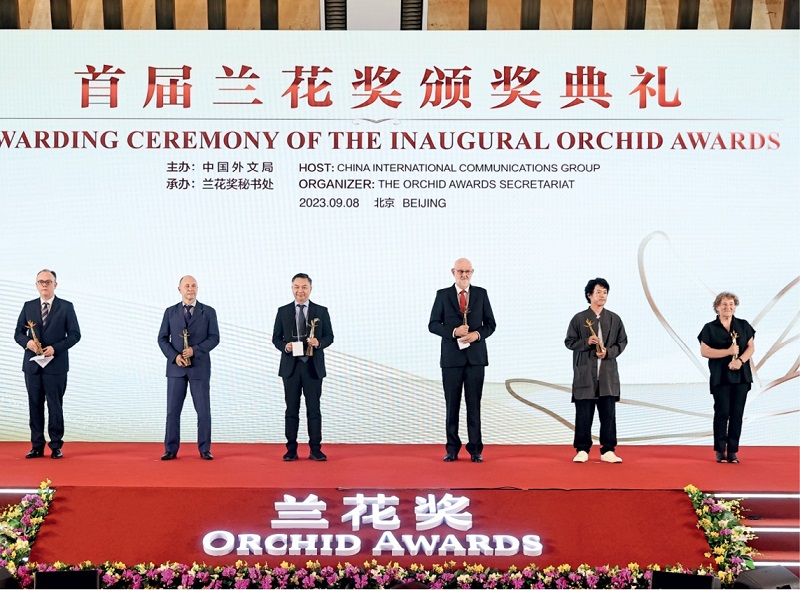
In 2022, the CICG launched the Orchid Awards to honor non-Chinese individuals and institutions for their contributions to cultural exchange and mutual learning between China and the rest of the world and to dialogue and cooperation among global civilizations. The awards span three categories: Lifetime Honorary Prize, Outstanding Achievement Prize, and Friendship Envoy Prize. The selection is based on the achievements, contributions, and global influences of the candidates.
As a practice of the Global Civilization Initiative, the Orchid Awards has become an important avenue for cultural exchange between China and the wider world. In July 2025, it was admitted into the Action Plan of the Global Civilizations Dialogue Ministerial Meeting. In March 2026, it was written into China’s 15th Five-Year Plan, making its significance as an exchange platform increasingly prominent. Supporting events, such as Travelogue of China and Rendezvous with the Orchid: Conversations on Civilization, allow people from different cultures to engage in dialogue while traveling together across China.
Think tanks serve as a fulcrum for rational dialogue. In May 2026, CICG co-hosted with the Carter Center of the United States the China-U.S. High-Level Think Tank Dialogue on “Expand People-to-People Ties, Foster Mutual Trust in China-U.S. Relations.” It built on the success of the China-Russia Dialogue in Sanya, Hainan Province, held in March of the same year, and the symposium on China and Argentina joining hands to explore paths to modernization held in Argentina in July 2025. The value of exchange among think tanks lies in laying out the views of all sides and distinguishing disputes over facts from differences in perception, identifying the points of converging interests, and pinpointing the fields to build consensus.
All the above platforms, though different in form, serve one mission – answering the question of “how can diverse actors participate in global governance?” Media, think tanks, universities, publishing houses, and youth organizations can set up their respective platforms, jointly laying down the cultural foundation of global governance.
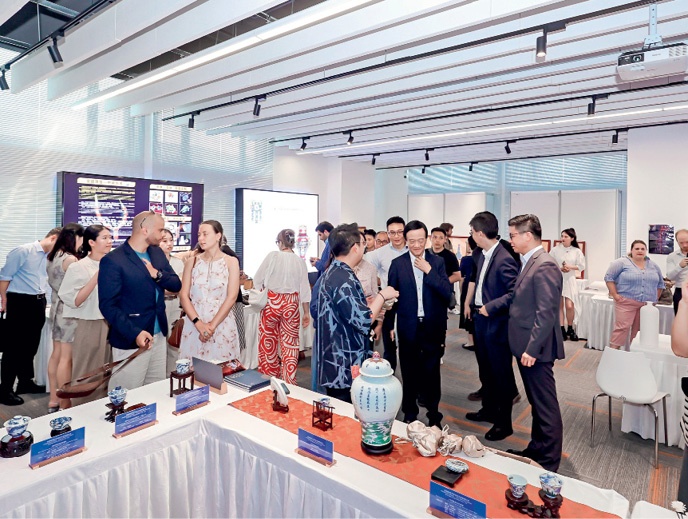
Participants in the China Today Salon event “The Bridge of Peace: Dialogue Between Greater Bay Area and European Youth Leaders” visit an exhibition of intangible cultural heritage on the sidelines of the event in Hengqin New Area, Zhuhai, Guangdong Province, on July 27, 2025.
From Dissolving Barriers to Advancing Cooperation and Development
People-to-people exchange is indisputably the foundation of international relations because it plays three roles.
The first is dissolving barriers. Prejudice is rarely dispelled by argument; more often it fades away through acquaintance. A young European who has never been to China forms an impression of this land entirely from secondhand accounts. But when he strolls through an exhibition hall in Hengqin or discusses the AR glasses supply chain with a Chinese entrepreneur, those secondhand accounts begin to give way to firsthand experiences.
The second is deepening cooperation. If contact stops at pleasantries, it is no more than a courteous gesture. What is more meaningful is turning contacts into mechanisms. This is why we have established the Global Youth Mutual Learning Center at the University of Oxford, regular dialogues among think tanks, and China Today Salons in Cairo, Madrid, Hengqin, Shenyang, and Lhasa. The value of these mechanisms is that they keep the door open for international exchange even when the political climate turns cold.
The third is driving development. People-to-people exchange must ultimately come down to improving people’s well-being. The “A Date with China” campaign invites foreign correspondents, Internet celebrities, and students in China to join Chinese journalists in reporting tours across various parts of the country. These immersive trips combine reporting with communication, discussion, and research. The participants tour villages that have risen out of poverty, visit scenes of digital development, witness achievements in ecological protection, and talk to students receiving vocational training at Luban Workshops. In this process they are reminded that dialogue among civilizations is not purely a philosophical matter; it is also about employment, technology, and the sharing of development capacity.
It is precisely through people-to-people exchange and capacity building that many countries in the Global South have moved from participation in discussions to participation in rule-making and agenda-setting.
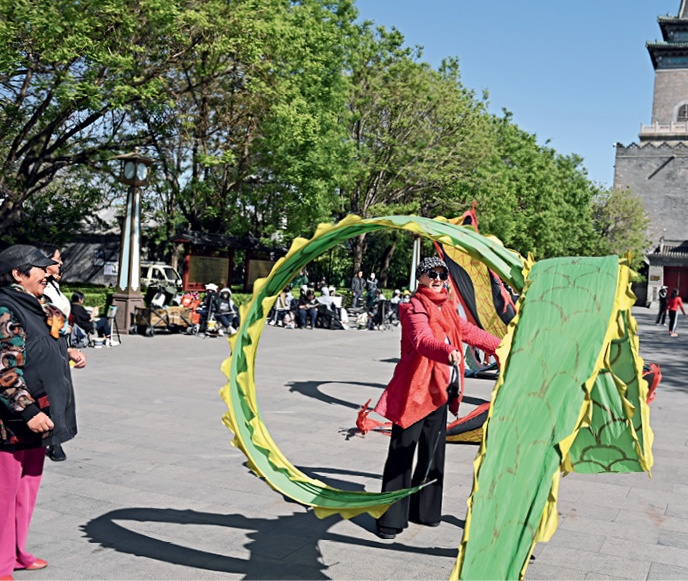
Inaugural Orchid Awards jury member Rosalind Oliver tries the ribbon dance at the iconic Drum Tower, Beijing Central Axis, on April 26, 2023.
From Harmony within Diversity to Universal Harmony
Chinese civilization has abundant experience and traditional wisdom in dealing with differences. One famous phrase in this regard is harmony within diversity, which is about methodology.
Harmony within diversity is one of the cultural roots of the Global Governance Initiative, deeply embedded in the rich soil of China’s fine traditions. It is not only an approach to interaction, but also the value guidance at the civilization level. Difference is not an obstacle to exchange; it is the reason for exchange.
The Global Governance Initiative upholds sovereign equality and multilateralism as its core principles. It recognizes that all countries and all civilizations, despite their differences, are equal, and all have the equal right to participate in global governance. We never expect the other side to become us. What we strive to do is building understanding about our differences.
The precondition for harmony within diversity is acknowledging the existence of difference before seeking harmony. Multilateral consultation becomes possible only by seeking cooperative consensus on the basis of respecting differences. Any dialogue premised on assimilation is doomed to fail.
Our ideal is universal harmony, which sets the direction for our action. It is not homogenization; rather, the beauty of all civilizations should be appreciated, and they can thrive together. Global governance should not fall into the hands of one country, but be shared by all countries. By reiterating this ideal today, we hope to see that countries with different levels of development, different social systems, and different cultural traditions participate equally in global affairs, regardless of size or strength.
True consensus comes only from equal-footed dialogue; it cannot be imposed by any party on others. And equal-footed dialogue is possible only when both sides possess a certain level of common language, which is precisely what people-to-people exchange is meant for.
This ideal should also materialize at the grassroots level. Global governance should not be confined to conference rooms in Geneva and New York; it is also forged in the meet-ups in Hengqin, industrial parks in Shenyang, and neighborhoods in Lhasa. Governance will become truly “people-centered” after young people, journalists, publishers, and intangible cultural heritage artists meaningfully engage with their peers from other parts of the world.
Coming back to the question at the beginning: how to prevent the “clash of civilizations” narrative from becoming self-fulfilling?
My answer is simple: let more people from different civilizations meet and engage in exchange.
The foundation of global governance is not built on declarations, but through steadfast efforts in the form of direct engagement, frank dialogue, and pragmatic cooperation.
From “reading China” to “understanding each other,” and from “harmony within diversity” to “universal harmony,” there is no shortcut on this path. Every dialogue we hold, every foreign visitor we receive, every book we publish, and every door we open for salons is another brick laid for the foundation of global governance.
The more bricks laid down, the stronger the foundation becomes.