Tianjin knows what unequal terms feel like. In the 19th century, this port city was among the locations where China was forced to open its doors under the threat of foreign gunboats, signing treaties in which its own sovereignty meant nothing. It is then historical justice that on September 1, 2025, Tianjin became the city where Chinese President Xi Jinping proposed the Global Governance Initiative (GGI) – at the Shanghai Cooperation Organization Plus Meeting, where China sat with the wider world rather than a single bloc. From a city once compelled to accept terms written by others came a proposal about how all nations should collaborate for the global good.
The GGI arrived at a deeply unsettled moment in human history. Tensions are high across the globe, as regional conflicts threaten to escalate at any given moment. Threatening rhetoric in public discourse, rising defense budgets, and the casual normalization of force as policy are all contributing to the potential for war. The post-WWII international system, built at enormous cost, is being hollowed out at exactly the moment it is most needed.
What is striking, against that backdrop, is how quickly the GGI stopped being one country’s idea. Nearly 160 countries and international organizations have expressed support for the initiative. More than 60 countries have joined the Group of Friends of Global Governance, now established in New York, Geneva, and Vienna – the three cities where the postwar system does its daily work. At the UN headquarters in late May, delegates from over 60 countries met under its banner to align positions on UN reform, unilateral sanctions, dispute settlement, and the governance of digital and climate affairs. In June, China issued a white paper titled More Just and Equitable Global Governance: China’s Principles, Proposals and Actions – giving the GGI a systematic shape.
For a diplomatic proposal, 12 months is a short time to make such profound progress. Numbers alone do not prove an idea is right. But they do suggest the GGI voiced something many governments had long thought of and rarely said aloud: that the world cannot be governed indefinitely by a few, in the name of all.
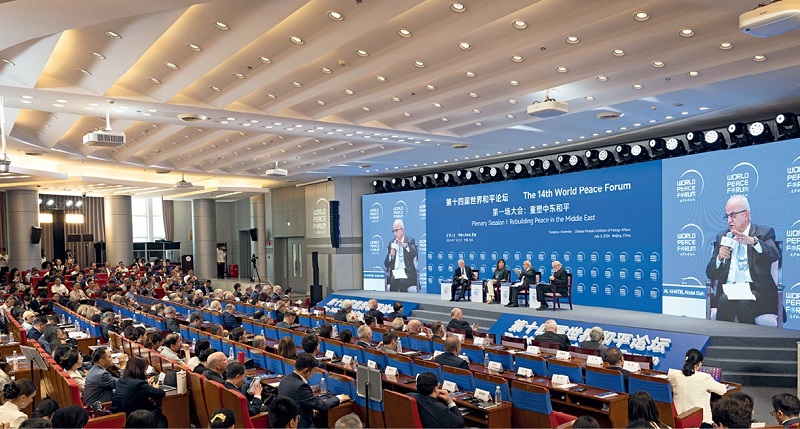
Abdul Ilah Khatib (second right on stage), former foreign minister of Jordan, speaks at the first plenary session of the 14th World Peace Forum at Tsinghua University on July 3, 2026. Launched by China in 2012, the forum is a non-governmental international security platform. This year’s theme is “Global Governance and International Security Cooperation: Integrity, Innovation, and Inclusiveness.”
Equal by Right, Not by Permission
The GGI rests on five principles. They are better read as a single proposition, in which each reinforces the other.
Sovereign equality comes first because everything else depends on it. All states – large or small, rich or poor, and whatever their political system – enjoy equal rights and bear equal responsibilities: equal participation, equal decision-making, and equal benefit. This is not a courtesy extended to the weak. It is a correction. For most of the modern era, the Global South has been governed far more often than it has governed, and the habit has outlived the empires that produced it. Making the principle real is what turns Global South voices from a recorded minority into a participating one.
The international rule of law is what that equality requires in practice: the full and complete observance of the UN Charter’s purposes and principles, avoiding a selective approach; and international law applied uniformly, without double standards and mistaking a handful of countries’ domestic rules for universal law. In an age when sanctions are imposed unilaterally and treaties are exited as a matter of convenience, this is the most demanding item on the list – and the one most easily evaded by those who invoke it most often.
Real multilateralism, practiced rather than invoked, means the UN at the center, open cooperation among states, and broad consensus in place of diktat. The alternative is what we are seeing frequently and should be avoided: international mechanisms fragmented, politicized, and converted into arenas for geopolitical competition.
A people-centered approach sets the purpose. The measure of global governance is not the comfort of chancelleries but the well-being of people – sustainable development, poverty reduction, human security, and basic rights. Policy that does not answer to real social needs is administration, not governance.
Taking action is the acid test. As President Xi says, facts speak louder than rhetoric. The point is not to add another declaration to the pile but to produce visible results – in areas of infrastructure, connectivity, education, health, and economic development.
What runs through all the five principles is a double rejection: of the bloc logic inherited from the Cold War, which divides, confronts, and disconnects the international community; and of an older colonial logic, in which a metropole extracted wealth from territories governed by force. Against both, the GGI proposes an open system in which every region and every civilization can take part on equal terms.
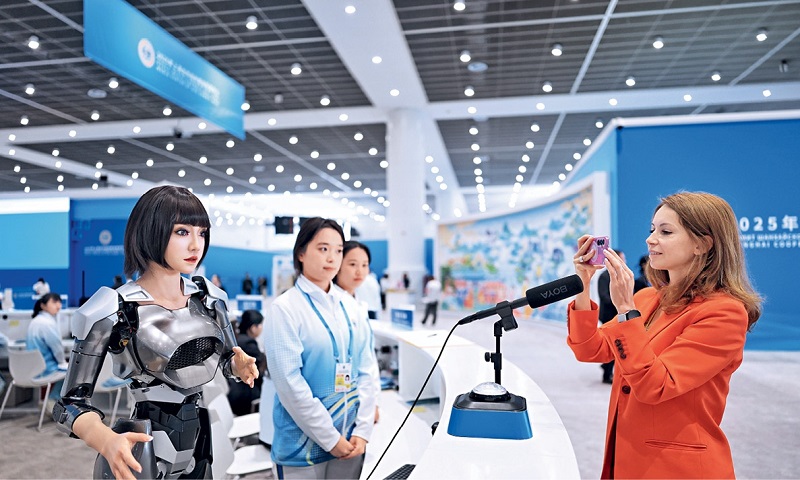
A foreign journalist takes photos of an interactive humanoid robot named “Xiaohe” at the media center for the Shanghai Cooperation Organization Summit 2025 held in Tianjin on August 31, 2025.
A Coherent Architecture
The GGI did not appear out of nowhere. It is the newest element in a body of proposals that President Xi has put to the international community over more than a decade – and the one that gives the others their institutional shape.
The earliest and most material is the Belt and Road Initiative (BRI), launched in 2013. More than three-quarters of the world’s countries have joined the BRI, and China has signed over 200 cooperation documents with more than 150 countries and 30-plus international organizations. Railways, ports, power grids, digital corridors and industrial parks have greatly boosted local development in regions along the routes. Whatever one’s view of any individual project, the underlying proposition has been vindicated: cooperation can be inclusive, respectful, and oriented toward shared development rather than zero-sum extraction.
Alongside the BRI stand four global initiatives, proposed in sequence since 2021. Each addresses one dimension of the same problem.
The Global Development Initiative (GDI) lays the material foundation, placing development back at the center of the global agenda. It has launched over 1,800 “small and beautiful” livelihood projects, concentrated on poverty reduction, food security, development financing, and green growth. More than 130 countries and international organizations support and cooperate under it; 88 have joined its Group of Friends, and nearly 100 have signed cooperation documents with China.
The Global Security Initiative (GSI) safeguards stability, advancing a vision of common, comprehensive, cooperative, and sustainable security – dialogue rather than confrontation, partnership rather than alliance, win-win rather than zero-sum. It has the support of more than 130 countries and regional or international organizations, and its core concepts have been written into over 140 bilateral and multilateral documents. The GSI’s achievements are tangible: Chinese mediation helped restore diplomatic relations between Saudi Arabia and Iran in 2023, and China played a major role in bringing Palestinian factions to sign the Beijing Declaration, and together with Pakistan produced a five-point initiative for restoring peace in the Gulf.
The Global Civilization Initiative (GCI) cultivates shared understanding: respect for the diversity of civilizations, and the conviction that exchange should overcome estrangement, mutual learning overcome conflict, and coexistence overcome claims of superiority.
The GGI supplies the architecture – how the system itself should be reformed, and by whom.
The complementarity of these dimensions is crucial. Through infrastructure projects, development programs, mechanisms for inter-civilizational dialogue, and spaces for political coordination, developing countries are no longer simply recipients of support. They are becoming co-authors of a more just international order.
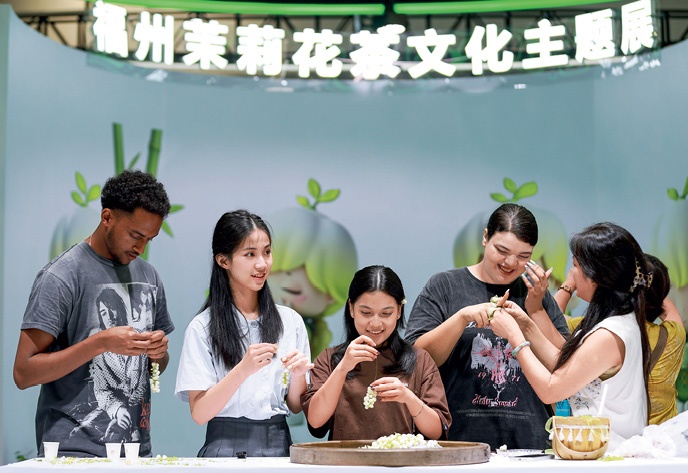
A group of international students from Fuzhou University of International Studies and Trade make jasmine flower bracelets on September 4, 2026.
 Trust Before Treaties
Global governance cannot be confined to diplomatic agreements and economic projects. A treaty signed in a conference hall does not survive if the people behind it regard each other with suspicion. For international cooperation to last, it must have a stronger foundation: genuine mutual understanding among peoples.
This is why the GGI assigns a central role to cultural, educational, and social exchange – and why the GCI matters more than its reputation as the “softest” of the four initiatives would suggest. Academic exchanges, joint cultural programming, youth forums, city-to-city partnerships: these have repeatedly proven to be the most effective instruments available for dismantling prejudice, building trust, and making a shared vision of the future imaginable rather than abstract.
That infrastructure is being built, quietly and at scale. China has established more than 3,000 sister-city and sister-province relationships with over 150 countries. Joint archaeological missions, collaborative heritage preservation, and the translation of classic works into multiple languages are restoring a past that belongs to no single civilization. The Luban Workshops – a vocational program that began in Tianjin, the very city where the GGI was born – now operate 38 projects in 32 countries, training young people in artificial intelligence, advanced manufacturing, and new energy where such skills are scarce.
None of this is a substitute for governance. It is its precondition. Exchange does not follow agreement; it is the other way around. When China proposed that the UN General Assembly establish June 10 as the International Day for Dialogue among Civilizations, co-sponsored by more than 80 countries, it was acknowledging precisely that in a fractured world, the capacity to listen across differences serves as a form of international infrastructure.
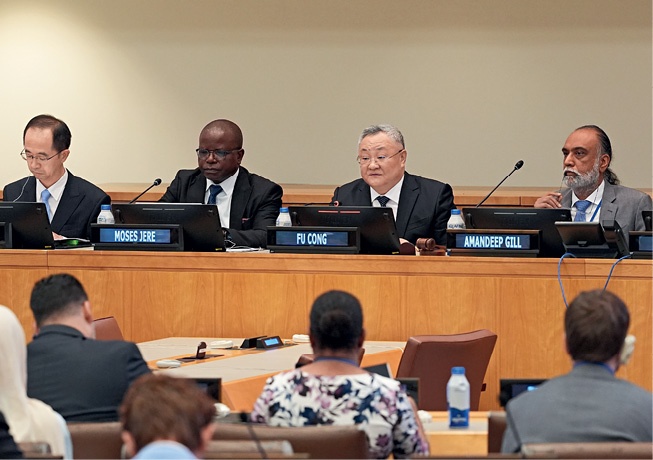
China’s Permanent Mission to the UN holds a briefing at UN Headquarters at the 2026 World Artificial Intelligence Conference (WAIC) and the High-level Meeting on Global AI Governance on July 31, 2026, in New York.
From Declaration to Institution
One year is not long enough to remake global governance. It is, however, long enough to test whether a proposal has traction – and on that metric the GGI has done more than survive.
It has moved from concept to platform. The Group of Friends now functions across three UN centers, and its meetings produce joint positions rather than press releases. At its May meeting in New York, China set out nine directions for reform: making the UN more effective; strengthening the UN Security Council’s authority and capacity; modernizing peacekeeping; building international consensus on accelerating development; correcting the course of international human rights governance; deepening reform of the economic and financial system; establishing rules for artificial intelligence; governing new domains such as cyberspace and outer space; and promoting exchange and mutual learning among civilizations. None of these proposes a new institution to replace the old one. All of them propose repairing the one we have.
It has moved from principle to institution. In October 2025, weeks after the GGI was launched, the International Organization for Mediation opened its doors in Hong Kong – becoming the world’s first intergovernmental body devoted to settling disputes by mediation, a method the UN Charter itself recommends in Article 33 and one that had no institutional home until now. Its headquarters occupy the former Wan Chai Police Station, a building established to keep order in a colony; it now houses an organization for resolving disputes by consent rather than coercion.
In July 2026, representatives of 29 countries from Asia, Africa, Latin America, and Europe signed the agreement establishing the World Artificial Intelligence Cooperation Organization (WAICO), which will be headquartered in Shanghai and will be the first intergovernmental body dedicated to the technology most likely to reshape this century. UN Secretary-General António Guterres, who attended the signing, framed the point plainly: “Technology that will shape the future of humanity must be shaped by all humanity. It cannot be governed by a handful of countries or a handful of companies. Every nation needs a seat at the table.”
And it has moved from one country’s proposal to a shared vocabulary. Guterres has said that in the global initiatives China has proposed there is “full respect for multilateralism and “full support of the UN as the central piece of multilateral institutions,” and that their principles are “totally compatible with the UN Charter.” That compatibility is not incidental; it is the initiative’s anchor.
It is worth adding, since the charge is so often made, that this is not a project of withdrawal from the system it criticizes. China’s share of the UN regular budget has risen from under one percent in 2000 to more than 20 percent in 2025, making it the second-largest contributor. China also provides over 23 percent of the UN peacekeeping budget and is the largest troop contributor among the permanent members of the UN Security Council. Reform is easier to argue for when one is paying the bill.
Hierarchy or Reciprocity
The first anniversary of the GGI is more than a symbolic date. It is an opportunity to take stock, and to restate a commitment to a global governance that is more just, more equitable, and more firmly centered on people.
It is worth saying clearly, because it is so often overlooked: these initiatives are not charity directed toward the Global South. They are equally necessary to the countries in the developed world. The crises now afflicting the advanced Western economies – stagnation, demographic decline, political polarization, and the social disruption of new technologies – cannot be resolved in national isolation, and certainly not behind walls. They can only be addressed in an environment of universal cooperation, where all countries exchange resources and knowledge on equal footing. Solidarity is not a concession granted by the strong to the weak. It is the only arrangement that works for everyone.
That is why the choice in front of us is not between competing civilizational camps. It is between a world organized by hierarchy and one organized by reciprocity. The first has been repeatedly tried, and it has left behind a record of extraction and war. The second is harder – it requires patience, compromise, and the willingness to weigh a small country’s argument as seriously as a large one’s. But it is the only foundation on which a 21st-century order can actually stand.
A year in, the GGI has shown that it can build consensus, drive cooperation, and produce tangible solutions to global problems..
JOSÉ LUIS CENTELLA is president of the Communist Party of Spain.