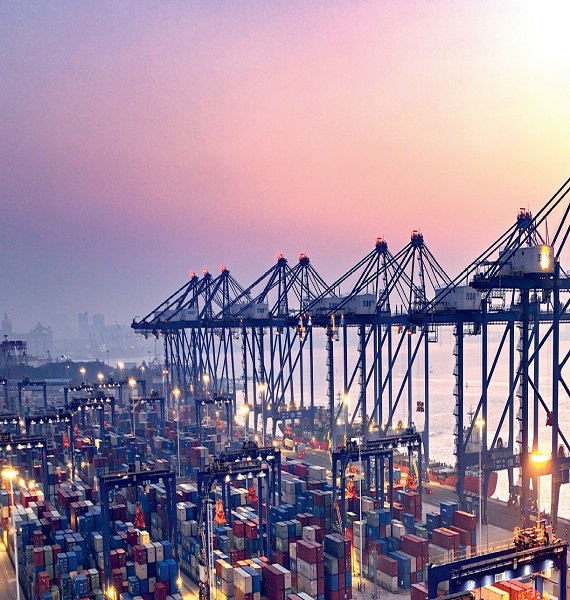
With the official launching of the island-wide independent customs operations, Yangpu International Container Terminal in Hainan enters a period of intense activity. Chen Yuancai of Hainan Daily
The Hainan Free Trade Port (FTP) officially launched island-wide special customs operations on December 18, 2025. One month in, a reporting team from China International Communications Group (CICG) conducted an exclusive interview with Feng Fei, secretary of the Hainan Provincial Committee of the Communist Party of China (CPC) and chairman of the Standing Committee of the Hainan Provincial People’s Congress. Drawing on early results and the policy benefits already taking shape, Feng shared insights into Hainan’s core strengths, development potential and the opportunities it offers to the world.
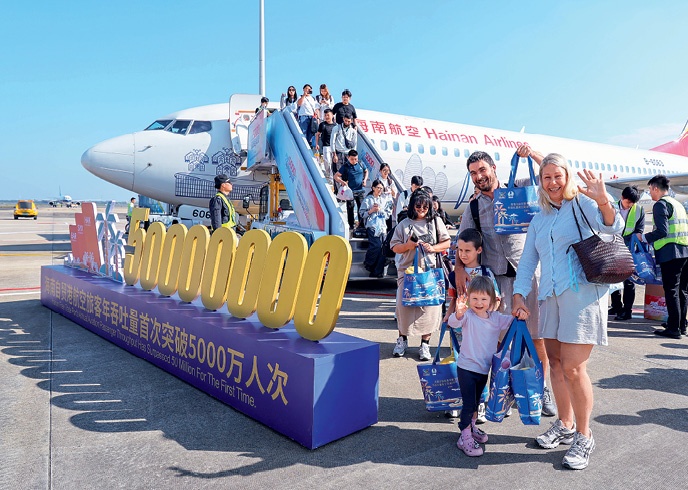
As Hainan Airlines’ Bangkok–Haikou flight and China Southern Airlines’ Chengdu–Haikou flight land in succession on December 30, 2025, the Hainan Free Trade Port’s passenger throughput in 2025 set a new annual record by surpassing the 50-million mark for the first time. The photo shows foreign passengers arriving at Haikou Meilan International Airport on a Hainan Airlines flight from Bangkok.
CICG: Island-wide special customs operations have been described as a critical milestone for Hainan. In your view, how will this move promote China’s interaction with the global economy? And how will it redefine Hainan’s role in global trade networks?
Feng Fei: As General Secretary Xi Jinping noted, the official launch of island-wide special customs operations in the Hainan FTP on December 18, 2025 is a landmark step in China’s unwavering commitment to expanding high-level opening-up and advancing an open world economy. It will be of significant and far-reaching importance both domestically and internationally.
Special customs operations do not mean closing off the island. On the contrary, they represent a higher level of openness. The strategic goal of building the Hainan FTP is to create a key gateway for China’s opening-up in the new era. It is designed to support the development of a new nationwide development pattern in which domestic and international economic cycles reinforce each other and operate efficiently, ensuring smoother and more robust connections between China and the global trading system. This will create new opportunities for the improvement and development of global trade networks.
Under special customs operations, the Hainan FTP will play a leading role in advancing high-level opening-up. Centered on a policy framework featuring zero tariffs, low tax rates, and a simplified tax system, as well as free and convenient trade, investment, cross-border capital flows, personnel mobility and transportation, and the secure and orderly flow of data, Hainan will connect on one end with China’s enormous unified national market and on the other with international markets. It will serve as a frontier for China’s deeper integration into the global economy – promoting not only the freer flow of goods and production factors but also steady progress in institutional opening-up. By aligning with international rules, regulations, management practices and standards, Hainan is positioning itself as a strategic hub where domestic and international economic cycles converge.
To this end, we are accelerating the development of “two bases, two hubs, and two networks.” The two bases are a headquarters base for Chinese enterprises expanding into international markets and a headquarters base for foreign enterprises entering the Chinese market. The two hubs are an international shipping hub for the New International Land-Sea Trade Corridor and a regional aviation gateway to the Pacific and Indian Oceans. The two networks focus on international economic and trade cooperation and people-to-people exchanges and cooperation, respectively. These measures are designed to transform Hainan from a regional trade node into a comprehensive trade hub that links domestic and international markets, with a focus on Southeast Asia and beyond.

Eager customers select and purchase duty-free goods at the crowded Sanya International Duty Free City in Sanya, south China’s Hainan Province, on January 17, 2026.
CICG: During the first month of island-wide special customs operations, what key data or concrete examples best demonstrate how the system is working in practice? What have been the biggest challenges, and how has Hainan addressed them?
Feng Fei: Based on feedback from all sides, the island-wide special customs operations have run smoothly and in an orderly manner, with an encouraging start. Results are evident in the smooth flow of goods, the facilitation of personnel mobility and the aggregation of factors. First, policy dividends have been effectively unleashed. During the first month from December 18 to January 17, the number of entities benefiting from the “zero tariff” policy increased by over 10,000, maintaining steady growth. The value of imported goods reached RMB 750 million, a year-on-year increase of 38.9 percent. The duty-free sales supervised by customs reached RMB 4.86 billion, up 46.8 percent year on year, and the number of shoppers rose 30.2 percent year on year to 745,000. Second, the appeal of opening-up has grown significantly. Inbound and outbound passenger trips through Hainan’s “first-line ports” reached 289,000, a year-on-year increase of 31.3 percent. Of those, 82,000 were visa-free entries, up 64 percent year on year. Additionally, the entry and exit of international vessels saw a year-on-year growth of 19.6 percent. The province has seen 26,800 new business entities, with the proportion of new enterprises in the total increasing from 42 percent before the start of special customs operations to nearly 80 percent. New foreign-invested enterprises grew by 13 percent year on year, and over 5,100 new foreign trade enterprises were registered, reflecting a further optimization of the economic structure. Siemens Energy has established its first gas turbine assembly base and service center in Hainan. Boao Fulong Cardiovascular Hospital, the first wholly foreign-owned hospital, has been approved to operate. Kazakhstan’s SCAT Airlines launched the country’s first seventh-freedom air route, connecting Sanya to Prague. An increasing number of companies are choosing Hainan for their operations, and the momentum of “developing in Hainan” remains strong. Third, as the benefits of Hainan’s special customs operations take effect, duty-free shopping, trade, and cultural and sports tourism have become hot topics in domestic and international media and among the public. Areas of public concern, such as anti-smuggling and environmental protection, are also operating smoothly. Moving forward, the focus will shift from “establishing systems” to “optimizing systems for tangible results.”
Under special customs operations, the Hainan FTP operates on a framework of “freer access at the first line, regulated access at the second line and free flow within the island.” Freer access at the “first line” refers to implementing a series of measures for free and convenient entry and exit between Hainan FTP and other countries and overseas regions. Regulated access at the “second line” refers to precise regulation of entry and exit between Hainan FTP and other regions on the Chinese mainland. Here, precise controls are applied to manage what has been liberalized at the “first line.” Within the island, goods and other factors of production can flow relatively freely.
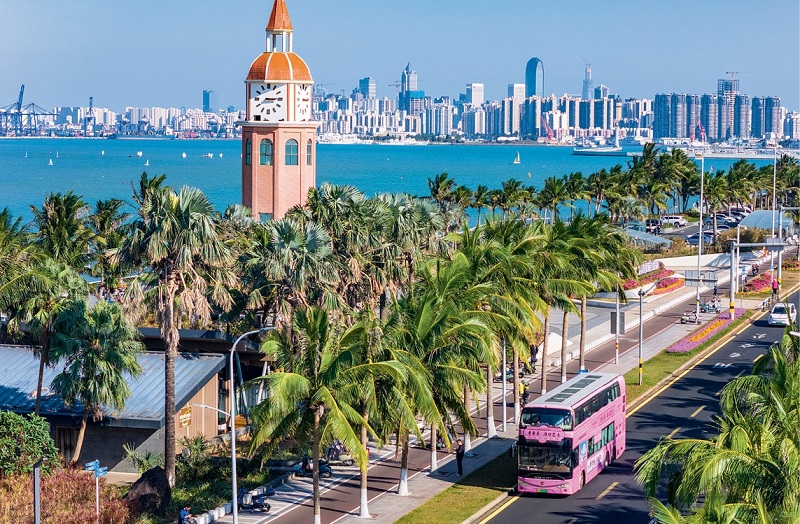
The Laobacha Haikou Bus, a double-decker mobile teahouse, travels along Binhai Avenue, taking visitors on a journey of enjoying the scenery and culture of Haikou City, south China’s Hainan Province, on January 8, 2026.
CICG: Strong intellectual property protection is a major concern for foreign investors. What specific measures has Hainan implemented to align with international trade rules and protect IP?
Feng Fei: Effective IP protection is a major factor in attracting foreign investment. In recent years, Hainan has been working to establish itself as a leader in IP protection, ensuring equal treatment for all business entities and rigorously combating infringement. In 2025, Hainan recorded the highest growth nationwide in its IP development index. On the legal front, the Hainan Free Trade Port Law of the People’s Republic of China includes specific provisions for IP protection in Article 23. Hainan has also enacted supporting regulations and established a dedicated IP court, providing strong legal safeguards.
Regarding platform development, Hainan is focusing on key sectors such as the Nanfan seed industry, deep-sea technology, commercial aerospace, biomedicine, and equipment manufacturing. We have established the Yazhou Bay Science and Technology City IP Special Zone and comprehensive IP service demonstration areas in Sanya and Haikou, as well as two sub-centers for overseas IP dispute resolution. In terms of international cooperation, Hainan is leveraging platforms such as the Yazhou Bay IP Special Zone and the Boao Forum for Asia to facilitate international IP exchanges. We are also strengthening collaboration with the World Intellectual Property Organization on IP protection, talent development and green, low-carbon development. Hainan is proactively aligning with high-standard trade rules, introducing 20 action measures under the Regional Comprehensive Economic Partnership (RCEP) and 16 measures for deepening cooperation with RCEP member states. We are also piloting alignment with rules under the Comprehensive and Progressive Agreement for Trans-Pacific Partnership (CPTPP), accelerating the development of internationally compatible frameworks in areas such as IP protection and fair competition. Protecting IP in accordance with the law is a key priority and firm commitment of the Hainan FTP. We will continue working diligently to do even better.

A performance of the intangible cultural heritage Yingge dance is staged at the Dongpo Old Wharf in Haikou, south China’s Hainan Province, on January 10, 2026.
CICG: How do opening-up policies directly benefit ordinary residents of Hainan? What measures has the government taken to ensure that people’s well-being keeps pace with the process of opening-up?
Feng Fei: The Hainan FTP with Chinese characteristics is one that is jointly built and shared, and that advances common prosperity. Whether people genuinely feel a sense of gain is a key measure of the Hainan FTP’s success. Our goal is to ensure that residents enjoy tangible benefits from the construction of the Hainan FTP. Take income growth, for example. Approximately 80 percent of Hainan’s land is rural, about 40 percent of its permanent residents live in rural areas, and agriculture contributes around 20 percent of its GDP. Addressing issues related to agriculture, rural areas and farmers – particularly increasing farmers’ incomes – is a major priority in building the Hainan FTP. By leveraging the port’s opening-up policies alongside policies to strengthen agriculture, benefit farmers and enrich rural areas, we have achieved growth in disposable income for both urban and rural residents that has exceeded GDP growth for several consecutive years. Rural residents’ income growth has outpaced that of urban residents, and per capita income growth for the rural population lifted out of poverty has surpassed that of the general rural population. The urban-rural income ratio has narrowed to below 2:1, significantly better than the national average for the same period. In terms of employment, the port’s opening-up policies and favorable investment climate have attracted a significant number of high-quality enterprises to Hainan, generating quality job opportunities. We have intensified efforts to enhance employment quality. In the first three quarters of 2025, new urban employment in the province increased 8.4 percent year on year, maintaining a stable and positive trend. Regarding prices, we have established a balancing mechanism covering the production, transportation, sales and storage of essential commodities. We are strengthening the production and supply of vegetables and grains, enhancing cross-regional distribution of daily necessities and facilitating direct connections between municipal and county-level “vegetable basket” groups and local growers. This has kept essential goods prices at reasonable levels.
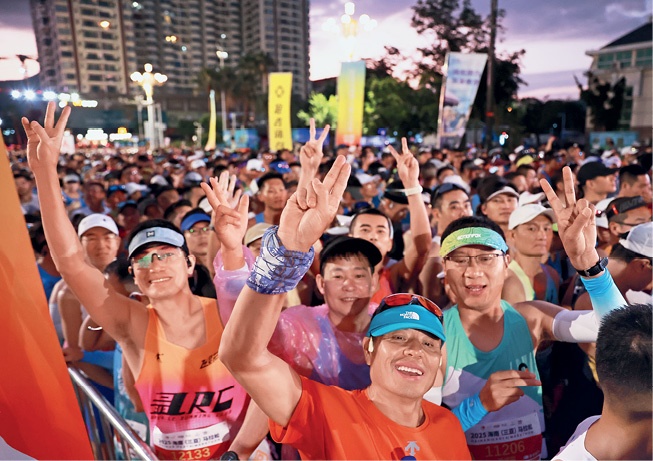
Runners at the 2025 Hainan (Sanya) Marathon take off at the sound of the starting gun fired in Sanya, south China’s Hainan Province, on December 28, 2025.
CICG: For international investors and entrepreneurs still observing and assessing the situation, what is the core message you want to convey?
Feng Fei: As I just mentioned, within less than a month of launching island-wide special customs operations, we have achieved notable results: goods are flowing smoothly, people are moving conveniently and business activity is concentrating. Currently, 22 Fortune Global 500 foreign-invested enterprises have established operations in Hainan. To date, 131 headquarters or regional headquarters have been established here, with investment from 180 countries and regions. Both the total volume and growth rate of foreign direct investment in Hainan rank among the highest nationwide. We genuinely sense that Hainan is becoming a new frontier for China’s opening-up, a new hub for regional mutually beneficial cooperation, and a new engine driving globalization.
The zero-tariff policy has been significantly expanded, now covering 6,637 tariff lines – 74 percent of all lines. The port operates under China’s shortest negative list for foreign investment access and has pioneered the nation’s first negative list for cross-border trade in services. It has introduced 22 special measures to ease market access and taken the lead in opening sectors such as value-added telecommunications, education, health care and legal services to foreign investment.
The foundation for industrial development is solid. Drawing on Hainan’s opening-up policies, natural resources and trends in technological and industrial transformation, we are strengthening, extending and upgrading four leading industries: tourism, modern services, the high-tech sector, and tropical high-efficiency agriculture. We are also developing strategic emerging industries such as seed industry, deep-sea exploration, commercial aerospace, green and low-carbon initiatives, and the digital economy. At the same time, we are cultivating future industries including biomanufacturing, hydrogen energy, brain-computer interfaces and embodied intelligence. The goal is to build a modern industrial system that is advanced, distinctive and well-structured.
The business environment continues to improve. We are accelerating the development of a first-rate business environment that is market-oriented, law-based, and internationalized. Dedicated government agencies have been set up to oversee its daily advancement, ensuring equal treatment and fair competition for both domestic and international investors. We have also established a one-stop international commercial dispute resolution mechanism integrating mediation, arbitration and litigation. Efforts to build a safe and peaceful island are being deepened as well.
We sincerely invite investors from around the world to invest and do business in Hainan. We are committed to providing full support and services to ensure your ventures succeed, you find the talent you need, and your businesses thrive. Let us share in the opportunities of this era as we build an open world economy together. 
ZHANG JUAN is deputy editor-in-chief of China Today.