Located on the northwest tip of Hainan Island, the Yangpu Port is a scene of bustling activity with towering gantry cranes busily loading containers on and off large cargo vessels. Port orders here have surged as a result of a slew of special customs policies that went into force last December.
According to Lin Hongpin, head of the Yangpu Branch of the Hainan Pilot Station, “Now, one out of every two international vessels we pilot is a megaship over 200 meters long.” Since the initiation of new policies for the Hainan Free Trade Port (FTP), the need for piloting such large vessels has risen by nearly 20 percent from the same period last year.
Behind this shift lies Yangpu’s strategic positioning among FTPs as a “pioneer zone” and “model area.” Amid China’s new round of high-standard opening-up, the Yangpu Port is charting a path towards becoming an international hub. To achieve that end, a number of transformative measures, especially the establishment of the Yangpu China ship registry port, have been implemented to accelerate the expansion of global routes and deepen international cooperation.
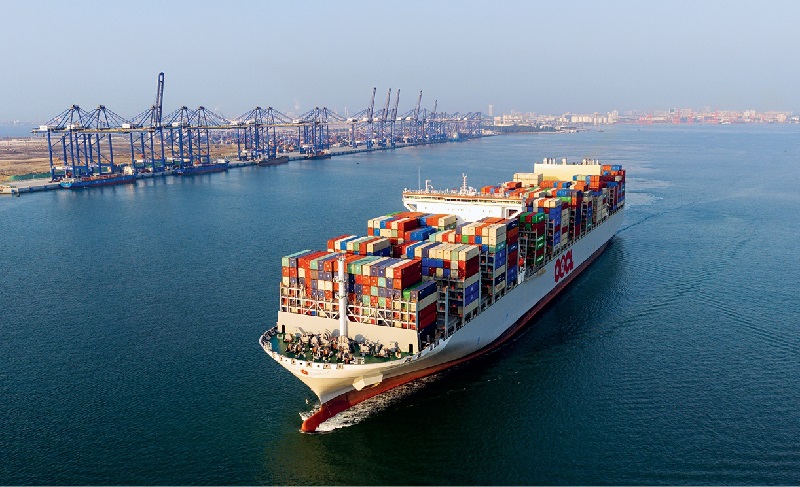
The OOCL Iris, a massive 367- meter-long, 16,828-TEU container ship sails off from the Yangpu Port.
A Century-Old Aspiration
Because of its important geographic location, the Yangpu Port has been playing a significant role in the country’s strategic plans.
Looking back in history, this area has long been regarded with high expectations. During the late Qing Dynasty (1644-1911), the prominent official Zhang Zhidong, proposed the idea of building a port here; later during the Republic of China (1912-1949), Sun Yat-sen envisioned the area as “China’s future major port” in his Plans for National Reconstruction; and in the 1970s, Premier Zhou Enlai also listed it in a national plan for key ports.
Yangpu is endued with many natural advantages. For example, it has Hainan’s finest deep-water shoreline resources and lies just over 20 nautical miles from major international shipping lanes, which makes it an important node linking shipping routes in the Pacific and Indian Ocean. However, despite its advantages, its development was once limited by transport and industrial conditions. When the Yangpu Economic Development Zone was established in 1992, the port had only two 10,000-ton berths and could only handle less than one million tons of cargo annually.
The turning point came with the launching of the Hainan FTP in 2018, which significantly raised Yangpu’s status. “Yangpu” was referred to seven times in the Master Plan for the Construction of the Hainan Free Trade Port, released in 2020, defined as a “pioneer zone” and “demonstration zone,” placing it on a fast track for development.
“Today, if you want to shoot areal footage of the whole port with a drone, it has to fly for nearly three kilometers,” said Deng Xiaolong, a Yangpu TV reporter who has documented the port’s changes since 2016. “In the past, due to limited number of berths, it could only handle container ships of 40,000–50,000 tons. Today, the shoreline extends over a distance of nearly two kilometers, and 150,000- and 200,000-ton container vessels are regular visitors here,” Deng added.
This transformation was evidenced by solid figures. When Su Zhuoyi, director of remote operations at Hainan Harbor & Shipping International Port Co., Ltd., first joined the company in 2018, the terminal had only four gantry cranes and an annual capacity of just 200,000 TEUs. Since then the number of cranes has risen sharply, and in 2025 more than three million TEUs have crossed through the port’s docks. The port is still aiming for higher targets.
Official statistics show that the Yangpu Port handled 85.95 million tons of cargo in 2025, a year-on-year increase of 29.64 percent, and foreign trade cargo topped 42.48 million tons, up 12.82 percent. These rising numbers reflect the growing policy dividends.
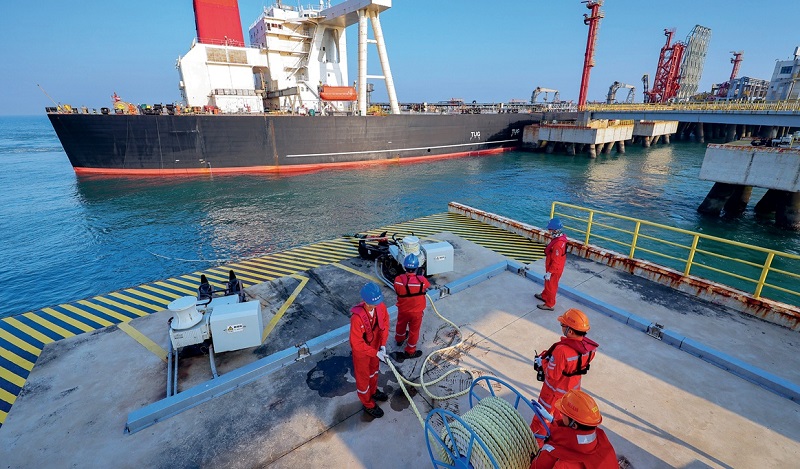
Workers secure a vessel’s mooring ropes to the dock at the Yangpu Port.
Institutional Innovation
The driver of Yangpu’s strong growth is institutional innovation. The most noteworthy policies China has put in place are those concerning the Yangpu China ship registry port.
In June 2020, the Master Plan for the Construction of the Hainan Free Trade Port formally established Yangpu as a new ship registry port. Aligned with international standards, China introduced a series of highly attractive incentives: importing vessels for transportation by enterprises that are registered in the Hainan FTP can enjoy zero tariffs; domestically built vessels registered at the Yangpu Port and engaged in international shipping qualify for export tax rebates; and eligible enterprises and individuals can benefit from preferential corporate income tax and personal income tax rates.
In response to these policies, many shipping companies have been attracted to Hainan. Ge Liqiao, head of the Shipping Development Promotion Division of the Hainan International Shipping Registry, told China Today that her agency launched services such as “one-stop services” and “dedicated officer services,” cutting the amount of required application materials by 60 percent. Its review approval efficiency is comparable to Singapore and Hong Kong. By the end of 2025, 82 international vessels had been registered under the Yangpu Port, with carrying capacity totaling 7.6 million deadweight tons, ranking it the top among China’s free trade zones (ports).
Institutional innovation also extends to other port operations. Sinopec Hainan Refining & Chemical Co., Ltd., for instance, has seen clearance efficiency and capital turnover significantly improved under the region’s newly-initiated delivery and declaration model. “Goods can be shipped out in batches first and then their declaration can be made within a month after that. This one month of extension helps us a lot,” said Song Pengjun, deputy manager of the company’s planning and operations department.
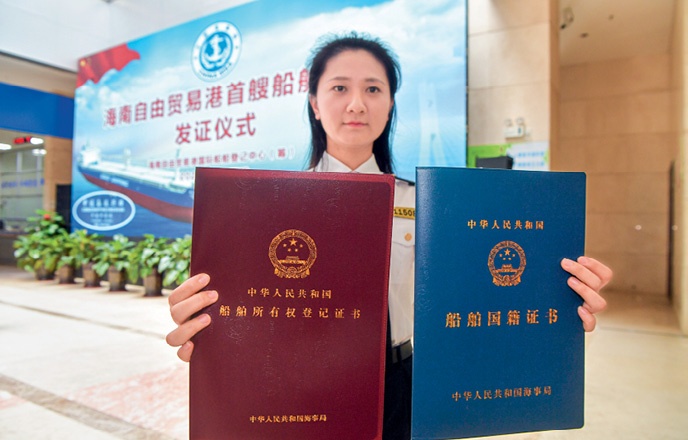
A staff member shows the first Certificate of Vessel’s Nationality issued by the Hainan Maritime Safety Administration and Yangpu Economic Development Zone. It is conferred on the vessel “COSCO Shipping Xing Wang,” making it the first ship registered under “Yangpu China” as its port of registry.
A Global Shipping Network
With advanced infrastructure and supportive policies, the Yangpu Port is making great strides in constructing a global shipping network and building a regional hub of international shipping.
So far, the port has opened up 65 domestic and international routes. Domestic routes cover major coastal ports and connect with the Beibu Gulf and the Guangdong–Hong Kong–Macao Greater Bay Area. Internationally, new direct ocean routes to the west and east coasts of the U.S. and the west coast of South America have filled the gap in Hainan’s intercontinental services. Yangpu has also formed a sister port relationship with Abu Dhabi Port, which strengthens trade ties with the Middle East. Within Asia, a shipping network covering the RCEP (Regional Comprehensive Economic Partnership) region has taken shape.
Yangpu’s rapid development is often compared with the Port of Singapore, but Chen Qi, deputy director of the Danzhou Municipal Commerce Bureau (Yangpu Investment Promotion Bureau), said this is a misunderstanding for the two pursue different development paths and their complementarity outweighs competition. In fact, cooperation between both ports is deepening. Hainan Harbor & Shipping International Port Co., Ltd. has signed a memorandum of understanding with PSA Corporation Limited to enhance cooperation in route expansion and improve operational efficiency for smoother China-ASEAN trade.
The Yangpu Port’s phenomenal transformation reflects China’s expanding openness in the new era and showcases the fruitful achievements of the Hainan FTP. As the island-wide special customs operation is in full swing, the deep-water harbor is now brimming with vitality, speeding towards the goal of becoming a world-class shipping hub.