Preferential policies, efficient government, and a favorable geographical location … a multitude of factors make the Hainan FTP a promising land for businesses.
Soon after the Hainan Free Trade Port (FTP) launched special customs operations at the end of 2025, private enterprises operating at its Yangpu Port began to benefit substantially from the favorable policies and surging growth momentum in the region. While riding on an ocean of opportunities opened by the FTP, local businesses are bringing the island to a new level of prosperity, and thriving together with it as a community of shared future.
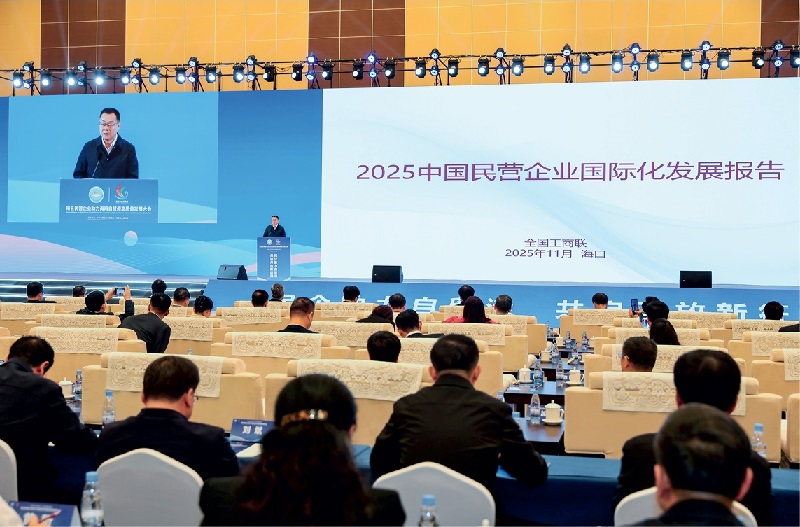
Representatives from over 700 leading private businesses attend a conference aimed to motivate the private sector to pursue high-quality development at the Hainan FTP on November 28, 2025. The 2025 Report on the Internationalized Development of China’s Private Businesses was released at the event.
Government Support
At the factory of Zhong’ao Soup Industry (Hainan) Technology Co., Ltd., a highly automated broth production line is operating at high efficiency. Around it lie a neat array of stainless steel tanks and pipelines for different functions. The company specializes in the research, development, and production of bone soup ingredients. On November 28, 2025, its first-phase project went into operation in the bonded area of Hainan’s Yangpu Port.
“In the Hainan FTP, especially in Yangpu, government departments operate with high efficiency and reach out to enterprises to provide all necessary services. The government has established a dedicated task force and created a WeChat chat group for directly communicating with enterprises. Any request that an enterprise might have, the enterprise can simply raise it in the group, and the secretary-general will then coordinate relevant authorities to work on it. When necessary, the Party secretary will personally look into the issue. Such an approach was almost unimaginable in my past experience,” said Yu Lianfu, chairman of Zhong’ao Soup Industry. Since starting operation in Yangpu in 2022, Yu has been deeply impressed by the efficient services of the port authorities.
When a comprehensive plan for developing the Hainan FTP was released in June 2020, Yu, with more than 20 years of experience in bone broth business, immediately sensed new growth opportunities that this FTP would unlock for enterprises like his.
“Back then, there weren’t any McDonald’s or Starbucks around here, and it was even hard to get a taxi,” Yu recalled his first visit to Yangpu. Today, the area is bustling with hotels, office buildings, and other facilities built along wide roads, vastly contrasting the desolate scenes of five years ago.
Another early bird among private businesses in the FTP is Hainan Ausca International Oils and Grains Co., Ltd. Its chairperson Zhang Hui also became interested in the FTP when news of its opening up came out. Not long after, a business promotion team from Yangpu reached out to her in Guangxi, some 500 km away from Hainan. “I think it was fate that brought me to Hainan,” Zhang said with a smile.
In August 2020, Ausca launched a RMB 3.5 billion investment in Yangpu, producing rapeseed and soybean oil. Within only six and a half months, the project with two production lines began operating, exemplifying the rapid speed at which things happen in Yangpu. Zhang attributes this industry-leading pace to the high efficiency of the local government. “Government departments proactively tracked the progress on issues such as application processing, registration, and utility connections, providing efficient services in all areas,” she explained.
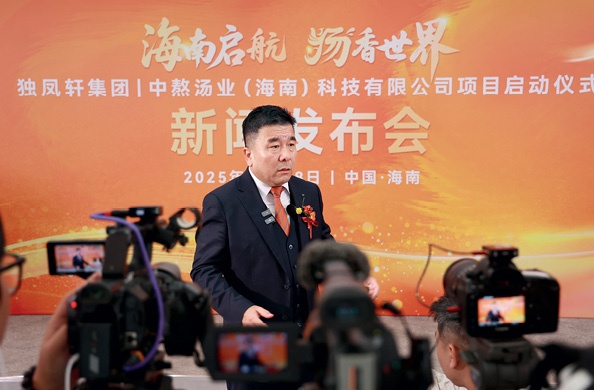
Yu Lianfu, chairman of Zhong’ao Soup Industry, takes questions from reporters.
Exploration and Innovation
As a major institutional innovation in China’s high-standard opening-up, the Hainan FTP has made great efforts to realize high efficiency during exploration, making revisions when needed during implementation. This is a path for the port and local enterprises to explore and grow together.
“Our company was one of several that participated in stress testing before the official launch of island-wide special customs procedures,” said Zhang. During this testing process, participating enterprises became the first to benefit from favorable policies; meanwhile they were asked to identify and report any glitches that might arise in their operations. “We concluded several ‘first-of-its-kind’ transactions, with almost no precedents to refer to,” she recalled.
For instance, the customs system initially struggled in dealing with complex business models, which caused recurring problems for Ausca during the customs procedures. By working closely with relevant government departments, the company helped optimize the system’s design and workflow.
Zhong’ao Soup Industry had a similar experience. “We also submitted a proposal to Yangpu’s authorities regarding policies for the bone processing industry,” said Yu Lianfu. “Policy formulation is an ongoing process that continuously incorporates feedback from enterprises.”
This government-business collaboration is mutually beneficial. “For every metric ton of imported bones, we save 12 percent in tariffs and nine percent in value-added tax,” Yu explained. The company imports more than RMB one billion worth of raw materials annually, meaning it can save RMB 100 million or more in costs.
Import duties are also exempted for goods meeting certain conditions that are processed in the Hainan FTP and whose value increases as a result. This provides strong support for regional enterprises in expanding on the domestic market. Data shows that this policy alone has saved Ausca approximately RMB 300 million in tariffs. Furthermore, both Ausca and Zhong’ao along with their staff are eligible for preferential treatment given to corporate and individual income taxes, at a reduced rate of 15 percent for the former and a maximum rate of 15 percent for the latter. This further reduces the company’s overall operating costs and heightens its appeal to high-end talents from across China and the rest of the world.
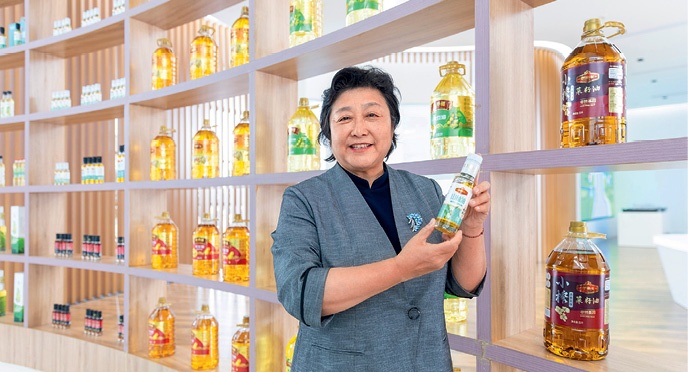
Zhang Hui, chairperson of Hainan Ausca International Oils and Grains Co., Ltd.
Reaching Outward
Under the drastically shifting international trade environment in 2025, a shipment of Ausca faced the risk of having to pay a big sum of security deposits on its imported raw materials. With the help of the municipal government of Danzhou (which administers Yangpu), the company quickly adopted a “both ends reaching outward” business model – sourcing raw materials and selling finished products overseas, hence shifting its focus to the international market. “What makes Hainan exceptional is that its government is responsible and proactive. This is something that truly impresses us,” Zhang said.
On August 7, 2025, Ausca’s first batch of 5,000 tons of soybean oil left Yangpu Port for India. “The contract was signed on July 31, and just seven days later, the cargo was loaded up and shipped out. This wasn’t something our company could have achieved ourselves. It was the result of coordination between the government, customs authorities, COSCO Shipping, and other parties,” Zhang reflected with emotion.
Previously, Ausca primarily focused on the domestic market. By transitioning to the new business model, it has found strong demand for its products in neighboring countries and regions. Today, it is exporting products to a dozen countries and regions around the world, including Japan, the Republic of Korea, and Singapore, with an export volume for last year that reached 97,800 tons, and its foreign trade value amounted to US $825 million.
As of the end of 2025, Hainan had expanded the visa-free policy to citizens from 86 countries, strengthening the ties between peoples and businesses worldwide. “Now, many international companies, including our suppliers and partners, can travel to Hainan with greater ease,” Zhang noted. Zhong’ao Soup Industry is also receiving more visiting clients, many of whom, as far as from Australia and North America, have shown interest in cooperation. It is now making plans to leverage its geographical advantages to develop the Southeast Asian market.
The strong growth potential has bolstered Yu Lianfu’s confidence in the company’s future. Within less than two months after the inauguration of the first phase project, Zhong’ao Soup Industry had started to make plans for its second-phase factory and new cold storage facilities.
Looking ahead, Yu has an even bigger vision: “We hope to bring together related enterprises to create an industrial cluster for the deep processing of bones and meat.”
“The FTP is a platform where domestic and international markets intersect, and businesses can find vast room for growth both domestically and internationally,” Zhang observed. During the next five years, Ausca looks forward to increasing its annual output value from RMB 10 billion to RMB 20–25 billion.
Zhang, who started her career in 1980, had planned to shift her focus gradually from work to life before she came to Hainan. But now, she plans to work here for another 20 years and grow together with the FTP. 
LI JIAQI is a reporter with People's China magazine.