Siemens Energy, one of the world’s leading energy technology companies, became the first foreign-funded manufacturer to establish a branch and began construction of a gas turbine assembly base and service center in Hainan on December 18, 2025.
The historic event took place on the first day of the Hainan Free Trade Port (FTP)’s island-wide special customs operations at the Yangpu Economic Development Zone in Danzhou City, northwest Hainan.
Approximately eight kilometers away, two Siemens V94.2 gas turbines, which had supplied power to Hainan for 30 years, were decommissioned as planned a month earlier.
Behind this tale of gas turbines lies a three-decade-long journey of industrial upgrading and opening-up. German giant Siemens has evolved progressively from an operation and maintenance service provider to a local smart manufacturer. Meanwhile, Yangpu has transitioned from being a testing ground that relied on large-scale development to a platform for high-standard opening-up in the Hainan FTP. The two have witnessed each other’s transformation.
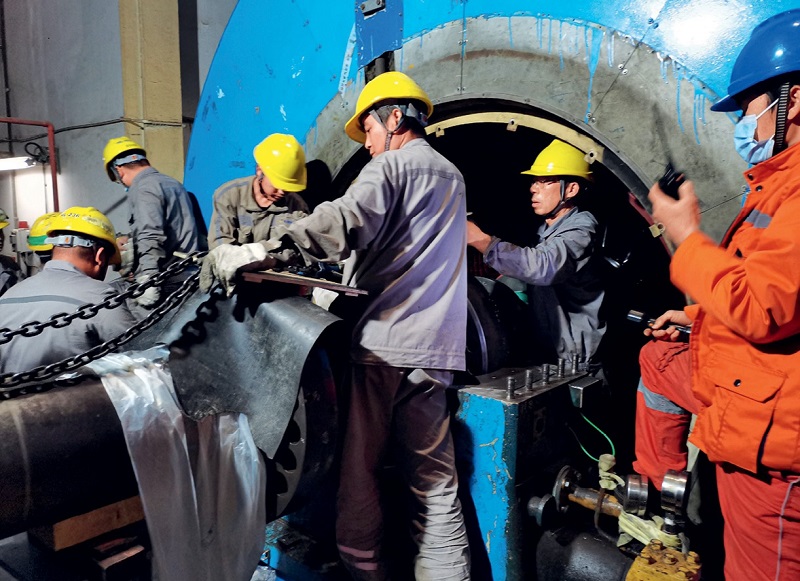
During the 2023 Spring Festival holiday, workers at the Yangpu Power Plant perform rotor reinstallation after successfully addressing a rotor ground fault in a Siemens gas turbine in 2025.
Power Plant Transformation
The Yangpu Economic Development Zone was officially established in 1992, becoming China’s first national-level economic and technological development zone developed by foreign investors in a contiguous area and enjoying the benefits of bonded zone policies.
The following year, the Yangpu Power Plant was registered as a Hong Kong-funded company. Facing Hainan’s weak power infrastructure and urgent energy needs at the time, the plant decided to import two Siemens V94.2 gas turbine combined cycle units to alleviate the electricity shortage constraining local development.
“These were the most advanced gas turbines introduced into China at the time, and also the gas turbine units with the largest installed capacity,” said Hu Cheng, the power plant’s chief engineer.
In 1994, while working in Liaoning Province 3,000 km away, Hu learned that the Yangpu Power Plant had imported these turbines and headed south to study them. He arrived in Yangpu, which was then still a small fishing village. “At the time, I just wanted to learn more about it [the turbines],” he said.
As a technical specialist and translator, Hu subsequently became involved in the entire process of the units’ installation, operation, and maintenance in the decades that followed. In retrospect, he said that Siemens Energy’s maintenance team provided professional and reliable support, with meticulous planning and precise schedule control for each overhaul. Whether for the installation and commissioning or subsequent major overhauls, the German technical team would always arrive punctually at the Yangpu Power Plant to provide on-site support.
For a long period of time, maintenance of the units was led by the German team. To master the core technologies and handle unexpected failures, Hu learned from German engineers on the job, observing every installation detail and recording various parameters, while also immersing himself in self-study, working through thousands of pages of English technical manuals and control programs.
Building on this solid foundation, he led his team through arduous tasks such as major overhauls in the nearly 50°C heat in engine rooms, and emergency power supply during typhoon season. He also spearheaded a series of important technical upgrades, including the conversion from oil to gas and modifications to the low-nitrogen combustion system.
The steady improvement in technical capabilities gave the Chinese side a stronger position in bilateral cooperation. In 2016, the two parties signed a more flexible and selective 10-year service agreement, replacing the previous all-inclusive model. This shift not only brought a supply of more specific spare parts but also made maintenance service response and execution more efficient.
Over three decades, these two units, with a total installed capacity of 440 megawatts, cumulatively generated over 28.4 billion kilowatt-hours of electricity. They underwent seven major overhauls and two significant upgrades, yet maintained stable operation throughout. At their peak, they bore approximately 40 percent of Hainan grid’s peak-shaving load, becoming central to the safe and stable operation of Hainan’s power grid.
With the establishment of more power enterprises in the Yangpu area and the vigorous development of clean energy sources like wind and solar power, the role of these two turbines, once hailed as the “energy heart” of Yangpu, gradually diminished. In October 2025, after reaching their designed service life limit, the two units were shut down as planned.
“It’s like seeing off an old friend who has completed his mission. There’s reluctance, but more than that, pride – in 30 years, these two turbines never once failed us or caused any trouble for the Hainan power grid,” Hu recalled. The years he spent with the units witnessed not only his personal experience of Yangpu’s transition from struggling with power shortage to owning an optimized energy structure, but also the transformation of the land itself from a barren stretch to a modern industrial zone.
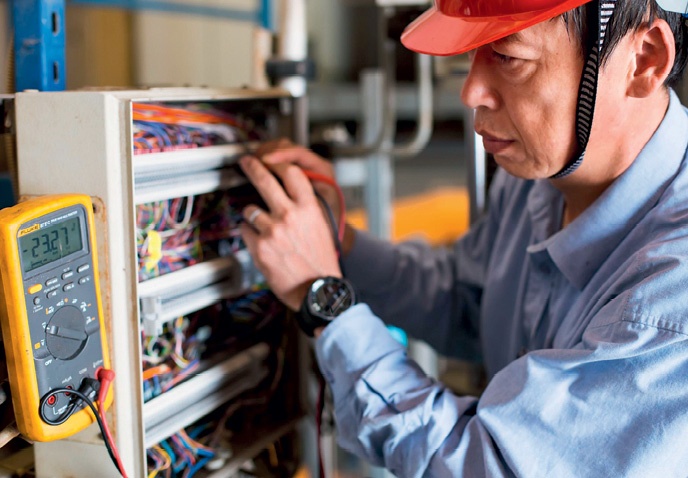
Hu Cheng measures the field feedback signals of the Siemens gas turbine control system.
From Supplier to Co-Builder
In 2020, the Master Plan for the Construction of the Hainan Free Trade Port was released, designating Yangpu as a pilot and demonstration zone for the FTP’s development. Yangpu took the lead in implementing a “freer access at the first line, regulated access at the second line” system. The former means treating the border between the Hainan FTP and all other countries and regions outside China’s customs territory as the first line, and implementing a series of free and convenient entry-exit measures. The latter means treating the border between the FTP and China’s mainland as the second line, and applying precision management on items enjoying free access at the first line. This bringing new opportunities for the area to explore institutional opening-up.
Siemens Energy was aligning its global strategy with comprehensive localization under the principle of “in China, for China, and for the world.” This direction happened to align with Hainan’s goal of building a “clean energy island” and China’s “dual carbon” commitments. Yangpu’s planning in the field of intelligent equipment manufacturing caught the attention of Siemens Energy’s executives, leading to renewed discussions. However, initially, cooperation was confined to a “look and see” approach.
“A heavy-duty gas turbine involves tens of thousands of components, and at that time, not a single component could be locally produced in Hainan. The first questions that popped up were: how to guarantee the supply chain? Could the overall cost be higher?” said Li Rui, deputy general manager of the Energy Development Department at Yangpu International.
Hainan’s weak industrial foundation in high-end manufacturing at the time was the biggest obstacle to project implementation. What ultimately dispelled the company’s concerns were Hainan’s continuously improving business environment and the tangible policy dividends brought by the island-wide special customs operations.
This included the shortest negative list for foreign investment access in China, China’s first negative list for cross-border trade in services, significantly relaxed market access restrictions, zero tariffs, preferential enterprise income tax, and establishment of the Yangpu China ship registry port. With the implementation of policies facilitating customs clearance, trade, and investment liberalization and facilitation, Hainan is creating an efficient, stable, and transparent development environment for global high-end manufacturing.
On the first day of the speical island-wide customs operations on December 18, 2025, Lars Voelker, general manager of Siemens Energy (Hainan), personally experienced how quick the process actually is.
He successfully obtained the business license for the company at the Yangpu government service hall – the process from application submission to license printing took just one working day.
The Siemens Energy gas turbine assembly base and service center is the first foreign-funded manufacturing project in the Hainan FTP following commencement of the island-wide special customs operations. The base covers nearly 2.7 hectares of land, with a total built area of over 13,000 square meters. It is scheduled to be completed and operational by 2027, by which time it aims to achieve localized production of gas turbines in Hainan.
This is not merely a production base but a comprehensive platform integrating high-end manufacturing, technological research, development and innovation, and offshore services.
The base will primarily serve markets in Hainan and Southeast Asia, engaging in gas-fired power generation, offshore wind power, and green hydrogen energy. “This marks a brand new chapter in our cooperation,” said Joern Schmuecker, senior vice president of Siemens Energy. He said that this project aligns with the Hainan FTP’s goal of building a new hub for a high-level open economy. The company will contribute to building a high-end industrial ecosystem and promote energy transition in China and globally.
“From the operation of the first Siemens Energy unit, to deepening service cooperation, and now to the landing of the gas turbine assembly base and service center, I have witnessed Siemens Energy’s transition from a ‘maintenance provider’ to a ‘co-builder,’ and I’ve personally experienced Yangpu’s leap into an industrial cluster,” said Hu.
He noted that this project will not only help foster an advanced industrial ecosystem in Yangpu but also accelerate technological exchange and industrial upgrading in Hainan’s energy sector.
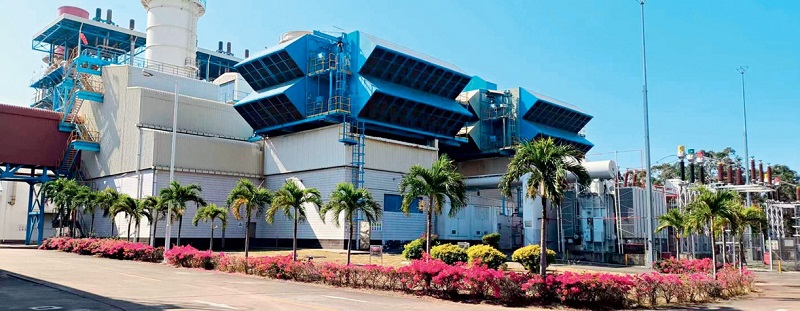
A corner of the Yangpu Power Plant.
More Industries and More Talent
Launching a project is just the beginning. The long-term foundation for development lies in talent and fostering a complete, strong industrial chain.
The arrival of Siemens Energy in Yangpu has attracted the attention of a number of upstream supporting enterprises – such as KOCEL, Anhui Yingliu Group, and Shenyang Instrument Transformer. A precision manufacturing ecosystem centered on high-end gas turbines is now taking shape.
As the first overseas university officially approved to operate independently in China, Hainan, Bielefeld University of Applied Sciences has also made its home in Yangpu, and is set to welcome its first graduating cohort next year. Its practice-oriented education model is closely aligned with the industrial needs of the Hainan FTP, aiming to provide application-oriented expertise to enterprises.
Amid this three-decade-long industrial transformation in Hainan, Hu has also undergone his own professional evolution. Starting as a front-line engineer, he grew into a technical expert and national model worker, and has now shifted his focus to talent development.
At the training base established within the repurposed Yangpu Power Plant, Hu leads an innovation studio where he guides employees in overcoming technical bottlenecks, building capabilities in new energy and equipment adaptation, and preparing skilled individuals for the energy sector’s future.
“We aim to make our technical backbone the core force supporting the development of clean energy,” said Hu. “Just like those two veteran power units: reliable, responsible, and deeply rooted in this land.”