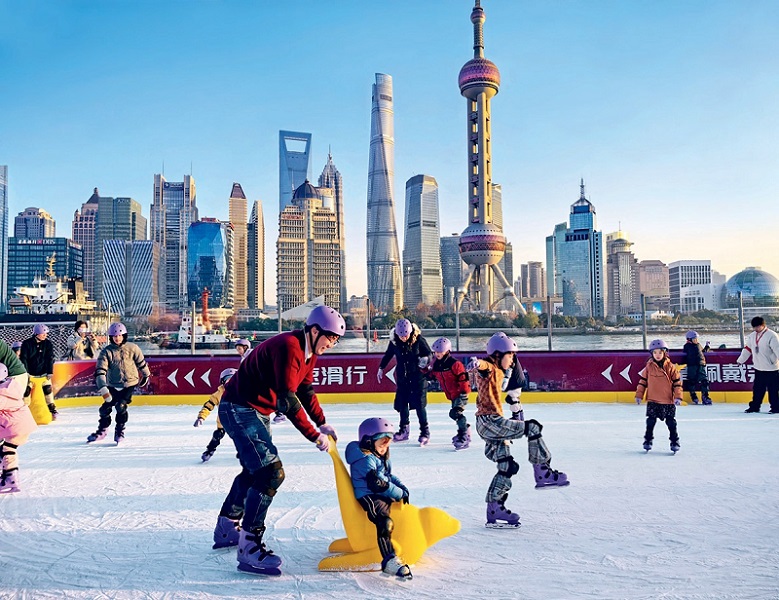
A skating rink that has been transformed from a ship deck at the North Bund in Shanghai is crowded with local residents on January 3, 2026.
China's ice and snow economy, riding on the winter sports boom, is stimulating consumption across the country, fueling regional development and creating new industrial ecosystems.
This trend perfectly matches one of China’s key tasks for 2026, namely “developing an economy led by domestic demand and building a robust domestic market” set at the annual Central Economic Work Conference, held in December 2025.
Thomas Bach, honorary president for life of the International Olympic Committee, had predicted drastic changes in winter sports in China around the time of the Beijing 2022 Winter Olympics. He noted that the over 300 million people in China participating in ice and snow activities opens a new dimension for world winter sports — a growth in public participation and infrastructure in the country that will in turn continue to drive the development of winter sports.
The Research Report on China’s Winter Industry Development of 2025, officially released at the 2025 International Winter Sports Fair’s main forum in Beijing last October, shows that China’s ice and snow industry was projected to exceed RMB 1 trillion in 2025. For the 2024-2025 snow season, total consumption surpassed RMB 187.5 billion, with the spending at ski resorts alone reaching RMB 78.6 billion.
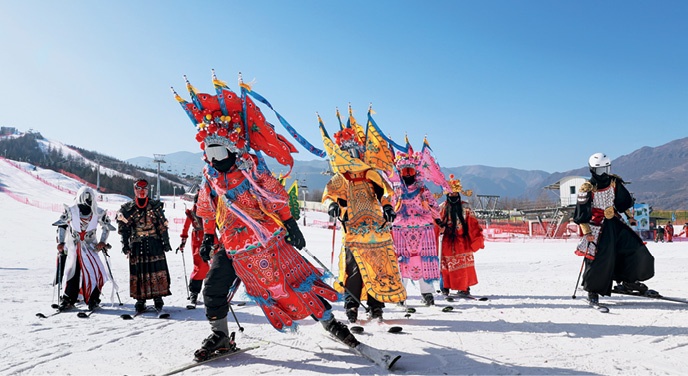
A group of skiers dressed up in Peking Opera costumes at Songmingyan International Ski Resort in Linxia Hui Autonomous Prefecture, Gansu Province, on December 16, 2025.
Increasing Incomes
Lang En’ge runs a homestay business at the foot of the Xiaohaituo Mountain in Yanqing District in northwest Beijing. In his free time, he often climbs to the top of the mountain to look at the National Alpine Ski Center in the distance, a legacy from the Beijing Winter Olympics. In 2017, during preparations for the Games, he founded the Yanqing Haituo Farmers’ Ski Team with over a dozen fellow villagers and served as team captain. He later became a torchbearer and volunteer for the Games.
The Beijing Winter Olympics catapulted the Yanqing suburban district, one of the three competition zones of the Games, into prominence. With the sharp increase in the number of visitors to the region, many farmers including Zhang have converted their homes into hotels.
“Some of my guests come to Yanqing to ski, and I enjoy chatting with them. If there’s an opportunity, I’d like to reestablish the farmers’ ski team and set up a skiers’ lodge at the foot of the Xiaohaituo Mountain. It will serve as a platform for skiers to connect, retain tourists, and stimulate the development of catering and cultural tourism industries in surrounding regions,” Lang said.
Some 200 kilometers away in Chongli District of Zhangjiakou City in Hebei Province, another site of the Beijing Winter Olympics, photojournalist Wu Diansen has been recording snow seasons each year through his lens.
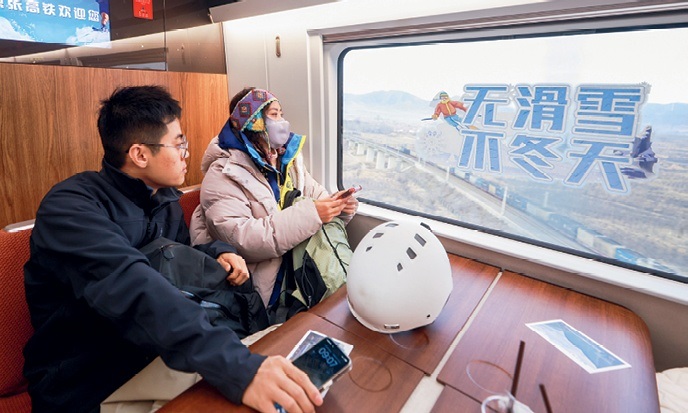
The Beijing-Zhangjiakou High-Speed Railway has greatly stimulated the ice and snow economy in the regions it connects, with an occupancy rate of around 98 percent during winter months.
During the 2022 Games, he served as assistant photography manager at the Genting Snow Park, witnessing the ice and snow miracle unfurling in this small town.
“In my frames, Chongli transformed from a rural town with just one major street lined with small, single-story houses into an internationalized district strewed with modern skyscrapers. That feeling is truly marvelous,” Wu recalled. What impressed him most is the site of the Beijing Winter Olympic Village and National Ski Jumping Center, formerly a poor, desolate mountainous hamlet dotted with earthen houses, now a cluster of glittering modern facilities.
The change goes beyond infrastructure. “You can see it from the many locals who run restaurants, ski shops, and work in other sectors of the ice and snow industry: everyone has become more confident. They have become better informed and more articulate,” said Wu. His camera has documented both the development of a city and the transformation of its people.
The stories of Lang and Wu are only two examples of the changes and opportunities that winter sports have brought to many regions across the country. In northeast China, villagers living near ski resorts have become snowmaking engineers, instructors, or homestay operators. In northwest China’s Xinjiang Uygur Autonomous Region, ancient fur skiing (using wooden skis covered in horsehide) is a new attraction for tourists, providing local herders with additional sources of income. The ice and snow industry has opened up diverse channels for creating employment and building wealth.
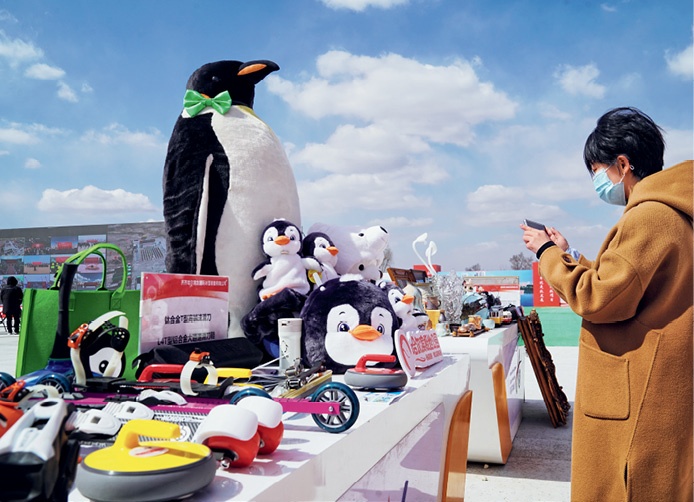
A T-shaped speed skate made of titanium alloy is among the high-tech products displayed at an event highlighting high-quality development projects in Harbin, Heilongjiang Province, on April 7, 2023.

Nationwide and Year-Round
After the Beijing Winter Olympics, China’s ice and snow economy has expanded from its traditional strongholds in the colder northeastern and northern provinces to the entire nation, with each area having developed its distinct features.
In the north, which is endowed with rich winter resources, the industry has shifted its focus from scale expansion to quality improvement and the integration of new business forms. For example, Harbin City set the record of receiving 90.36 million visits and earning RMB 137.22 billion in tourism revenue during the 2024-2025 winter. This success was driven by its promotion of ice and snow art, a deep fusion of Russian culture with northeast China’s customs, and attentive services.
With technological advances and the strong passion for winter games, the ice and snow economy has transcended geographical and seasonal constraints. Even in the snowless south, people can now enjoy the pleasure of winter sports.
A report on the ice and snow consumption market by the Winter Sports Management Center of the General Administration of Sport of China shows that as of April 2025, there were 79 indoor ski centers (using real snow) across China, an increase of 33.9 percent from the previous winter. These centers are concentrated in east and south China, with 24 in Zhejiang, Jiangsu, and Guangdong provinces, which account for 30.38 percent of the national total. Hubei in central China and Guizhou in southwest China also have a significant number of ski resorts.
These venues located in metropolitan areas or their suburbs almost operate throughout the year, satisfying the needs of ski enthusiasts in the south. Meanwhile, new-tech products like ski simulators and dry ski slopes have entered residential communities, shopping malls, and school campuses, making the sport a part of the daily life of the general public.
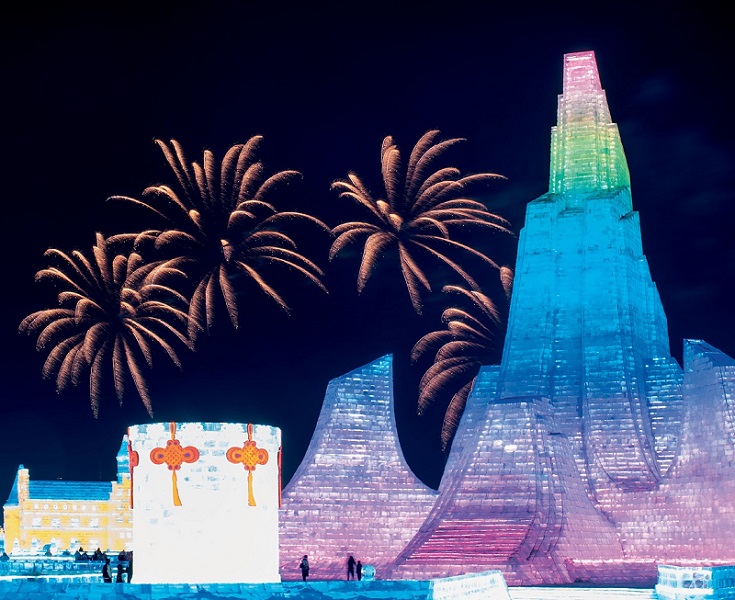
The 42nd China • Harbin International Ice and Snow Festival opens in the capital of Heilongjiang Province on January 5, 2026.
A Gigantic Industry
During the 2024-2025 winter, 292 million Chinese participated in ice and snow sports, an increase of 27.44 million compared with the previous winter. Public enthusiasm has given rise to a complete industrial chain of ice and snow sports that encompasses equipment manufacturing, event operation, training services, and culture-tourism integration, with great potential for growth.
Data from Xiaohongshu, or Red Note, a Chinese social networking and e-commerce platform, shows the diversity of Chinese skiers, from beginners who rent equipment, to enthusiasts who prefer personalized skis, and to professionals who buy top-tier gear. They are mostly young people, often ski with their families, and are more fashion-conscious. Against this trend, a huge consumer market is taking shape, with greater focus on the aesthetic appeal, technological performance, and customization of equipment, while attending to the needs of customers at different levels.
The strong demand is driving innovation on the supply side. Data from the Ministry of Industry and Information Technology shows that China has established 15 major categories of ice and snow equipment, the number of enterprises engaged in relevant fields grew from about 300 in 2015 to around 900 in 2023, and their sales revenue soared from below RMB 5 billion to approximately RMB 22 billion over this period.
Domestic brands are on the rise, gaining competitiveness for their Chinese design elements, customization for Asian body types, and adoption of smart wearable technology. Chinese manufacturers have made breakthroughs in carbon fiber skis, indoor ski simulators, and ski waxing vehicles, moving the ice and snow industry further toward intelligent manufacturing.
What makes winter sports a trillion yuan industry? Individual consumers, regional governments, and businesses all play an intrinsic part. 
The Chinese edition of this article was published on the overseas edition of the People’s Daily on December 19, 2025.
GAO MENG, LI CHUNYU, and YANG FAN are reporters with Xinhua News Agency.