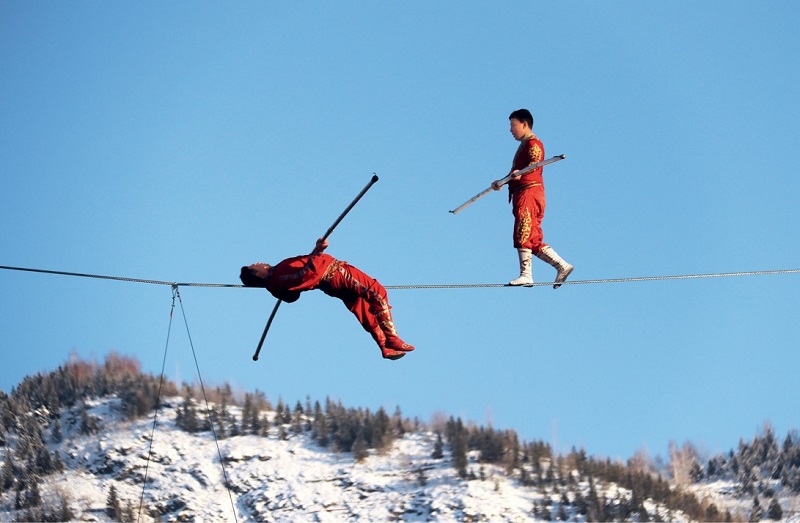
Two acrobat artists perform Dawazi acts at a cultural park in Altay Prefecture, northwest China’s Xinjiang Uygur Autonomous Region.
Uygur Dawazi (Davaz) is a traditional acrobatic art form of the Uygur people, a Chinese ethnic group from Xinjiang Uygur Autonomous Region in northwestern China. The word “dawazi” means “high-wire walking” in the Uygur language, and the art has been maintained for over a thousand years, preserving the ancient characteristics of the performance style. In 2006, Uygur Dawazi was included in China’s first national list of intangible cultural heritage.
Dawazi performances are usually conducted in the open air. During each performance, artists execute a variety of highly difficult movements on ropes or steel wires suspended dozens of meters above the ground, such as sitting down, lying down, blindfolded walking, plate-spinning, and jumping. Through the whole performance, Dawazi artists do not wear any type of safety harness, only rely on a balancing pole about six meters long. Accompanied by traditional Uygur folk music, performers sing and dance to the rhythm while performing challenging acts on the wire. Due to its high level of difficulty, Dawazi requires great courage and perseverance. Performers typically begin training at a young age and need at least six years of practice before they are allowed to perform on stage.
Adili Wuxor is one of the most influential contemporary Dawazi artists. Born into a Dawazi family who has practiced and passed down the art for over 400 years, he is the sixth-generation inheritor of this tradition. Adili and the Dawazi Art Troupe he founded are well-known across China. His performance in locations such as the Great Wall, Zhangjiajie National Forest Park, and China’s National Stadium, awed numerous audiences watching on site or through broadcast.
To better preserve this age-old art, Adili established the “Adili Dawazi Art Inheritance Center” in 2011 in Yengisar County, Xinjiang, where more than 50 students have been trained. In addition to preserving family traditions, the troupe continues to keep this traditional art alive by incorporating modern elements into it and promoting the art through various channels.