In the global endeavor towards carbon neutrality and sustainable development, biomanufacturing is transitioning from a frontier concept to an industrial mainstream. In the process, it is becoming a key force in reshaping material systems, driving industrial transformation, and cultivating new quality productive forces.
As a major component of China’s national strategic emerging industries, biomanufacturing, with synthetic biology as its foundation, renewable biomass as its raw material, and microbial cell factories as its carrier, is disrupting traditional petrochemical routes and opening a new path of industrialization that is green, low-carbon, circular, and safe.
At the parallel forum of the 2026 Zhongguancun (ZGC) Forum Annual Conference, titled “Bio-Manufactured New Materials Industry Application Innovation Conference”, experts from around the world reached a consensus: biomanufacturing is no longer a choice for the future, but an emerging force of the present; it is also no longer the breakthrough of a single technology, but a systemic revolution that spans the entire industry chain.
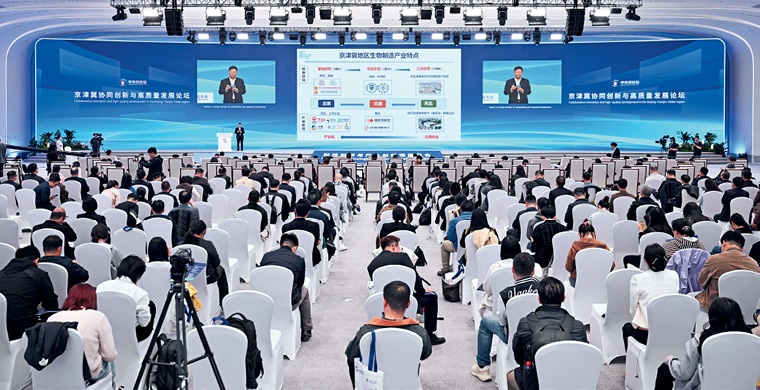
A sub-forum themed “The Collaborative Innovation and High-quality Development in the Beijing-Tianjin-Hebei Region” of 2026 ZGC Forum Annual Conference is held in Beijing, on March 27, 2026.
A Foundation for Future Industries
China has incorporated biomanufacturing into the key directions of future industries in its planning. From top-level design to local implementation, from technological breakthroughs to scenario applications, and from policy support to ecosystem construction, a comprehensive chain-driven advancement pattern has been established.
The 15th Five-Year Plan (2026-2030) outlines a clear directive to strategically plan for future industries and promote quantum technology, biomanufacturing, hydrogen energy, and nuclear fusion energy as new economic growth drivers. It is a strategic initiative that makes biomanufacturing central to national industrial development, endowing it with the historical mission of driving economic transformation and cultivating new quality productive forces, while also providing Chinese solutions for global green transformation.
As a national scientific and technological innovation hub, Beijing regards biomanufacturing as the focal point of the future industry and the key for cultivating strategic green industries. Its advantages of abundant universities and research institutes, innovation resource agglomeration, and rich application scenarios will be relied on to form a development pattern of basic research, pilot platforms, and demonstration scenarios.
According to Jiang Guangzhi, head of the Beijing Municipal Bureau of Economy and Information Technology, the capital is expediting the cultivation and layout of a number of biomanufacturing pilot production lines, to transform innovative achievements into new quality productive forces. A biomanufacturing innovation competition will also be held to gather global innovation forces, advace biomanufacturing from a single point breakthrough to cluster leadership, promote innovation, agglomeration, demonstration leadership and regional radiation, and hasten the construction of a future industrial growth matrix.
Under the guidance of the national strategy and the resonance of local pragmatic promotion, biomanufacturing is becoming an important support mechanism for cultivating new quality productive forces and building a modern industrial system.
Intelligent Manufacturing Chain
From laboratories to production lines, from technological breakthroughs to industrial booms, the core value of biomanufacturing lies in reconstructing the materials industry through life sciences. Bio-based degradable materials, represented by polyhydroxyalkanoates (PHA), are the landmark achievements of this transformation.
Unlike traditional petroleum-based plastics, PHA is produced through microbial fermentation, can fully degrade in natural environments such as soil and oceans, eliminating microplastic pollution at the source. In addition, it has excellent mechanical properties, processability, and biocompatibility, making it advantageous for us in fields such as packaging, textiles, medical applications, 3D printing, and agriculture.
After years of technological breakthroughs, China has achieved full-chain advancements from strain modification and process optimization to 10,000-ton production and multi-scenario applications, establishing a leading position in the global bio-based new materials sector.
According to Chen Guoqiang, a professor at the School of Life Sciences, Tsinghua University, PHA possesses an extremely rich combination of properties, capable of meeting the material needs of numerous industries. Through halophilic microbial technology, seawater fermentation, non-sterilized production, and low-cost mass production are achieved. The result is a major reduction in freshwater consumption and energy use, endowing PHA with the industrial competitiveness to replace petroleum-based materials on a large scale.
As disruptive technology, it not only aligns with the requirements of green development but also fundamentally resolves the conflict between material development and environmental protection, providing a feasible path for the large-scale implementation of bio-based materials worldwide.
In terms of industrial implementation, China has established a globally leading 10,000-ton PHA production line, forming a multi-category, high-performance and low-cost matrix materials. Its products range from high-end medical consumables to everyday packaging materials, from textile fibers to agricultural mulch films, achieving a leap from laboratory samples to market commodities.
According to Xu Xuanming, chairman of PhaBuilder, the company is empowering biomanufacturing with AI, driving full-process optimization of strain design, fermentation control, and material modification to reduce costs and expand applications, thus enabling the adoption of bio-based materials in households.
At present, China has joined the first tier of the global PHA industry, with its industry chain integrity, technological maturity, and market penetration rate all ranking high in world ratings.
However, the value of biomanufacturing goes far beyond material substitution; it lies more in reconstructing the industrial ecology and reshaping the global value chain. Traditional material industries are highly dependent on fossil resources such as oil and coal, with long industrial chains, numerous links, high carbon emissions, significant pollution risks, and vulnerability to international energy prices and geopolitical conflicts.
By using renewable biomass such as straw, kitchen waste, and industrial by-products as raw materials, biomanufacturing can turn waste into treasure. It establishes a new industrial system characterized by diversified raw materials, low-carbon production, green products, and closed-loop recycling, fundamentally enhancing the resilience and security of the industrial and supply chains.
On the application side, bio-based materials are rapidly penetrating key sectors of the national economy, becoming essential materials for green transformation. In the field of food packaging, for example, biodegradable materials are replacing traditional plastics, addressing the challenge of managing white pollution. Bio-based fibers offer properties such as antibacterial, deodorizing, and skin-friendly in the textile sector, opening up a new high-end green textile track. In the medical field, biocompatible materials are used in implantable devices and drug carriers, reducing rejection reactions and improving therapeutic outcomes. And, in agriculture, fully degradable mulch films solve the persistent problem of mulch residue, protecting arable land quality and food security.
Mengniu Dairy, in collaboration with Tsinghua University and PhaBuilder, has launched the world’s first commercialized harmless PHA biodegradable straw, achieving marine degradation, safety and positive user experience, becoming a typical example of how biomanufacturing technology serves daily consumer needs.
According to Li Hongliang, assistant vice president of Mengniu, the widespread application of bio-based materials requires coordinated efforts across the industry chain, policy support, and consumer education. Chinese companies are actively promoting green transformation through concrete actions, integrating the concept of sustainability into everyday consumption and bringing it into households across the country.
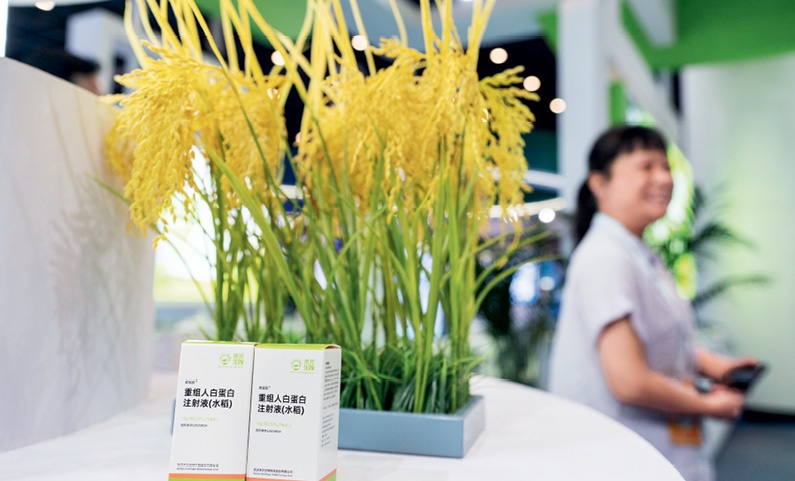
Latest achievements and development trends in biotechnology and biomanufacturing sectors are showcased at the China Bioindustry Convention in Wuhan, Hubei Province on September 4, 2025.
Looking Ahead
Looking to the future, the competition in biomanufacturing is a competition in technology, ecology, and standards. Major global economies have included biomanufacturing and bio-based materials in their national strategies, increasing R&D investment, improving policy support, and striving to seize the discourse power in standards.
China, with its complete industrial system, abundant biomass resources, vast application market, and open innovation ecology, has already gained a favorable position in global competition. However, China still has room for improvement in the development of basic components, high-end equipment manufacturing, international standard setting, and global ecological collaboration, and needs to continuously strengthen original innovation, deepen international cooperation, and improve its ecological system to consolidate and expand its leading advantages.
At the ZGC Forum, the global industry reached consensus: biomanufacturing is an important solution for humanity to address common challenges such as climate change, resource depletion, and environmental pollution. Since no country can thrive in isolation, openness, collaboration, and shared innovation are essential.
China has always adhered to the concept of open innovation and is willing to share opportunities for breakthroughs in biomanufacturing technology, industrial implementation, and scenario expansion with countries around the world. Together, the international community can build a global biomanufacturing innovation consortium, jointly establish international standards, overcome technical bottlenecks, expand application scenarios, and cultivate the industrial ecology.
According to Dr. Frank Hezel, vice president of Global Business Management Resins at BASF Group, China’s innovation pace in the field of biomanufacturing is remarkable. BASF is willing to deepen cooperation with Chinese partners to promote technological innovation and the engineering application of bio-based polymers, contributing to global green transition.
Global industry generally believes that China, with its vast market potential, strong innovative vitality, and well-established industrial ecology, is the most promising cooperative hub in the global biomanufacturing field.
China’s biomanufacturing new materials industry is entering a new phase of rapid development. With synthetic biology as the engine, green and low-carbon as the foundation, and open cooperation as the path, China is seizing the global commanding heights of bio-based new materials, empowering high-quality development through biomanufacturing.
Facing the blueprint of the 15th Five-Year Plan, biomanufacturing will continue to unleash innovative momentum, steadily strengthen the industrial foundation, improve the ecosystem, and deepen international cooperation, enabling green materials to benefit all sectors of the economy, allowing Chinese innovation to inject lasting power into global sustainable development, and making new and greater contributions to the building of a community with a shared future for humanity and achieving sustainable development for all mankind.