As a millennium-old hub connecting Eastern and Western civilizations, Xinjiang in northwest China preserves a diverse and abundant cultural legacy. Here, visitors can trace the formation and development of China as a unified multiethnic nation, learn about how various religions were introduced here and their adaptation to the Chinese context, and explore exchanges and mutual learning among different cultures.
Since its establishment in 1959, the Xinjiang Uygur Autonomous Region Museum has served as an important window showcasing the splendid history of Xinjiang with its collection of 24,592 pieces or sets of cultural relics.
Among its most celebrated treasures are the Han Dynasty (206 B.C.-A.D. 220) brocade armguard woven with the Chinese characters that say “five stars rising in the east bode well for the Central Plains,” a silk painting of Fuxi and Nüwa, a painted wooden figurine of the Heavenly King trampling a demon, and a painted figurine of a horse-riding Tang Dynasty lady wearing a veiled hat. These precious relics silently narrate the brilliant culture that once flourished on this borderland.
An Armguard Bearing a Good Wish
The Han Dynasty Brocade Armguard Woven with Chinese Characters is a first-grade cultural relic under the state-level protection, and is also one of the 195 Chinese artifacts prohibited from being exhibited out of the mainland.
In October 1995, an archaeological team working in the Kunlun Mountains made a compelling discovery at the Niya ruins of the Han Dynasty in Hotan Prefecture, southwest Xinjiang. A piece of brightly colored brocade was found on the right arm of the remains of a male. Amid its intricate patterns were eight Chinese characters written in seal script.
This is the earliest known appearance of the word “zhongguo” (meaning China today but the state in the Central Plains during the Han Dynasty) discovered so far in Xinjiang. The “five stars” refer to Venus, Jupiter, Mercury, Mars, and Saturn – reflecting the ancient Chinese cosmological belief of the Five Elements – metal, wood, water, fire, and earth. In ancient times, the alignment of these five celestial bodies was regarded an extremely good omen. Scholars believe that the phrase is a widely used expression of the astrological beliefs and aspirations for prosperity and good fortune during the Han and Jin (265-420) dynasties.
The armguard is made of Shu brocade, a luxurious silk fabric once described as “an inch of brocade worth an inch of gold.” Rectangular with rounded corners, it measures 18.5 centimeters in length and 12.5 centimeters in width. The brocade uses five colors corresponding to the Five Elements. The eight characters are woven among motifs of auspicious creatures such as peacocks, cranes, and tigers, an extremely rare combination.
The Niya ruins were on the site of the ancient Jingjue Kingdom, one of the Thirty-Six Kingdoms in the Western Regions during the Han and Jin dynasties, and a major stop wyet it ended up in the hands of someone thousands of miles away in Xinjiang. This indicates close connections between the Jingjue Kingdom and the Han Empire.
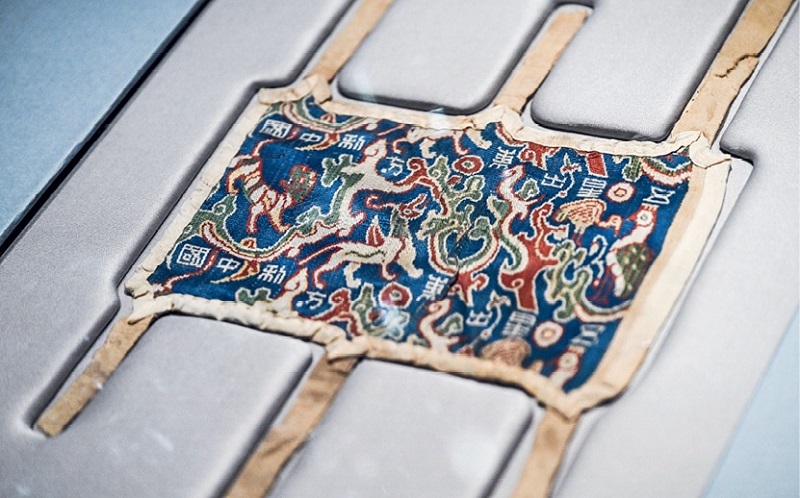
The national treasure, the Han Dynasty (206 B.C.-A.D. 220) brocade armguard woven with the Chinese characters that say “five stars rising in the east bode well for the Central Plains” is on display at the Xinjiang Uygur Autonomous Region Museum.
Creation Deities
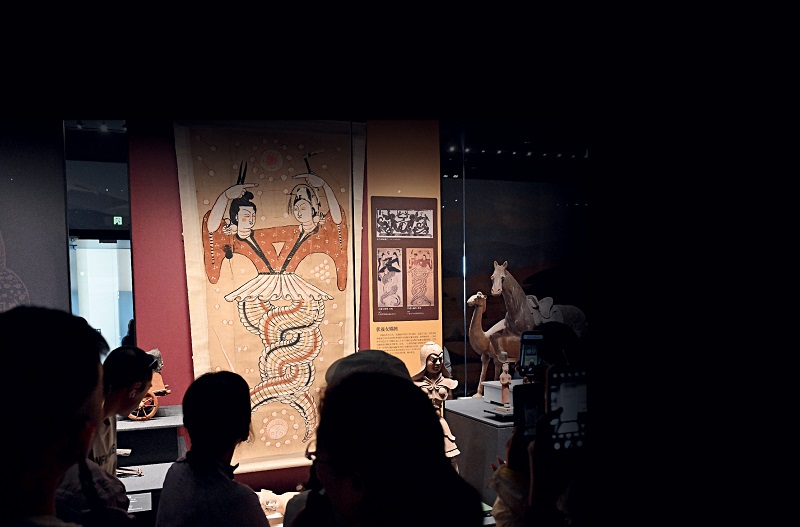
Fuxi and Nüwa are the gods who created humanity in Chinese mythology. The silk painting of them unearthed in 1965 from a tomb in Turpan in central Xinjiang is an essential item to check out for visitors at the Xinjiang Uygur Autonomous Region Museum.
The earliest textual references to the pair date back to the Warring States period (770–476 B.C.). The myth of the two gods creating humankind had already spread widely in China before the Han Dynasty. During the Han Dynasty, their images most commonly appeared on painted bricks. The two deities are typically depicted with human upper bodies dressed in Han-style clothing and long serpent-like tails below. Their tails often intertwine, symbolizing human creation.
A number of such depictions were found in Tang Dynasty (618-907) tombs in the Turpan region. This shows that by that time, the various ethnic groups living there had developed a shared understanding of ancestral origins and ancestor worship.
Research shows that the painting in the Xinjiang museum dates back to the Tang Dynasty. It measures 220 centimeters in height and 116.5 centimeters in width. In the painting, Nüwa, with a high knot, wears red blush on her cheeks and a floral ornament on her forehead, holding a compass in her right hand. Beside her, Fuxi wears a knot secured by a long hairpin and holds a carpenter square in his left hand.
They are surrounded by the vast cosmos. Above them is a blazing sun, while beneath their intertwined tails is a bright moon. The sun and moon are encircled by eleven large stars each, with additional stars scattered around the figures, indicating the profound connection between human origins and the universe.
Tomb Guardian
In 1973, another valuable relic was unearthed from the tombs in Turpan: a painted wooden figurine from the Tang Dynasty depicting a Heavenly King trampling a demon. It served as a tomb guardian protecting Zhang Xiong, a general of the Gaochang Kingdom, and his wife in the afterworld.
At the time it was excavated, the colors were still well-preserved. The Heavenly King’s glaring eyes give the figure a lifelike presence. Tomb guardians were funerary objects created to intimidate evil spirits and protect the soul of the deceased.
This figurine is cladded in typical Tang Dynasty armor resembling a military officer from Chang’an, then capital of the Tang Dynasty. However, the cuffs and trouser legs are decorated with patterns characteristic of the Western Regions. This suggests that Central Plains burial customs spread westward and merged with local cultural traditions.
The figure’s construction is intricately crafted. Its limbs are connected with mortise-and-tenon joints, allowing it to move. More surprisingly, even the teeth can be removed.
The Heavenly King’s right foot carved as a tenon fits precisely into a mortise in the abdomen of the demon beneath it. The demon itself is carved with striking simplicity: apart from facial features outlined in black ink and a small red cap, the body retains the natural color of the wood, creating a dramatic contrast with the richly decorated Heavenly King.
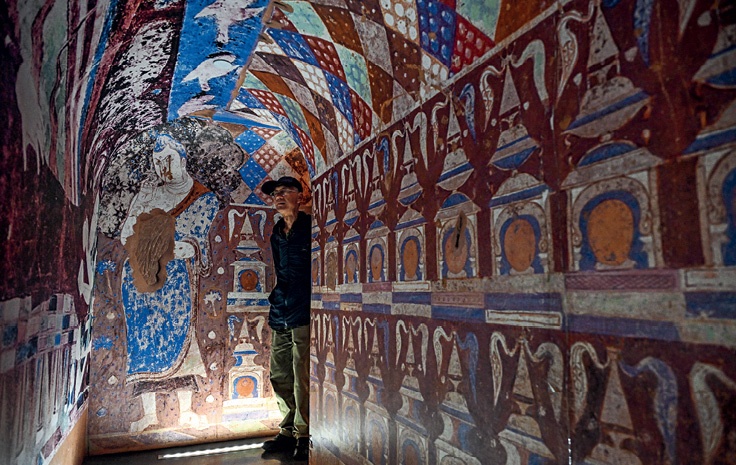
A visitor at the Xinjiang Uygur Autonomous Region Museum is walking through a replica of the No. 171 Cave of the Kizil Thousand-Buddha Caves in Xinjiang, one of China’s earliest large-scale grotto complexes.
A Horse-Riding Lady with a Veiled Hat
The painted figurine of a horse-riding lady wearing a veiled hat emanates a sense of femininity among the museum’s collection. Unearthed in 1972 from an ancient tomb in Turpan, it portrays a noblewoman of the Tang Dynasty out on a ride. Holding the reins in her left hand, she sits on the horse wearing a relaxed expression on her face, as if roaming in a scenic countryside during springtime.
She is wearing a pink short top and a green floral long skirt, imbuing her attire with a refreshing and elegant touch. On her head is a fashionable veiled hat of the time, which completes the outfit. The hat’s frame was typically made of rattan, covered with fabric, with a piece of lightweight net attached to the brim. This style of veiled-hat during the Tang Dynasty was among the various styles introduced from the Silk Road and mixed with local aesthetics. The sheer veil allows the refined makeup to be faintly seen. It is not only an aesthetic choice, but also functional as the hat provides shade from the sun and protection from wind and sand, making it an essential accessory for women going out.
Even her traveling companion – the horse – was well decorated. The saddle, bridle, and forehead ornament were elaborately designed, creating an aura of elegance. For many women of the Tang Dynasty, horses were indispensable companions for outings and sightseeing, with horseback excursions being a popular leisure activity among aristocratic women.
Bringing Cultural Relics to Life
Today, the museum is using new technologies and creative programs to help visitors better understand the history and culture of Xinjiang.
On the fourth floor, a digital experience hall uses virtual reality and motion-sensing interaction to recreate the Xiaohe Cemetery, a Bronze Age burial ground located in southeast Xinjiang, in full panorama, giving visitors a vivid sense of being on the site. Visitors can also enjoy immersive experiences of other historical sites such as the Kizil Caves, the Niya ruins, and the ancient city of Loulan – all famous for their profound historic value.
Xinjiang is well known for its music and dance tradition. Since 2022, the museum has staged a performance titled Voices Travels Thousands of Years, where each chapter is inspired by a prized artifact. While enjoying Xinjiang’s unique melodies and dance routines, audiences engage in a dialogue with cultural relics that transcend millennia.
In addition, educational programs such as “Drawing Cultural Relics in the Museum” and “Little Artifact Conservators” allow students to learn about Xinjiang’s history while developing awareness of cultural heritage protection. During festivals such as the Spring Festival and Eid al-Adha (one of the most important Islamic festivals), the museum also invites visitors of different ethnic groups to experience intangible cultural heritage activities including paper cutting, embroidery, and traditional music and dance.