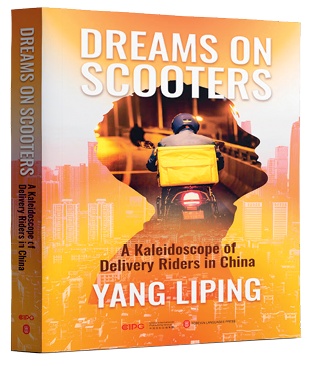
Dreams on Scooters: A Kaleidoscope of Delivery Riders in China
Author: Yang Liping
Price: RMB 98
Paperback, 339 pages
Published by Foreign Languages Press
As early as the Song Dynasty (960-1279), restaurants in China’s urban centers offered food delivery upon request. Evidence of this can be found in a famous 12th-century scroll painting Along the River During the Qingming Festival, which portrays the bustling capital of Bianjing (modern day Kaifeng in Henan Province). One scene in it shows a boy emerging from a restaurant holding chopsticks in one hand and a stack of bowls in the other – a depiction of what may have been an early form of takeaway service.
Today, food delivery has evolved into a vast modern industry. According to A Report on Development Trends and Future Investment in China’s Food Delivery Industry (2025-2030) released by YuboInfo.com, an advisory consulting institute, instant retail now accounts for 18.7 percent of household consumption in China, and delivery networks have become deeply embedded in urban life. With the rapid integration of the digital economy and city services, the food delivery industry has developed into a massive business ecosystem employing more than 15 million workers.
As of August 2025, the country’s average daily volume of food delivery orders had surpassed 230 million, while the median monthly income of delivery riders reached RMB 6,800 – 47 percent higher than in 2020. As the sector expands, delivery riders are increasingly viewed not just as couriers but as essential contributors to the everyday functioning of cities.
Despite their growing presence, these workers are often described as “intimate strangers,” serving millions daily yet remaining largely invisible. Data from riders of China’s mega digital service platform Meituan shows nearly half of them were born in the 1990s, over 24.7 percent hold an associate degree or higher, 35.2 percent previously worked in factories, 31.4 percent once ran their own businesses, and about 40 percent are part-time riders. Still, statistics cannot fully capture the lives of the riders on the scooters – how they experience city life, balance work and family, and find moments of joy or frustration in their demanding work.
These questions lie at the heart of Dreams on Scooters: A Kaleidoscope of Delivery Riders in China, the first book of literary reportage devoted to China’s food delivery workers. Drawing on two years of fieldwork and nearly 100 interviews, author Yang Liping portrays the lives, struggles, and aspirations of riders within the broader context of China’s poverty alleviation efforts and its pursuit of common prosperity.
The book unfolds across nine thematic chapters, each exploring a distinct facet of the riders’ lives, from their professional predicaments to romantic entanglements and family relations. The opening chapter, “Choice,” examines why people enter this line of work and the dilemmas they face in doing so. Chapter Two, “Marriage Ad on a Delivery Box,” turns to their emotional lives and the search for love. Other chapters look at their daily routines, family relationships, and experiences during the COVID-19 pandemic, when delivery riders became a vital lifeline for many urban residents.
The narrative is brought to life through a series of vivid personal portraits. There is Chu Xuebao, a “Delivery Star” who completes 70-80 orders in a single day and walks more than 30,000 steps. Liu Haiyan delivers food alongside her husband, forming a rare husband and wife rider team. Wang Jibing writes poetry between deliveries. Zhang Weichao rides through Shanghai to pay for his child’s medical treatment, while Dai Zi works 17 or even 20 hours a day to fund his daughter’s surgery. Old Cao has managed to buy two apartments through years of hard work. Three brothers deliver together, pooling their earnings and sharing a rented room. Li Bangyong sometimes carries his daughter on his back while working, and Wang Jiansheng once climbed seven flights of stairs in 41 seconds on one leg to deliver a meal to a pregnant customer. Another rider, Song Zengguang, rose from an ordinary courier to become a station manager and eventually a nationally recognized model worker.
Gaining the trust of these riders was not easy. As Yang recounts, most were initially reluctant to talk – every minute spent in conversation meant one less order and less income. Their livelihoods depend on constant movement: each delivery helps pay for baby formula, elderly parents’ medicine, rent or mortgage payments, and the basic costs of surviving in the city. To better understand their lives, Yang once followed a rider from seven in the morning until ten at night, observing every stage of his workday and meeting his family in order to reconstruct a fuller picture of his life.
Written with warmth and empathy, the book presents a vivid collective portrait of ordinary people whose labor helps keep modern cities running. The book highlights not only the hardships of delivery work but also the dignity, resilience, and generosity of those who perform it. Riders support their families, help strangers in need, and often step forward during emergencies.
Through its mosaic of personal stories, the book offers a rare window into one of the largest and most essential workforces during the digital age. By documenting the lives of nearly 100 riders, Yang captures both individual destinies and the broader reality of millions of workers who keep China’s delivery economy in motion.