The Jiangxi Provincial Museum, built in 1953, houses a collection of 60,437 items/sets, including 370 first-grade cultural relics. Its most prized treasures include the Shang Dynasty Bronze Double-Faced Deity Head, the Shang Dynasty Bronze Double-Tailed Crouching Tiger with a Bird Perching on its Back, the Shang Dynasty Jade Crouching Birdman with Movable Rings, and the Yuan Dynasty Blue-and-White and Underglaze-Red Porcelain Granary.
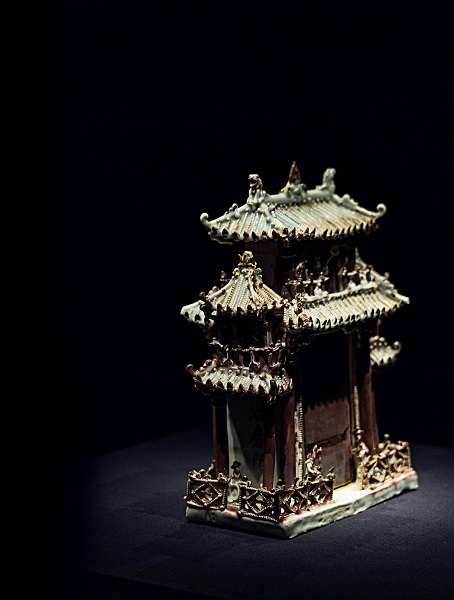
The Porcelain Blue-and-White and Underglaze-Red Granary from the Yuan Dynasty (1206-1368) is a national treasure.
A Double-Faced Head
The double-faced bronze head attracts visitors with its peculiar form. Its appearance is a little abstract: a large nose, high cheekbones, protruding ears, deep eye sockets with bulging eyeballs, and a wide mouth revealing eight teeth in a “standard smile.”
Ancient people believed that displaying deity-like objects enabled them to communicate with the immortals during rituals. The head has the same patterns on both sides and is characterized by a half human and half god aura, with an eerie yet solemn expression. The fusion of humanity and divinity reflects the reverence people living in the late Shang Dynasty (1600-1046 B.C.) had for supernatural power in bronze art.
Unearthed at the Dayangzhou site in Xingan County, Jiangxi Province, this bronze head is the only example of its kind found in China dating back to the Shang Dynasty so far, bearing significant historical value.
The Shang Dynasty marked the peak of China’s bronze culture. Traditional views held that the Shang bronze culture originated in the Central Plains, while the Jiangnan region (a vast area in the southern lower reaches of the Yangtze River), once called the “southern barbarian lands,” lacked the advanced skills needed for making bronze ware. The excavation of the Dayangzhou Shang tomb in 1989 proved that the ancient inhabitants of Jiangxi had mastered highly advanced techniques in copper mining, smelting, and casting. It represents another center of bronze culture, independent from the bronze culture in the Central Plains.
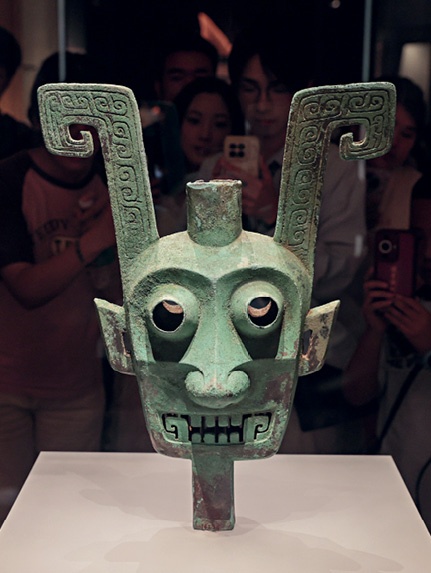
The Shang Dynasty Bronze Double-Faced Deity Head impresses crowds of visitors with its eerie, abstract appearance.
A Bird-Friendly Tiger
Another signature artifact from the Dayangzhou site is the bronze tiger with a bird on its back and twin tails. This is the largest surviving bronze tiger from the pre-Qin period (before 221 B.C.) found so far.
The sculpture measures 53.5 cm in length, 25.5 cm in height, and weighs 6.2 kg. This tiger is slightly larger and heavier than most modern cats. It looks alert and poised to strike, and has an open mouth revealing sharp teeth. Its eyes are bulging and ears are erect, and body is covered with intricate patterns. This big cat has a small companion – a bird resting on its back, creating a striking contrast with the fierce animal beneath. Because of this amusing contrast, scholars affectionately call it the “little bird tiger.”
Putting animal motifs on bronze ware was a common practice during the Shang Dynasty, and tiger imagery often appeared in southern regions. More than 50 representations of tigers have been found on the bronze ware excavated from the same site. Tiger symbolism has run through Chinese culture for thousands of years.
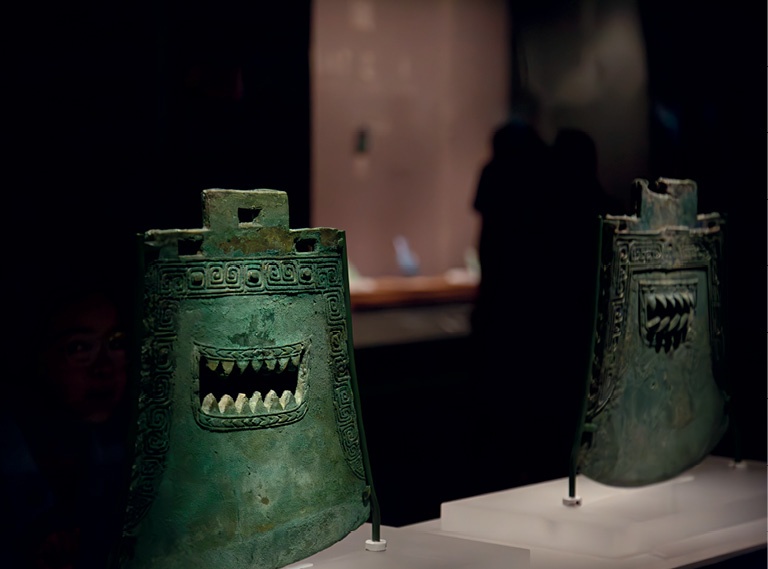
Shang Dynasty Yue (Battle-Axe) with Eye and Thunder Patterns on display at the Jiangxi Provincial Museum.
A Birdman “Ancestor”
The Jade Crouching Birdman with Movable Rings is an iconic jade ware which was also excavated from the Dayangzhou site in Xingan.
The figure is part human and part bird: it has a beak-shaped mouth with large C-shaped ears, bent arms as it crouches sideways, wings on both sides, and feathers on its back. It resembles the “birdman” described in the ancient Chinese text the Classic of Mountains and Seas, a writing about geography and mythical beasts. It is the earliest jade representation of a “birdman” discovered so far and the only known Shang Dynasty jade ornament of this type. Ancient Chinese worshipped birds and believed birdmen were immortal.
The ornament is quite small in size – 11.5 cm tall and 1.4 cm thick. It was carved from a single piece of jade. The part behind the figure was fashioned into three interlocking movable rings of nearly identical shape, size, and thickness, forming a flexible chain. The artisan must have been a master at openwork carving, especially the “movable chain” technique. It represents the highest level of jade craftsmanship from the Shang Dynasty, the techniques of which even modern artisans find extremely difficult.
It is also the earliest known jade ornament to have movable rings. It can be regarded as the ancestor of the longer movable chains popular during the Ming (1368-1644) and Qing (1616-1911) dynasties, placing it at a highly honorable place in China’s jade art history.
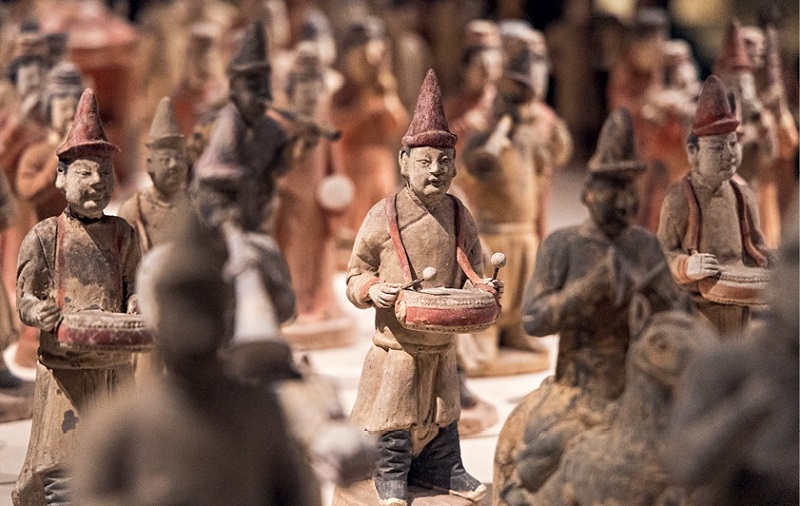
A collection of pottery figure musicians on display at the Jiangxi Provincial Museum.
A Must-See Porcelain Granary
The porcelain blue-and-white and underglaze-red granary from the Yuan Dynasty (1206-1368) is the crown jewel of the museum’s exhibits. It is included in China’s first list of 64 cultural relics prohibited from being exhibited overseas, and the only porcelain item on the list.
Excavated from the tomb of the Ling family in Jingdezhen, Jiangxi, the piece is perfectly preserved, exquisitely crafted, and inscribed with an epitaph.
It stands 29.5 cm high, 20.5 cm wide, and 10 cm long. Eighteen human figurines can be spotted on the item, serving various roles from theatrical performers to servants and guards. On the top of the granary is a tastefully decorated theater stage, where two dancers are performing in front of two people holding ceremonial fans, and a four-member band is playing the waist drum, pipa, and xiao.
The mix of techniques used in this national treasure is quite unique.
Underglaze-red porcelain was one of the brilliant inventions created by Jingdezhen craftsmen during the mid-Yuan Dynasty. Wood-fired kilns made controlling the temperature difficult, thus placing high requirements on the kiln master’s ability.
At the center of the base is a 12-line epitaph of 159 characters, briefly describing the life of the tomb’s occupant. Particularly important to notice is that the inscription contains a clear date, which is crucial for determining the artifact’s age. The owner was the granddaughter of Ling Yingshan, the head of Changxiang Academy in Jingdezhen, and this granary was specially commissioned as a burial object.
A couplet is written on the granary door, expressing a wish for wealth, peace, and safety. Times may change, but people’s longing for abundance and a good life remains the same.
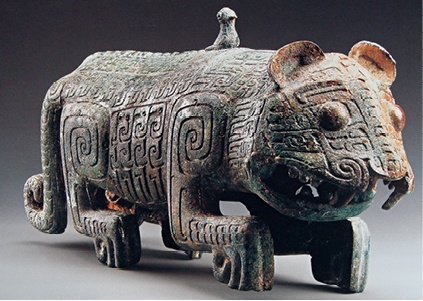
The Shang Dynasty Bronze Double-Tailed Crouching Tiger with a Bird Perching on Its Back is one of the iconic items on display at the Jiangxi Provincial Museum.
Outreach Programs
The Jiangxi Provincial Museum has long been committed to fulfilling its role in social education. To achieve this, it collaborates with more than 100 primary and secondary schools across the province in building a “second classroom” for youth education.
To promote educational equality, the museum has also partnered with special education schools and the Jiangxi Disabled Persons’ Federation to launch a cultural relic-themed project targeting children with special needs. The program produces audiobooks, illustrated books, and sign-language animations, allowing these children to access cultural and museum resources together with other children without barriers.