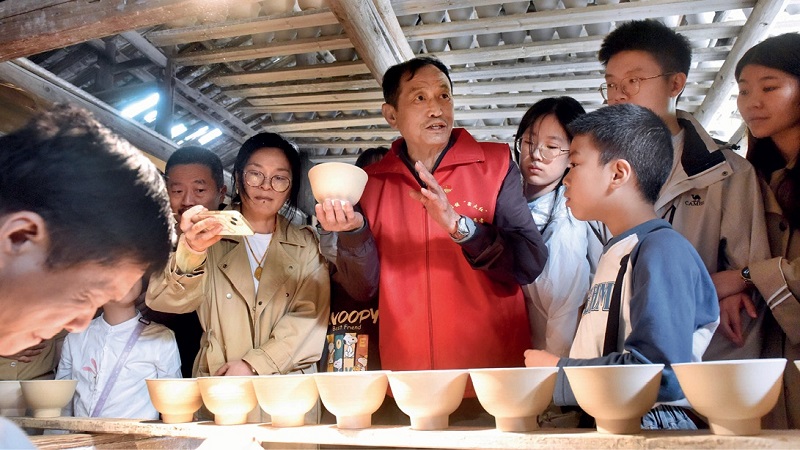
At a workshop in Jingdezhen City, a volunteer guide introduces the craft, history, and culture of Jingdezhen porcelain to a crowd of visitors.
Jingdezhen porcelain has long held an unrivaled position in the global porcelain industry, and its craftsmanship has been celebrated as one of China’s most iconic traditional handicraft for centuries. In 2006, this time-honored practice was inscribed on China’s first national list of intangible cultural heritage.
The city of Jingdezhen in Jiangxi Province rose to prominence as China’s porcelain capital during the Tang Dynasty (618-907), reaching its golden age under the Yuan, Ming (1368-1644), and Qing (1616-1911) dynasties when its ware commanded admiration both at home and abroad. Production was divided between private kilns serving the public market and imperial kilns devoted exclusively to the royal court.
Over the centuries, Jingdezhen developed a wide range of ceramic styles, with blue-and-white, famille rose, and rice grain porcelain standing as its most celebrated achievements. These innovations allowed the city to lead aesthetic trends across successive eras. At the same time, porcelain production became increasingly specialized, evolving into a highly refined and collaborative process involving many skilled artisans.
The process of making Jingdezhen porcelain follows a meticulous sequence: material selection, clay preparation, wheel throwing, trimming, glazing, painting, and firing. High-quality raw materials like kaolinite are first collected, refined through washing and aging to produce smooth porcelain clay. Artisans then shape the clay on a potter’s wheel and carefully trim it to achieve precise forms and elegant contours. Glazing follows, with decoration applied either beneath or above the glaze surface. Finally, the pieces are fired in kilns at extremely high temperatures. Careful control of the heat is essential, as it determines the final texture, strength, and color of the porcelain. Throughout the process, the craftsmen’s experience and skill play a crucial role.
In the modern era, Jingdezhen’s porcelain handcrafting techniques continue to evolve through a balance of preservation and innovation. National and local governments prioritize the protection of intangible cultural heritage, training professionals through initiatives like inheritor programs at ceramic academies and research institutions. At the same time, the city has launched projects to attract creative entrepreneurs, offering support for independent artisan studios.
Today, over 60,000 ceramic artists from China and abroad have established creative ventures in the city, expanding porcelain from mere functional ware into diverse art and culture products. This vibrant creative environment has also attracted growing numbers of tourists, making Jingdezhen a popular cultural destination. Through the combined efforts of tradition and innovation, the craftsmanship of Jingdezhen porcelain is experiencing a renewed vitality.