China's new-energy vehicle (NEV) industry has driven out ahead of the pack to become the global leader in green transformation of the automotive sector. As more European car companies have entered China’s market to enhance their competitiveness, cooperation between Chinese and European automotive industries has ushered in major opportunities.
Data from United Bank of Switzerland shows that since 2018, European automakers such as Volkswagen, Stellantis, Mercedes-Benz, and BMW have established technological partnerships with at least 38 Chinese companies and research institutions in fields that include software, hardware, batteries, and car networking.
From exploring China’s enormous consumer market to engaging in deep cooperation with China’s innovation ecosystem, an increasing number of European automakers continue to entrench their presence in the Chinese market, considering the country central to their global strategy. According to a 2026 global passenger car market report released by the Center for Automotive Research in Bochum, Germany, China’s importance in the global automotive market has increased exponentially. It points to cooperation with China as the future of the global automotive industry.
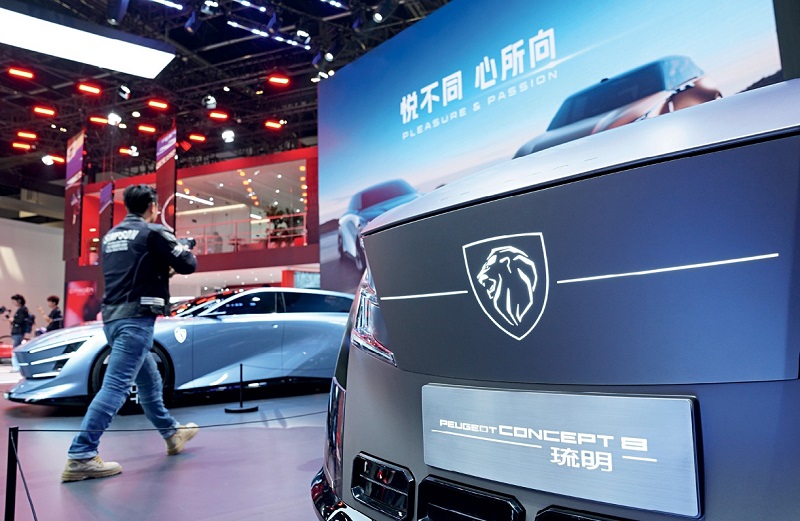
Peugeot showcases two visionary concept cars, Concept 6 and Concept 8, at the Auto China 2026.
Tech Leader
In the workshop of Volkswagen (Anhui) Automotive Company Limited, robotic arms move with pinpoint precision as they complete assembly processes. The stages of vehicle assembly, battery installation, and final inspection are efficiently interconnected, thanks to the application of advanced technologies such as magnetic levitation nail delivery and virtual precision measurement jigs.
The first model jointly developed by Volkswagen and XPeng Motors, the ID. UNXY 08, entered production in Hefei, Anhui Province on March 13. It took only 24 months from the signing of the cooperation agreement to mass production of this model. According to Oliver Blume, chairman of the Board of Management of Volkswagen, this model truly realizes development in China and creation for China, deeply integrating German engineering technology with cutting-edge Chinese innovation, and embodies the Volkswagen strategy of “in China, for China.”
At the end of February, Blume accompanied German Chancellor Friedrich Merz on a visit to China; in March, he went to Beijing to attend the annual meeting of the China Development Forum; in April, he attended the 19th Beijing International Automotive Exhibition. What has drawn Blume to China so many times over the past months is that the country is a global leader in automotive technology.
In the 1980s, joint ventures and international cooperation promoted the rapid development of China’s passenger car industry. Today, as the global automotive industry enters an era of electrification and intelligence, multinational car companies such as Volkswagen are accelerating their integration into China’s innovation landscape.
Volkswagen and China’s smart driving technology company Horizon Robotics established the joint venture Carizon in October 2022 to develop end-to-end intelligent driving solutions. It has also announced the independent design and development of system-level chips in China. This marks a new stage in Volkswagen’s efforts to build intelligent connected capabilities in China.
Volkswagen became a shareholder of XPeng Motors in July 2023, and the two parties established a strategic technology partnership to develop two Volkswagen-branded electric vehicle models specifically for the Chinese market, as well as a zonal electrical/electronic architecture. Currently, the two models based on this architecture have successively entered production.
Volkswagen inaugurated its first integrated R&D center outside Germany, with full-process vehicle development and validation capabilities, in Anhui in November 2025. The center has now achieved a complete end-to-end R&D loop, with all decisions regarding design, development, testing, and production carried out locally, shortening the product development process by approximately 30 percent.
According to Ralf Brandstätter, chairman and CEO of Volkswagen Group China, China is the most competitive and innovative automotive market in the world. To date, Volkswagen has invested approximately €3.5 billion in Hefei, establishing a complete NEV industry ecology encompassing R&D, manufacturing, and the supply chain. By expanding the R&D presence in Hefei, its ability to respond quickly to local market demands will be enhanced.
Volkswagen will launch more than 20 NEV models in China this year as part of its plan to provide approximately 50 NEVs to the Chinese market by 2030. These vehicles will also be exported to regions such as Southeast Asia and the Middle East.
Blume is confident that in the fields of electric mobility, digitalization, and intelligent mobility solutions, cooperation with Chinese partners has strengthened Volkswagen’s innovation capabilities both in China and globally. The experience in China also provides Volkswagen with reference for transformative development in the European market.
Hildegard Müller, president of the German Association of the Automotive Industry, stated that the German and Chinese automotive industries are highly complementary. China is not only one of the largest and fastest-growing automotive markets, but also an important arena for the application of key technologies and industrial innovation. German car companies have strengths in safety and engineering standards. Collaboration between the two sides will accelerate technological innovation, achieve synergies, and promote industrial upgrading.
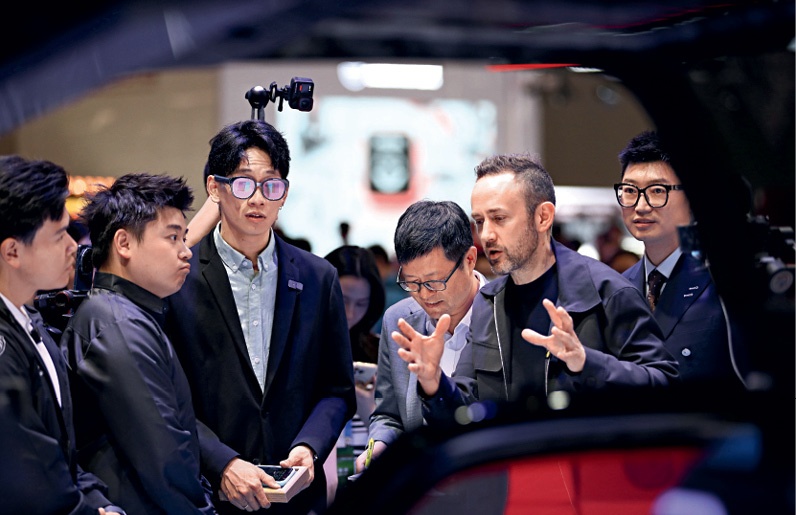
A staff member from Peugeot introduces the company’s vehicle to the Chinese audience at the Auto China 2026.
Strong Competitiveness
The Swedish heavy truck manufacturer Scania delivered the first batch of NEXT ERA heavy trucks this March, marking a new chapter in its deep engagement with the Chinese market.
The truck’s front design incorporates elements from the ding, a bronze sacrificial vessel in ancient China and symbol of strength, highlighting the brand’s commitment to quality. And for the first time, the Chinese Scania logo is used, conveying the company’s determination to embrace the Chinese market.
Scania’s base in Rugao, Jiangsu Province, is its third global industrial production base and a key manufacturing hub in Asia. It is solely built and operated by Scania and commenced operation last October, marking a new stage in the company’s localized development in China.
Policy breakthroughs are key to Scania’s recent development. China released a new negative list for foreign investment access in 2020, lifting restrictions on foreign ownership in commercial vehicle manufacturing. Scania quickly finalized the Rugao factory project, becoming one of the first international commercial vehicle companies to wholly own a factory in China, which is also its largest overseas investment project in nearly 70 years.
Since then, Scania has started its rapid development in China: the Rugao base was signed and established in 2020, an additional investment in the powertrain project was made in 2023, and a R&D company was established in Jiangsu in 2024. This century-old commercial vehicle giant has demonstrated its confidence in the Chinese market through concrete actions.
According to Camilla Dewoon, executive vice president and head of Scania Group China, the Rugao base breaks away from the traditional joint venture model. This will help the company improve efficiency in product definition, technology introduction, and operational management. It also reflects the higher openness level of China’s manufacturing industry and the continuous optimization of its business environment.
According to Dewoon, Scania is a witness to the opening-up of China’s manufacturing industry. With the support of the Chinese government, from plant construction to obtaining production qualifications, and from project launching to R&D implementation, every step of its establishment in China has been seamless.
At the Rugao base, rows of machine tools and intelligent assembly lines all showcase Scania’s globally leading manufacturing technology. The Rugao base is planned to have an annual production capacity of 50,000 heavy-duty trucks, half of which will be exported. In terms of production mode, the base has fully implemented Scania’s globally unified modular production and quality management system. Under the modular production system, standardized modules are combined in different ways like assembling building blocks, enabling the rapid production of customized heavy-duty trucks.
According to Dewoon, the Rugao base is of great significance, serving as a bridge to the future. China is the world’s largest heavy-duty truck market, with enormous commercial potential and extremely fierce competition. Operating here allows Scania to gain valuable experience. More importantly, most of the current innovations shaping the industry’s future, including autonomous driving, electrification, and intelligent connectivity, originate from China. The company hopes to integrate fully into the Chinese market, continue learning, and collaborate with Chinese enterprises.
According to Christian Levin, president and CEO of Scania, by localizing production and innovation in China, Scania has strengthened its competitiveness in the global market.
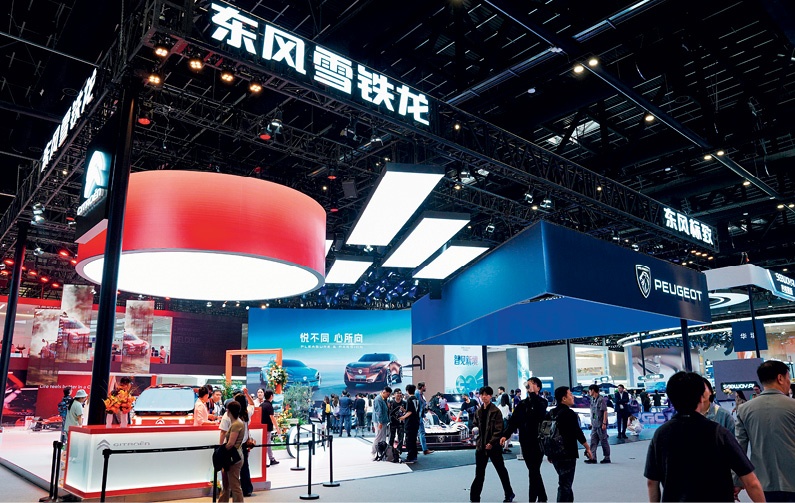
Dongfeng Citroën showcases its cars at the Auto China 2026 in Beijing from April 24 to May 3. Photos by Yu Jie
A Major Force
Chinese electric vehicle company Leapmotor sold more than 67,000 vehicles overseas in 2025, with sales in the European market surpassing 20,000 units, compared with only 771 in 2024. This significant growth stems from its strategic partnership with European automakers. Stellantis, the world’s fourth-largest automaker, and Leapmotor jointly established Leapmotor International in 2024.
According to Carlos Tavares, then CEO of Stellantis who facilitated this cooperation, through this strategic investment, Stellantis can fill the gaps in its own business model and benefit from Leapmotor’s competitiveness in China and even globally.
Stellantis, headquartered in Amsterdam, Netherlands, owns automotive brands such as Peugeot, Chrysler, Citroën, and Maserati. As early as 1992, it formed a joint venture with Dongfeng Motor in Wuhan, Hubei Province, establishing Dongfeng Peugeot Citroën, one of the earliest joint venture automobile enterprises in China.
In response to the new energy transformation, Stellantis has set the goal of achieving full electrification of passenger vehicles for Europe by 2030 and reaching net zero carbon emissions by 2038. To this end, Stellantis has shifted its investment in China from traditional joint ventures to cooperation in fostering the new industrial ecosystem, with Leap International being one of the results of this collaboration.
This cooperation aims to generate win-win outcomes. Stellantis accelerates and expands the global sales of Leapmotor products, while Leapmotor assists Stellantis in achieving its electrification goals. As of last June, Leapmotor had already launched operations in more than 30 overseas markets across Europe, Asia-Pacific, and Africa. Leapmotor International commenced operations in Brazil and Chile last November, and also announced that it will offer a full range of electric vehicles in the South American region.
The cooperation also aims to facilitate transformation and upgrading. Since last July, Stellantis’ senior executives have made nine visits to Wuhan, where Dongfeng Peugeot Citroën is based, seeking to transition into the NEV sector. Stellantis CEO Antonio Filosa said that they will work with Chinese car companies to accelerate the new energy transition, striving to produce more outstanding automotive models and achieve mutual benefits and sustainable development.
The cooperation, however, extends beyond merely manufacturing cars. Stellantis and CATL jointly initiated the construction of a lithium iron phosphate battery factory in the Aragon region of Spain last November. With a total investment of €4.1 billion, the project will fully utilize renewable energy and apply Industry 4.0 standards to ensure intelligent and sustainable production processes. It is scheduled to commence operations by the end of 2026.
John Elkann, chairman of Stellantis, said that the auto giant is committed to achieving a low-carbon future, actively adopting all available advanced battery technologies to provide customers with competitive electric vehicles. Its joint venture project with CATL will help it achieve comprehensive sustainability.
China is promoting a new blueprint for cooperation in the automotive industry with an open and inclusive stance. According to Ferdinand Dudenhöffer, a prominent German automotive expert and director of the Center for Automotive Research in Bochum, Germany, without being present in the Chinese market, one cannot truly enter the automotive industry. The scale economy benefits derived from the vast market and complete supply chain, combined with rapid development and innovation in cutting-edge fields such as power batteries, NEV, and autonomous driving technology, make China a major force driving the global automotive industry’s electrification and intelligent transformation. 
LIU ZHONGHUA and XU XIN are reporters with People’s Daily.