The land of present-day Yunnan Province, known for year-round warm climate and breathtaking natural beauty, is the cradle of human civilization in southeast China, leaving an abundance of historical and cultural legacies. More than a thousand years ago, the mysterious ancient Dian Kingdom flourished here; centuries later came the Nanzhao and Dali kingdoms.
The Yunnan Museum, built in 1911, is an important window into the region’s past. The establishment houses a collection of over 230,000 historical artifacts, attracting over several million visitors annually. Among its most prized treasures are the Warring States Period (770-476 B.C.) Bronze Table with Tiger and Oxen Motif, Western Han Dynasty (206 B.C.-A.D. 25) Bronze Cowrie Container with Figurines of a Gilt Horse Rider and Four Oxen, the Kingdom of Dali Gilt Silver Statue of Garuda Inlaid with Crystal Beads from the Song Dynasty (960-1279), and Ming Dynasty (1368-1644) Gold Crown Inlaid with Red and Blue Gems.
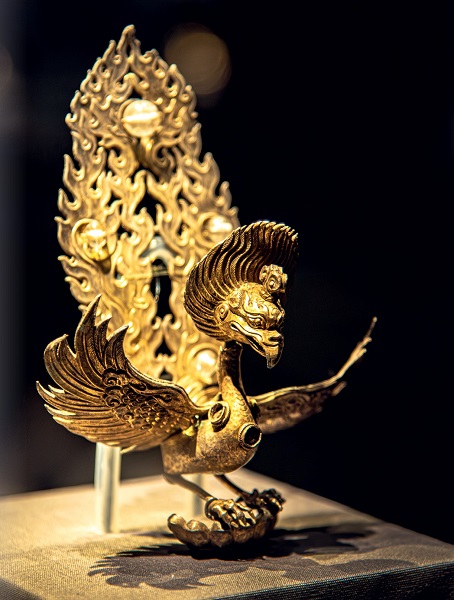
The Kingdom of Dali Gilt Silver Statue of Garuda Inlaid with Crystal Beads from the Song Dynasty on display at the Yunnan Museum.
A Dian Table
Warring States Period Bronze Table with Tiger and Oxen Motif is a bronze ritual table cast by the ancient Dian people. Two thousand years ago, an ancient society named “Dian” thrived nearby the Dianchi Lake in Yunnan. The earliest written reference to this society was made in the Han Dynasty (206 B.C.-A.D. 220) historian Sima Qian’s Records of the Grand Historian. The ancient Dian Kingdom exsited between the 12th-3rd century B.C., and was incorporated into the Han Dynasty during the reign of the ambitious Emperor Wu of Han.
The table measures 43 cm tall and 76 cm long and weighs only 12 kg, while its thickness averages merely 5 mm with a smooth surface. It is ingeniously designed with an ox, a calf, and a tiger. A strong bull constitutes the main body, with its four legs designed to support it and its arched back as an oval table top. A tiger is grabbing the ox with four claws tightly from behind, biting the ox’s tail, and its eyes are aggressively fixed on its prey. Beneath the ox’s belly hides a calf. The ox’s sharp horns could be used as a weapon against the predator, but it chooses to sacrifice itself to protect the calf. The artifact reflects ancient Dian people’s thoughts about the nature of life: death gives birth to new life, and life flows in circles.
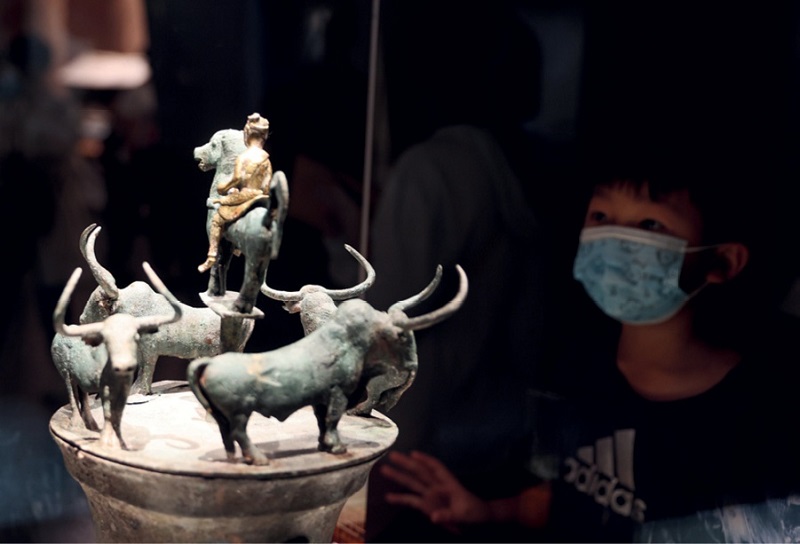
A young visitor admires the Western Han Dynasty Bronze Cowrie Container with Figurines of a Gilt Horse Rider and Four Oxen at the Yunnan Museum.
A Majestic Piggy Bank
Cowrie containers are a type of bronze ware unique to Dian culture. They are regarded as the most representative artifacts of Dian bronze civilization. The Western Han Dynasty Bronze Cowrie Container with Figurines of a Gilt Horse Rider and Four Oxen is a masterpiece of its kind.
This piece is distinguished by its lid: on the outer ring are four sturdy bulls with long, curved horns, running counterclockwise with dynamic energy; in the center, perched on a cylinder handle, is an imposing gilded soldier on horseback, wearing a sword at his waist; beneath him, the steed raises its head and tail as though ready to charge into battle along with its master. On the side of the container, two impressively designed tigers are climbing towards the top.
Cowrie containers are a piggy bank for the ancient Dian aristocracy to store cowrie shells – used as money in the kingdom. This container held a pile of cowries coming from the Indian Ocean. The clinking of shell currency inside the bronze container is a vivid echo of the trade between the ancient Dian Kingdom and the outside world more than 2,000 years ago.
Experts conclude that the object’s owner may have been a prominent figure of the state. The pair of tigers symbolize strength and power, the four bulky oxen demonstrate wealth, and the gild warrior signifies prestige and status. Few written records have been left by the Dian people. Still, these artifacts depict scenes of warfare, hunting, and ritual customs, allowing us to get a glimpse into the life of ancient Dian society.
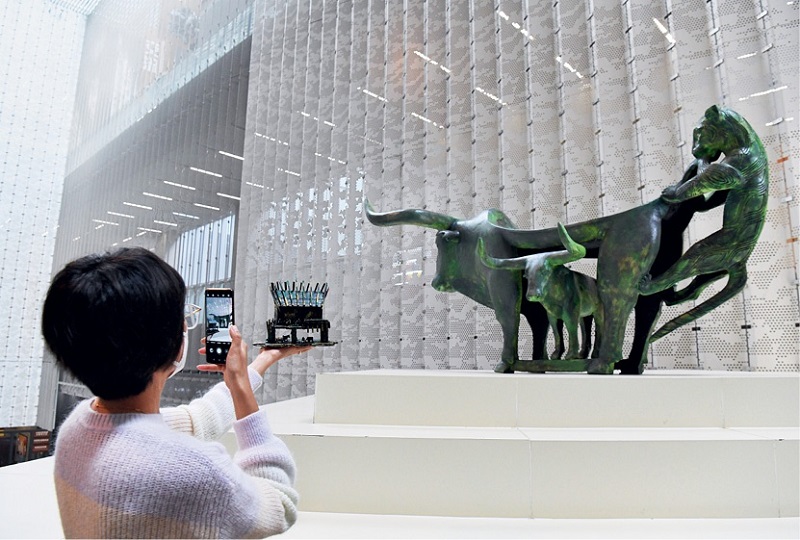
A visitor takes a photo of a handmade bronze model in front of the replica of the Warring States Period Bronze Table with Tiger and Oxen Motif on display.
A Guardian Bird
Three Pagodas are one of the most iconic buildings of Dali City, and one of the oldest and grandest structures in south China bearing witness to Nanzhao and Dali kingdom’s history.
In 1978, during maintenance work on the pagodas, many precious relics were discovered, including the Gilt Silver Statue of Garuda Inlaid with Crystal Beads. Garuda, known as golden-winged birds in Chinese culture, is one of the Eight Legions – a group of Buddhist deities.
For this piece, Garuda is portrayed as a bird wearing a feathered crown against a flame-shaped backdrop where five crystal beads are inlaid. It spreads its wings, poised to take off, and its sharp claws grasp a lotus pedestal.
According to local legends, vicious dragons once stirred up storms at Erhai Lake in Dali, causing frequent disasters. The people of Dali invited the Garuda to subdue them and eliminate the floods. Gradually revered as a “water-guarding deity,” the Garuda became a totem and was placed atop pagodas. Even today, many Garuda statues can still be seen in Dali.
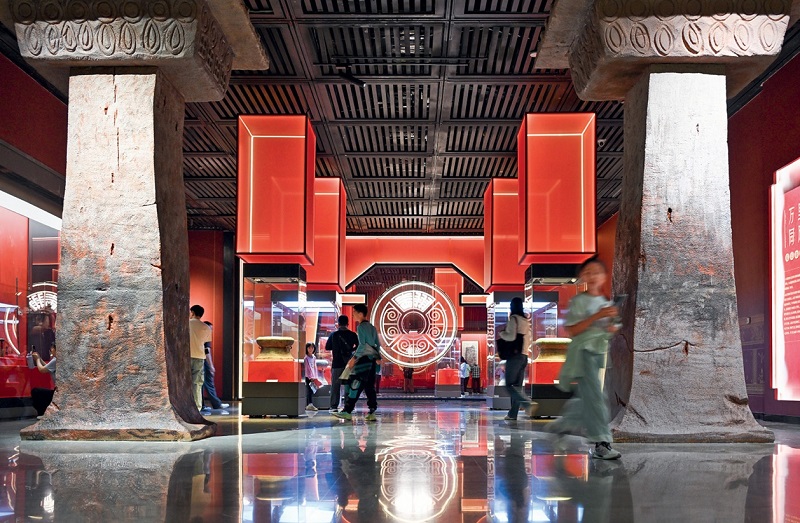
Visitors walk around the galleries at the Yunnan Museum on July 15, 2025.
A Gem-inlaid Crown
The Ming Dynasty Gold Crown Inlaid with Red and Blue Gems is another museum treasure. This hemispherical gold crown is formed by four layers of thin gold sheets resembling lotus petals, and inlaid with more than 50 precious gems in red, blue, green and white, adding a magnificent appeal to the glittering gold body. Each side of the crown has two holes allowing four gold hairpins to secure the crown to a topknot. This crown jewel is crafted with various techniques including hammering, chasing, openwork, inlaying and soldering.
Beyond its visual beauty, the crown is a powerful witness to Yunnan’s dynamic development. To strengthen central control over the southwest frontier, the Ming Dynasty (1368-1644) founder, Zhu Yuanzhang, sent the meritorious general Mu Ying (1345-1392) to quell violence and administer Yunnan with his troops. After his death, Mu Ying was posthumously titled Lord of Qianning, and his family inherited the title for twelve generations, guarding Yunnan until the fall of the Ming Dynasty and making major contributions to frontier stability. This gold crown was unearthed from the tomb of Xu, wife of Mu Song, Mu Ying’s sixth-generation descendant.
Behind the crown’s refined techniques, lies the technological legacy brought by large-scale migration in the Ming Dynasty. To govern the Yunnan-Guizhou Plateau, the Ming officials encouraged hundreds of thousands of soldiers and civilians to move from the south of the Yangtze River to Yunnan, bringing along agricultural and handicraft skills. Continuous migration formed a multiethnic society, with the Han people as the majority, and the many peoples living here came to share the common identity of “Yunnan people.”
Public Education
Revolving around collections and Yunnan’s regional culture, the Yunnan Provincial Museum carries out a variety of engaging public education programs.
During the International Museum Day on May 18, 2025, as a routine, the museum organizes an artifact appraisal event, where experts explain the age, materials, and conservation of relics. It organizes youth art exhibitions featuring student works inspired by museum collections, and offers hands-on workshops such as botanical rubbing, moss painting, and traditional incense-making, allowing visitors to complete and take home their creations.
For young audiences, the museum provides study programs and a “Junior Docent” event, in which students learn artifact stories, engage in guided tours, and design routes in the galleries. At the same time, exhibitions and courses are brought into schools and communities, offering tie-dyeing, paper-cutting, and ethnic costume pattern workshops, as well as mobile photo exhibitions, to increase public understanding of Yunnan’s multiethnic history and culture.