A promotional event for the fifth volume of Xi Jinping: The Governance of China was held in Ankara, capital of Türkiye, on July 1, 2026. Giray Fidan, a renowned sinologist and translator in Türkiye, sat down with China Today to discuss his thoughts on China-Türkiye cultural exchanges and China’s modernization drive.
Ma Liang and the Magic Brush is a household folktale in China. In the story, poor aspiring artist Ma Liang receives a magic brush that brings to life anything it paints. Thousands of miles away, a 12-year-old boy named Giray Fidan read the story in a Turkish comic book, and was inspired to learn more about China.
The young boy is now a renowned sinologist. Today, he wields a different kind of “magic brush,” the art of translation, and uses it to build a bridge between Chinese and Turkish civilizations.
Fidan, head of the Department of Chinese Language and Literature at Haci Bayram Veli University in Ankara, has devoted over two decades to the study of Chinese language and literature, as well as to literary translation. He has rendered into Turkish the works and ideas of ancient philosophers such as Confucius, the strategist Sun Tzu, the Qing-dynasty novelist Cao Xueqin, and the modern novelist Lao She. One side of his bookshelf is lined with original versions of Chinese literature and classics; the other holds their Turkish versions. Over the years, Fidan’s understanding of China has extended far beyond the printed page, reaching into the actual trends and events that shape contemporary Chinese society.
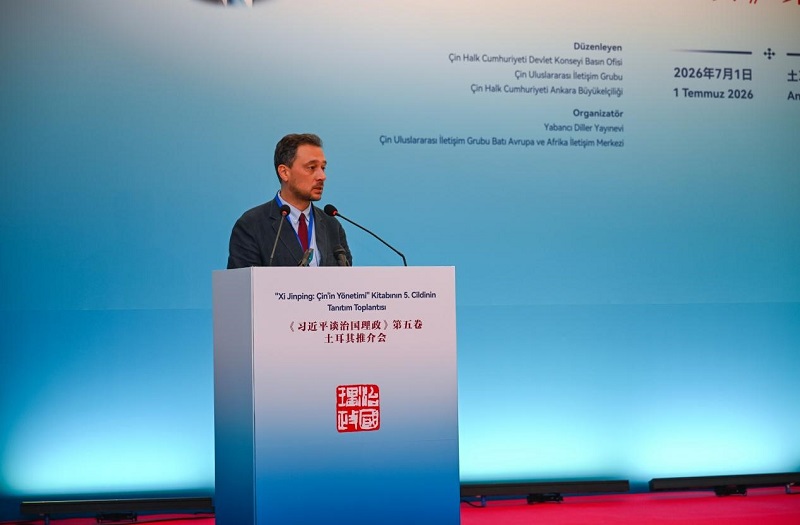
Giray Fidan, a renowned Turkish sinologist, speaks at the promotional event for the fifth volume of Xi Jinping: The Governance of China held in Ankara, capital of Türkiye, on July 1, 2026.
Chinese Wisdom on Governance
“Having studied China for 20 years and visited it many times, my impressions in recent years have been particularly striking,” said Fidan. He shared his observations on China’s governance today with one word: “clean.”
“I don’t mean just one particular city,” he explained. “What I saw was that cities of all sizes across China are very clean.” Yet his firsthand experience went far beyond improvements in the living environment.
He eloquently quoted the well-known Chinese saying: “Lucid waters and lush mountains are invaluable assets,” using it to illustrate the relationship between environmental protection and economic development. “This saying reminds me of ancient Chinese philosophers’ view of nature,” Fidan said. The Taoists, for instance, advocated that all things should develop according to their own nature. In Fidan’s view, Xi Jinping Thought on Ecological Civilization represents a creative evolution of that traditional philosophy.
Fidan said that the Chinese people regard nature as something to live in harmony with, rather than something to be conquered. The real power of the idea that “lucid waters and lush mountains are invaluable assets,” he believes, lies in the critical question it answers for humanity as a whole: can we have both economic growth and ecological protection?
“The answer is definite,” Fidan said. “We don’t need to sacrifice our lucid waters and lush mountains for economic development, because they are even more valuable assets.” He added that this message offers the world an important insight: besides relying on technology and markets, we may also draw inspiration from ancient wisdom to tackle environmental problems.
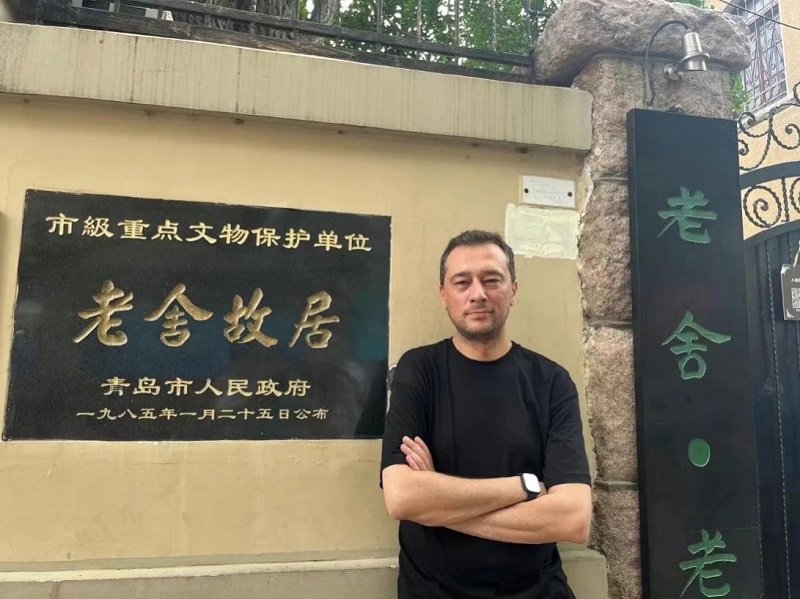
Giray Fidan poses in front of the former residence of Lao She in Qingdao, Shandong Province. (Courtesy photo)
An Answer Found in Coffee
Another change that impressed Fidan during his visits to China relates to coffee.
“China is a country of tea,” he said. “Years ago, it was hard to find a good cup of coffee, but today cafes are everywhere.” In his view, the fact that a society so deeply steeped in tea culture has embraced coffee in such a short time speaks to China's openness and grace. While safeguarding its own cultural heritage, China actively engages with the world with inclusivity and confidence, he added.
Fidan observed that in the process of modernization, every country must navigate the relationship between foreign influences and its own indigenous traditions. He cited the Communist Party of China’s “two integrations,” namely, integrating the basic tenets of Marxism with China’s specific realities and the best of its traditional culture, thereby continually adapting Marxism to the Chinese context and the needs of the times.
“Modernization does not emerge from nowhere,” Fidan explained. “Every country’s modernization must flow through its own river of civilization. China’s ‘second integration’ is the answer offered by that river.”
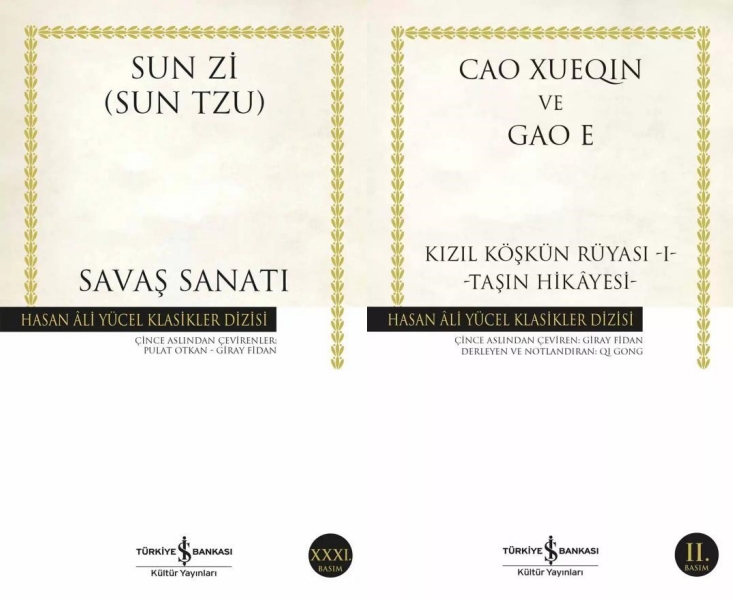
Turkish versions of The Art of War by Sun Tzu (left) and A Dream of Red Mansions by Cao Xueqin (right), both translated by Giray Fidan. (Courtesy photo)
Classics as a Window to Understanding China
Translating Chinese classics for Turkish readers is another of Fidan’s great passions.
While pursuing his doctoral degree in Sinology at Beijing Language and Culture University, Fidan attempted to translate the Chinese classics The Analects of Confucius. He quickly realized that translation is not merely a mechanical conversion of one language into another. “For example, to convey the concept of ‘benevolence’ to Turkish readers, we cannot translate it literally; we must find a cultural equivalent,” he said.
Upon returning to Türkiye, he set himself two goals: to re-translate Chinese classics, and to introduce contemporary Chinese literature to his homeland. He discovered that Turkish translations of many Chinese classics already existed, but most had been rendered from a third language, such as English, rather than directly from the original Chinese. This inevitably led to inaccuracies and omissions.
Fidan resolved to be the first to translate these classics directly from Chinese to Turkish. He started with The Art of War, collaborating with his former university professor Ou Gang. Since its publication 12 years ago, the translation has been reprinted 31 times, sparking a craze in Türkiye for ancient Chinese wisdom.
When selecting contemporary Chinese works to introduce, Fidan favors books that evoke shared human emotions and offer a glimpse of the real China today. One such work is Ordinary World, a celebrated Chinese literary classic written by Lu Yao. It tells the story of an ordinary person from the Loess Plateau striving for a better future, allowing Turkish readers to connect with its universal themes.
Currently, Fidan is undertaking his most challenge task yet: translating A Dream of Red Mansions into Turkish. He regards this project as the pinnacle of his sinological career, adding that the popularity of his previously published translations in Türkiye has greatly boosted his confidence.
“Books are the most solid bridge between civilizations,” Fidan said. Translating both classical and contemporary Chinese works like Xi Jinping: The Governance of China is his contribution to building that bridge between China and Türkiye.
From a boy enchanted by the tale of Ma Liang to a sinologist honored with the Youth Achievement Award at China’s Special Book Awards, the country’s highest international publishing honor, Fidan embodies the growing global reach of China’s cultural engagement. Today, he continues to wield his “magic brush,” not to paint pictures, but to portray the vibrant cultural exchanges between China and Türkiye, bridging the ancient roots of Chinese civilization with the aspirations of Turkish readers eager to discover China.