One person, one computer, one company. That concept came to life on July 2 at the 2026 Global Digital Economy Conference in Beijing, where the Global OPC Co-Creation Festival drew large crowds. One festival banner stood out in particular: “Come to Haidian – where one person’s dream meets a world-class stage.” Behind the banner, more than 30 one-person company (OPC) entrepreneurs made their collective debut, representing a startup revolution quietly taking shape in Beijing’s Haidian District.
Small yet Beautiful,
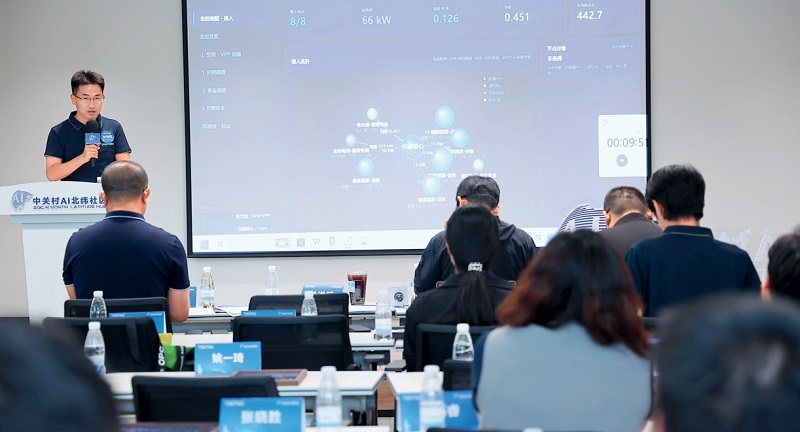
Zhang Xiaosheng speaks at a workshop held in the Zhongguancun AI Beiwei Community.
Fast yet Powerful
On June 17, 2026, the Beijing Municipal Bureau of Economy and Information Technology issued the Action Plan for Supporting AI-Driven OPC Innovation and Development (Trial). The plan explicitly calls for “accelerating the development of a vibrant and open AI innovation and entrepreneurship ecosystem, supporting young talents in starting businesses, cultivating a batch of AI-driven, modest-sized, specialized yet competitive innovation entities, and helping more OPCs grow rapidly.”
However, six months before this policy was unveiled, the transformation had already quietly begun at the Zhongguancun AI Beiwei Community, or ZGC AI NORTH LATITUDE HUB.
OPC is a novel organization in which a single entrepreneur or a very small team uses AI as a production tool to independently complete the entire business cycle, from R&D and product development to market delivery.
On December 8, 2025, when the acronym OPC was still unfamiliar to many people, the Zhongguancun AI Beiwei Community became the first innovation hub in Beijing to launch the AI OPC Service Initiative.
“We didn’t simply put up a sign,” said Dong Bo, CEO of Kr Star Innovation, the community incubator’s operator, told China Today. "We studied the entire logic, characteristics, social value, and economic significance."
In Dong’s view, the core of OPC lies in the AI prefix. “Solo entrepreneurship isn’t new, but AI technology has brought about a second wave of ‘technological democratization,’” he said. According to Dong, this wave is even more profound than the mobile internet era – disciplinary and academic barriers are being broken down; while creativity, the ability to think about scenarios, and the skill to leverage AI tools have become the core drivers of entrepreneurship.
“OPC entrepreneurs can use AI tools to compensate for gaps in specialized knowledge, turning their ideas directly into products. They don’t need massive teams to punch above their weight and solve major industry problems,” Dong added.
The entrepreneurs at Zhongguancun AI Beiwei Community bear this out. To date, more than 70 OPCs have already settled there. Most of their founders are in the post-95 or even post-00s demographic: one group with strong AI technical backgrounds, the other with deep industry expertise. Dong sums them up as “small yet beautiful” and “fast yet powerful.”
This low-barrier, high-flexibility model has quickly emerged as a new paradigm for youth entrepreneurship and employment. In April this year, Haidian District introduced special measures providing OPCs with startup funding of RMB 50,000 per year for two consecutive years, AI model subsidies of up to RMB 2 million per year, and a full suite of support services. The Beijing municipal action plan goes further, providing free “full-stack resource packages” that include token vouchers, computing power vouchers, and data vouchers, along with dedicated roadshows and compliance guidelines covering everything from financial and tax management to cross-border expansion.
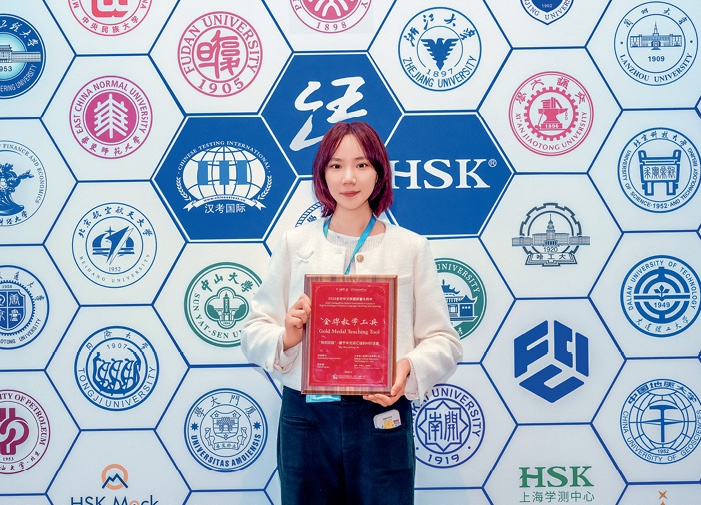
Chen Ye wins a gold medal at the 2025 ChinesePlus Global Gold Medal Projects in Digital-Intelligent Chinese Language Teaching and Learning, with her Chinese-teaching product, My Wordflow AI, which she developed using AI-assisted “vibe coding.”
A Handful Doing the Work of Thirty
Zhang Xiaosheng’s story exemplifies an agile pivot from big platform to OPC.
Before founding Vision Cangjie, he managed investments and operations for intelligent computing centers at a listed company. In that role, he identified a major trouble spot: As China carries out the Eastern Data and Western Computing project and pursues its carbon peaking and neutrality goals, computing centers are shifting to western regions rich in green electricity. However, a massive coordination gap exists between electricity and computing power.
“Electricity is generated and used in real time; while computing power is consumed continuously. How can unstable wind and solar power efficiently and stably support expensive intelligent computing centers? This is a blank space with no national or industry standards,” Zhang said. In 2023, when ChatGPT sparked a new wave of AI, he identified a technological opportunity to solve this problem and decided to enter the OPC field.
Zhang’s core team consists of just three to five people: a chief technology officer with expertise in model architecture, a principal investigator responsible for engineering implementation, and an expert well-versed in power systems. Yet this small team has leveraged what traditionally would require a R&D department of 20 to 30 people and an annual budget of RMB 15-20 million.
The secret lies in the deep empowerment of AI. “We’ve integrated a large number of AI agents,” Zhang said. They fed decades of power-industry experience and data into their self-developed AI system, creating an integrated dispatching brain – a self-developed intelligent scheduling system whose core function is to achieve collaborative optimization among the three dimensions of electricity, carbon emissions, and computing power. From code generation and documentation to data analysis and client communication, AI agents share the workload. This “human-machine collaboration” model keeps monthly costs far below traditional levels.
After settling into the Zhongguancun AI Beiwei Community in March, Zhang experienced benefits far beyond physical workspace. “The community connected us with vetted top-tier law and accounting firms. They also helped us apply for policy support and even organized dialogues with the Minister of SMEs and Startups of the Republic of Korea. That kind of overseas networking was unimaginable when we worked alone,” Zhang said.
Even more valuable was the community’s role as a virtual partner. Startup mentors helped him avoid pitfalls in advance on critical decisions like intellectual property (IP) protection and equity structure design. “In the AI field, IP protection and data rights confirmation are extremely complex. The mentors’ guidance helped us avoid many potential pitfalls down the road,”
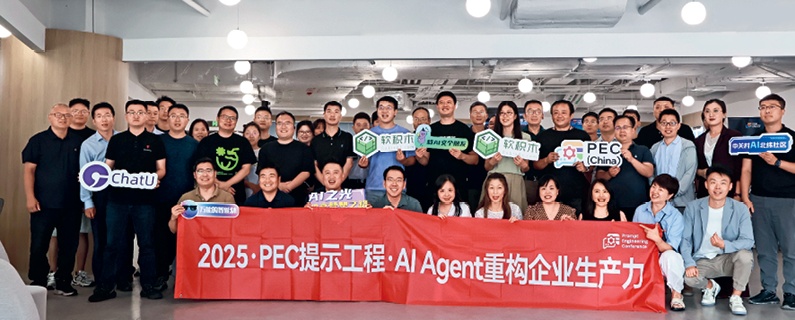
Participants take a group photo during the themed salon event on “PEC Prompt Engineering • AI Agent Reconstructing Enterprise Productivity,” hosted by the Zhongguancun AI Beiwei Community.
From Chinese Teacher to AI Maker
If Zhang represents the path of technically minded entrepreneurs, Chen Ye’s story demonstrates the potential of a humanities graduate in the AI era.
Chen Ye is a doctoral candidate of international Chinese smart education at Beijing Language and Culture University. She has devoted herself to Chinese-language teaching as a foreign language throughout her academic journey from bachelor’s through doctoral studies, and has served as a volunteer Chinese teacher in the Republic of Korea and as a government-sponsored Chinese teacher in the United Kingdom.
Last November, she won a gold medal at the 2025 ChinesePlus Global Gold Medal Projects in Digital-Intelligent Chinese Language Teaching and Learning, with her Chinese-teaching product, My Wordflow AI, which was developed using AI-assisted “vibe coding.” Since then, Chen has registered Beijing Yanhuo Education Technology Co., Ltd. and become an OPC entrepreneur.
“I was a Chinese teacher, teaching foreigners Chinese,” Chen said. While many people find it hard to connect her with being a tech entrepreneur, she independently developed a teaching product using AI tools.
The inspiration came during her time teaching at a school affiliated with University College London, where many students with special educational needs like ADHD and autism were overlooked in traditional classrooms. “As a teacher, I can’t help them all that much. The confidence they built up during the day can easily be worn away by the lack of a supportive family environment,” Chen said. So she designed an AI learning companion named “Longado,” a cute little dragon that offers cheerful, caring, and proactive support, helping children learn Chinese through practice based on comprehensible input.
The product’s core methodology is grounded in years of research into how vocabulary is memorized. Specifically, it takes the 11,092 HSK exam vocabulary words and classifies them at a granular level based on relevance across four to five dimensions, creating a “vocabulary chain” that works much like a large model’s adaptive recommendation engine. And turning that research idea into a functional product engine? She did it entirely on her own after setting up her company, using AI tools. “I never could have imagined this before,” Chen said, “but now AI makes it all possible.”
Chen’s core workflow runs entirely on an AI tool chain, using Claude and Codex to generate teaching web pages and management platforms, Jimeng for ancient-style instructional videos, and DeepSeek for low-cost web-game development. This tool chain directly replaces roles that traditional edtech companies would staff with front-end developers, user interface designers, video producers, and quality assurance engineers.
After settling into the Zhongguancun AI Beiwei Community in April of this year, the community’s accelerator brought in top-tier accounting and law firms to build a complete knowledge system for OPC entrepreneurs, covering everything from equity structure to IP protection. “I didn't even know the difference between a basic account and a general account,” Chen recalled. “Bank account opening, tax compliance … all of this was completely new to me.”
What impressed her even more was that a financial mentor not only helped her analyze her company structure, but also took her to SME forums and Middle East partnership meetings, opening a second growth curve for Chen’s overseas business. At the Global Digital Economy Conference, the Zhongguancun AI Beiwei Community provided free exhibition booths for OPCs. She received 20 orders in a single afternoon.
From Identity to Ecosystem
The main drawcard of the Zhongguancun AI Beiwei Community for these OPCs is “identity recognition.” “When they don’t even know what to call themselves, they suddenly discover a place that explicitly welcomes OPCs – this sense of belonging comes first,” Dong said, and it is built on the community’s unique service system.
Operated jointly by private enterprises, collective economy entities, and district-owned enterprises, the community has an innate capacity for innovation. It has rolled out a full-service framework structured around “1 Super Server + 4 Empowerment Pillars + 3 Stage Acceleration Engines,” covering the entire lifecycle from space and technology to financing and industrial implementation.
“How to become a real entrepreneur and how to sell products are the two core challenges OPCs face,” Dong said. To address this, the community launched its first AI OPC Accelerator in February. Two cohorts have gone through the program to date, systematically refining over 50 teams in areas ranging from technical prototype to business model. At this year’s “Entrepreneurship Beijing” OPC Competition, both first-prize winners came from this accelerator.
To facilitate the most difficult task of closing the business loop – the community has established a “Link Day” mechanism for regular matchmaking with industry-leading enterprises, and introduced a “Scenario List” to precisely connect mature OPC projects with exhibition spaces, roadshows, and media resources.
The Zhongguancun AI Beiwei Community’s practice has moved far beyond simple space operations. It now forms a unique “industry-academia-research” synergy with institutions like the National University AI Technology Transfer Center and Zhongguancun College. AI doctoral students from the college incubate projects, while the community directly takes on their industrial commercialization, linking the entire industrial chain from research to entrepreneurship.
“OPC is first and foremost a way of starting a business – it’s not a fleeting trend,” Dong said. The mission of OPC, he said, is not only to create new employment pathways but also to empower the real economy and play a unique role in the national “AI Plus” strategy.
“Our sample size is still small, and not many OPCs have real commercial orders yet,” Dong said. “But the trend is clear. What we need to do is keep running ahead and build the friendliest, most vibrant innovation ecosystem for the growth of OPCs.”
From Zhang Xiaosheng’s power-computing synergy and Chen Ye’s AI-powered Chinese education, to the more than 70 other OPCs clustered at the Zhongguancun AI Beiwei Community, a new AI-driven entrepreneurial paradigm is rapidly taking shape in Beijing’s Haidian District. These OPCs may be small in scale, but with minimal assets and cutting-edge technology, they are redefining the boundaries and possibilities of entrepreneurship.