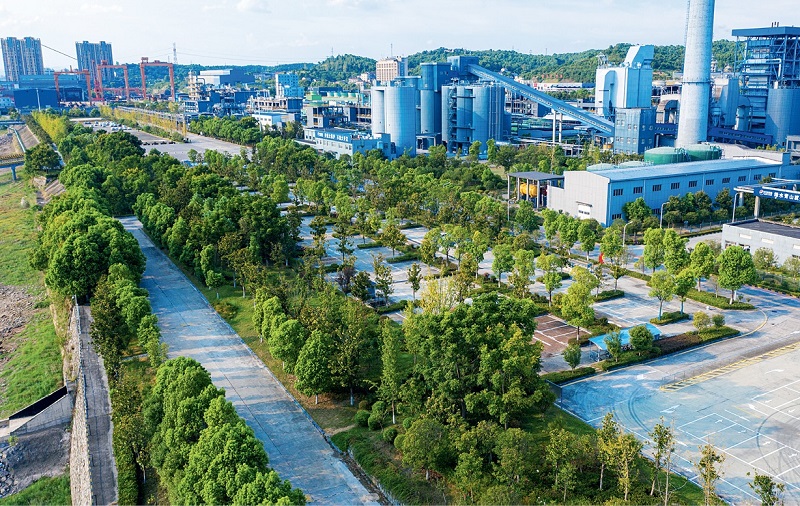
Yichang, a city in Hubei Province, sits at the junction of the middle and upper reaches of the Yangtze River. The river’s main stem flowing through the city accounts for nearly a quarter of the Hubei section, which in the past was crowded by pollution-spewing chemical plants.
But today, where industrial scars were once a health hazard, ecological restoration has blossomed. It’s a transformation that stems from a decade of sustained efforts in ecological governance and industrial restructuring in Yichang.
Breaking the Deadlock
A dull thunder broke the riverside silence in the Xiaoting District of Yichang, on September 9, 2018. The 60-meter-tall chimney of Xingrui No.1 Thermal Power Plant owned by Hubei Xingfa Chemicals Group Co., Ltd., a fine phosphorus chemical enterprise, collapsed in a large cloud of dust.
This demolition marked a turning point for Yichang in its breaking free from the predicament of “chemical plants hemming in the Yangtze.” The city took decisive action against its chemical industry, which had an output value exceeding RMB 100 billion. Lured by easy access to the waterway, more than 100 chemical enterprises had once squeezed into a one kilometer riverbank section. Their chimneys, pipelines, and warehouses physically cut the city off from the Yangtze.
The toll was a gravely overburdened river. Industrial wastewater, unregulated mining, and vessel pollution rapidly degraded the water quality of China’s mother river. The Yangtze was seriously ill.
In 2016, the strategic guideline of “prioritizing well-coordinated conservation while avoiding excessive development” brought new hope. Two years later, during his inspection tour of the Yangtze River Economic Belt, Chinese President Xi Jinping’s first stop was Xingfa Group’s Yichang New Material Industrial Park. A clear rule was set: put the ecological restoration of the Yangtze front and center, and pursue sound, orderly, and high-quality development underpinned by ecological conservation.
“We had already torn down riverside facilities and wharves, and sealed off sewage outlets,” recalled Li Shubing, chief engineer of Xingfa Group. “Vacant land was turned into green belts. One production installation was preserved and repurposed as part of an ecological study base.”
It was no easy task. Many pondered the same questions: What about the substantial financial losses? What would become of workers once the equipment was dismantled?
Xingfa Group was indeed at a crossroads. “Domestic traditional production capacity kept expanding, while high-end products faced foreign constraints, posing grave challenges to our competitiveness,” Li said. Xingfa realized that failure to pursue transformation and upgrading would spell disaster for it, and hence moved toward greener, high-end production.
Growing pains from transformation were inevitable. Xingfa vacated over 50 hectares of land once occupied by factory buildings, warehouses, and workshops, dismantling assets worth more than RMB 1.3 billion. In return, 900 meters of pristine Yangtze riverbank were restored. Through this process, the enterprise also achieved its phoenix-like rebirth. In 2025, Xingfa Group posted sales revenue of RMB 65.635 billion, with its products sold to 142 countries and regions worldwide.
Xingfa is far from an isolated case. Starting in 2017, Yichang rolled out a comprehensive greening plan for 134 riverside chemical enterprises – closure, renovation, relocation, and production shift. This multi-pronged approach turned the predicament of “chemical plants hemming in the Yangtze” into a prelude to renewal.
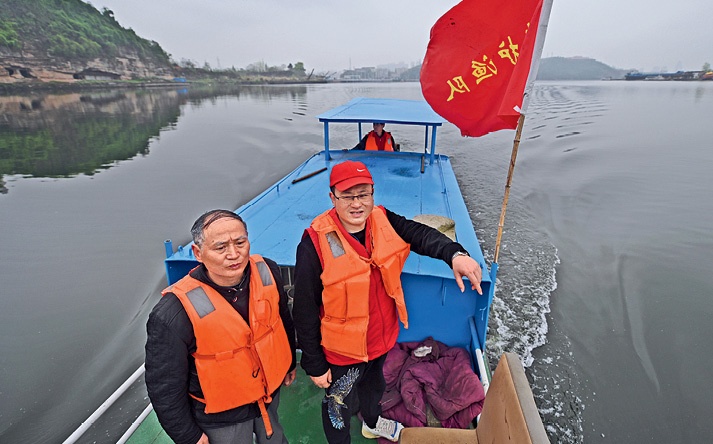
A fish protection team patrols the no-fishing waters of the Xiling section of the Yangtze River in Yichang City, central China’s Hubei Province.
Rebirth and Repurposing
Glyphosate herbicide is Xingfa’s flagship product. Yet its byproduct, methyl chloride, was once hazardous waste, which meant high transportation costs and immense safety and environmental pressures. “Later we found methyl chloride serves as a vital raw material for producing organosilicon monomers (chemical building blocks used to make silicone),” explained Li. Today, methyl chloride flows directly through pipelines into organosilicon production lines. In turn, dilute hydrochloric acid, a byproduct from organosilicon manufacturing, is reused as feedstock for glyphosate production.
Thus, a complete closed-loop cycle is taking shape, with no absolute waste, only resources misplaced. Following this circular logic, yellow phosphorus for glyphosate production can also yield high-grade electronic-grade phosphoric acid. Industrial salt, indispensable for organosilicon manufacturing, undergoes electrolysis to generate chlorine gas. The chlorine is deployed to make glyphosate feedstock and also turned into electronic-grade hydrogen peroxide for chip cleaning and etching.
Xingfa boasts another industry-leading recycling technology that recovers phosphorus from wastewater to produce caustic soda, generating more than RMB 100 million in recovered value annually. This achievement makes Xingfa one of only four glyphosate manufacturers nationwide to pass inspections by the Ministry of Ecology and Environment.
By tapping into the symbiotic and coupled relationships between different product lines, hazardous industrial waste was transformed into high-end raw materials. This waste-to-treasure “chemical reaction” has extended Xingfa’s industrial chain and increased product added value.
Continuous circulation raises the overall value of the whole industry. Xingfa independently developed the concentrated acid hydrolysis process in 2014. “The old hydrolysis process produced hydrochloric acid as a byproduct. Our new technology directly yields methyl chloride, cutting intermediate steps and lowering costs and energy consumption,” Li said. “This technology has now been adopted across the sector.”
In high-end electronic chemicals, proprietary technologies from Xingfa have expanded the range of usable phosphate rocks from those with the phosphorus pentoxide content above 68 percent to those as low as 16 percent. The group also extracts associated fluorine from phosphate rocks to produce electronic-grade hydrofluoric acid, breaking foreign monopolies. “Leveraging strengths in our phosphorus chemical chain, we have moved from following and keeping pace with foreign peers to leading in selected areas. Our high-end phosphorus-based new materials hold a flagship position globally,” Li said.
Sustainable Investment in Sci-Tech Innovation
Confidence for transformation comes from sustained investment in scientific and technological innovation. Xingfa has poured RMB 520 million into building the Hubei Three Gorges Laboratory. It collaborates with universities and other enterprises to build R&D platforms, foster clustered growth of industrial chains such as organosilicon, and tackle common technical hurdles, including phosphogypsum (a byproduct used to make phosphate fertilizers) utilization. Robust innovation has not only strengthened the group but also turned it into a magnet for talented personnel. “Previously, a company in a third-tier city like ours could hardly recruit highly educated professionals,” Li said. “Now the company has 75 PhD holders and 508 staff members with masters degrees, providing an endless stream of momentum for technological breakthroughs.”
At Xingfa’s smart management center, production data across the nearly 700-hectare park is displayed in full view. Five large screens line the wall, triggering instant alerts for any anomalies. “Manual monitoring has given way to robots, lifting the level of intelligence and automation,” Li said.
After almost a decade, ecological protection has not held back economic growth; instead, it has accelerated it. Relocating facilities away from the Yangtze riverbank has not pushed up logistics costs as some expected. Hubei Province specially approved two wharfs within the industrial park to support raw material inflow and pipeline direct transportation of hazardous chemicals. To assist, the nearby Yunchi Deep-Water Port and the Yichang Comprehensive Bonded Zone provide services enabling the enterprise to complete customs clearance right at its doorstep.
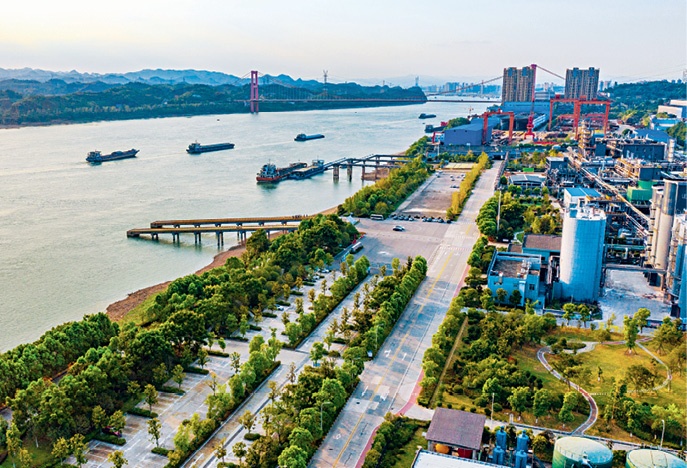
Xingfa Group has restored a clean river shoreline by removing buildings within one kilometer of the Yangtze at its Yichang New Materials Industrial Park.
 Volunteers Take Action
Amid vigorous overhaul of chemical enterprises in 2018, Ding Wanming, Party secretary of Tongling Community in Xiaoting District, took the lead to form a volunteer team with six retired members of the Communist Party of China. With funds donated by concerned enterprises, they built a floating garbage collection vessel to clear litter from the river. No one expected that this small team would grow into a large community boasting more than 14,000 registered volunteers.
“In the beginning, our work was simple: collecting floating debris and cleaning river shores. Gradually, we expanded to ecological outreach, law-based river protection, and water source conservation,” explained Li Shanshan, deputy director of a volunteer service center named Yangtze River Sentinels, an overarching volunteer group of Xiaoting District. Various volunteer groups work in tandem, drawing far more participants than the registered number. Among them are octogenarians who handwrite their work summaries on river protection. The volunteer community also includes fishermen who have discarded their nets following the fishing ban and young parents who bring their kindergarten-aged children to join activities.
“At first, many believed protecting the Yangtze was solely the government’s responsibility and had nothing to do with ordinary people. Now this mindset has completely changed,” Li said.
Nestled next to the New Materials Industrial Park of Xingfa Group, the Yangtze River Protection Education Center serves as a time archive documenting Yichang’s decade-long efforts to safeguard the Yangtze. Its exhibition hall features striking before-and-after photos. One photo captures a flock of egrets gracefully taking off along the Yunchi River. One year after remediation, egrets that had vanished for more than 20 years returned to nest here.
A primary tributary of the Yangtze, Yunchi was once choked with industrial waste and household garbage, a foul waterway locals avoided. Thanks to systematic remediation including pollution interception, sediment dredging, bank greening, and pipeline upgrades, the river has regained clear waters and lush banks, flowing smoothly into the Yangtze. Spurred by volunteer campaigns, nearby residents have learned to dispose of domestic waste properly and formed the habit of picking up litter, sustaining this pleasant living space.
Strolling along the Yangtze bank near the center, former coal yards and docks have been transformed into a park with thriving grass and birdlife. The Lighthouse Square, rebuilt through ecological restoration, has become a city landmark. Li commutes along the riverside every day and witnesses the steady environmental improvement. “Walking this route lifts my spirits and boosts my sense of wellbeing.”
Over a full decade, Yichang has answered a global question: are ecological protection and economic development inherently at odds? Since its opening more than five years ago, the Yangtze River Protection Education Center has welcomed over 2,000 international visitors to learn about local practices. To many, the greatest value of Yangtze River protection lies in its refusal to pit ecological conservation against industrial development and livelihood improvement. Instead, a systematic, complete policy framework balances residents’ livelihoods and watershed restoration, blazing a path toward sustainable governance.
Not long ago, Li led a group of children in a shore-cleaning activity. A young child passing by asked: “Can I join you?” That simple question carries greater weight than any statistics or reports – it means seeds of conservation have been planted in the hearts and minds of the next generation.
Just as a deafening blast a decade ago marked the end of the old development model, the child’s innocent inquiry today sparks vision for the future. The simple yet profound philosophy that lucid waters and lush mountains are invaluable assets has become a reality along the Yangtze River.