The Central Axis is the centerpiece of the Chinese capital’s urban spatial layout. The southern extended section of the Central Axis, or the South Central Axis, stretches from the Yongdingmen Gate Tower in the north to the South Fifth Ring Road in the south. While being a strategic transport link facilitating the coordinated development of the Beijing-Tianjin-Hebei region, it also showcases China’s vision for the future and highlights its cultural confidence.
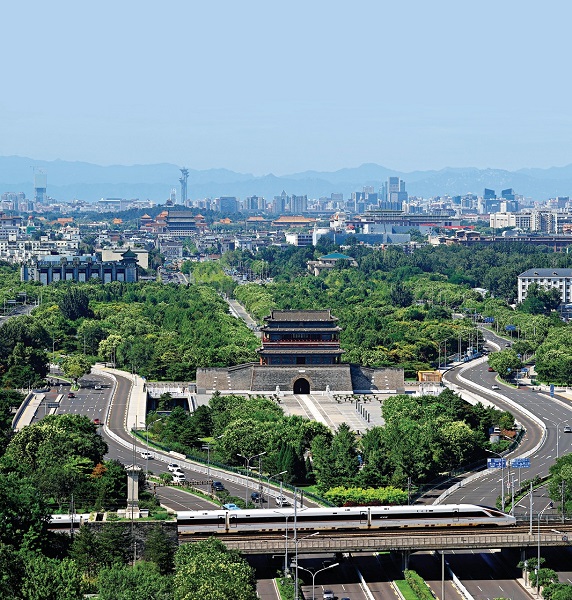
A Fuxing high-speed train passes Yongdingmen Gate, the landmark architecture at the southern end of Beijing's Central Axis.
Digital Intelligence Renewal
Walking into the Dahongmen Smart Industry Building located along the South Central Axis, one is immediately impressed with its advanced technology. The exterior is modern and magnificent, featuring a glass curtain wall on the outside of the structure.
The building’s total construction area is approximately 97,000 square meters. When completed, it will focus on attracting digital and intelligent industries, as well as businesses providing technology services.
“In the past, I thought constructing projects was demolishing old buildings and building new ones. This time, I do construction on an old building whose framework has been kept. I’m dealing with green materials and intelligent systems,” said Liu Xu, a worker doing the curtain wall installation.
“We have kept our traditional craftsmanship, but utilized a fully digitized management system. By scanning a code on the materials, you can immediately know their origin, and the progress is displayed in real time on large screens,” said Sun Nan, who works on assembling.
According to Tang Jia, chief designer of the renovation project, the building was originally used for clothing wholesale. The renovation plan complies with the urban image of the South Central Axis, creating a life-friendly structure while at the same time realizing ecological and environmental protection.
The beauty of the Central Axis is artistically rendered on the exterior curtain wall which has a large red frame decorated with approximately 14,000 adjustable illuminants. Inside, there are eco-friendly and intelligent offices and commercial space. The rooftop is also used as green space and a venue for public activities. Once completed, it will become a model of urban renewal along the South Central Axis.
“During the construction, we implemented full-process digital lean management through Building Information Modeling, and systematically integrated green technology, such as photovoltaics and water source heat pumps, which increase the overall energy-saving rate to 21.38 percent,” said project leader Zhou Jing. “We are currently building an intelligent digital platform to make services in the building more convenient. Nearly 200 companies have already moved in, and several interested parties are in the process of negotiations. The building is expected to be completed during the first half of 2026. We hope that through our efforts, it will become a new landmark on the South Central Axis.”
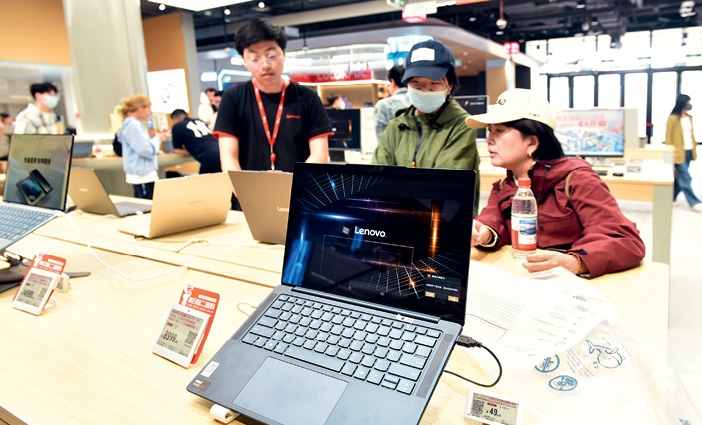
The JD MALL located on the South Central Axis is the largest and most cutting-edge JD offline flagship store in North China.
Digital and Cultural Integration
Dahongmen Garment Mall was once a sprawling garment wholesales market along the South Central Axis. It is now replaced by a modern and technologically sophisticated cultural and tech park — the South Central Axis International Cultural and Technology Park.
Highlighting next-generation information technology, the park is dedicated to promoting industries connected to metaverse and commercial aerospace. Currently, more than 500 enterprises have built offices in it, many of which are engaged in such popular sectors as integrated circuits and artificial intelligence. An industrial cluster is taking shape.
Companies in the park share a common vision — technological innovation. According to Ma Lidong, CEO of Yunxi (Beijing) Cultural Technology Co., Ltd., the reason he chose to develop his company here was that the park has a prime position in Beijing’s new business district, as well as an enabling atmosphere and comprehensive policy support for technological innovation.
Yunxi provides integrated technological solutions to businesses in the metaverse industry. With its strengths in xR, AIGC, and Audio Vivid technology, it has established the xR Cloud Performance Center, a virtual filming studio and digital performance base.
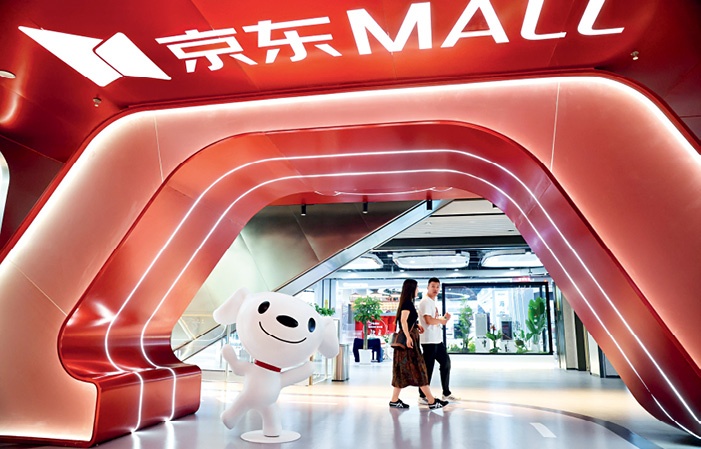
Visitors walk through the JD MALL in Beijing which has become an offline experience store that integrates shopping, entertainment, and leisure.
A New Benchmark for Tech Consumption
As the largest and most cutting-edge JD offline flagship store in North China, the JD MALL located on the South Central Axis has become a striking example of urban renewal as a result of its extensive technological experience.
The building used to be an idle commodity wholesale project in 2016. After being upgraded and transformed by JD.com, it has become an offline experience store that integrates shopping, entertainment, and leisure, integrating home appliances with home furnishings in everyday life scenarios.
“In addition to shopping, it is the perfect place for children to explore. The entire mall integrates AI technology, allowing close encounters with humanoid robots, robotic dogs, and other cutting-edge tech products that continuously fascinate children. It also makes shopping much more enjoyable,” said Ms. Wang, a customer.
According to her, the wide range of choices provided by offline stores allow customers to compare product performance and prices in person. All in all, purchasing costs are low and customers enjoy an excellent shopping experience in such stores.
In 2025, JD MALL’s annual sales ranked first among the e-commerce giant’s stores nationwide, with foot traffic to the store exceeding 100,000 visitors during major promotional events. Multiple business performance indicators consistently rank at the forefront of regional home appliance and home furnishing markets. Besides, offline AI technology consumption scenarios make technology products perceivable, accessible, and purchasable.
According to the Central Urban Work Conference held in Beijing in July 2025, urban renewal should be used as an important lever for optimizing urban structures, transforming growth drivers, improving quality, advancing green development, preserving cultural heritage, and enhancing governance efficiency. At the same time, the red line of urban safety should never be crossed. The combination of all these elements will help blaze a new path for urban modernization with Chinese characteristics.
According to Wang Shaofeng, Party chief of Beijing’s Fengtai District where the South Central Axis is located, Fengtai will proactively integrate itself into the modernized capital metropolitan area and the coordinated development of the Beijing-Tianjin-Hebei region. This will enhance its development capacity through the coordinated connectivity of transportation, talent, and industry. Moreover, the district will thoroughly implement the concept of building a people-oriented city, explore distinctive urban renewal models, improve an all-age-friendly service system, and diligently address the urgent concerns of the public, transforming development achievements into tangible and perceivable benefits for the people.