The four-day visit of British Prime Minister Keir Starmer to China – the first by a U.K. Prime Minister in eight years – has marked a significant step toward stabilizing and deepening bilateral relations, with financial and economic cooperation emerging as a cornerstone of the renewed engagement. Accompanied by a delegation of nearly 60 representatives of businesses and cultural organizations, including executives from HSBC, GSK, Jaguar Land Rover, and Airbus, the trip underscored a shared commitment to translating diplomatic dialogue into tangible economic outcomes.
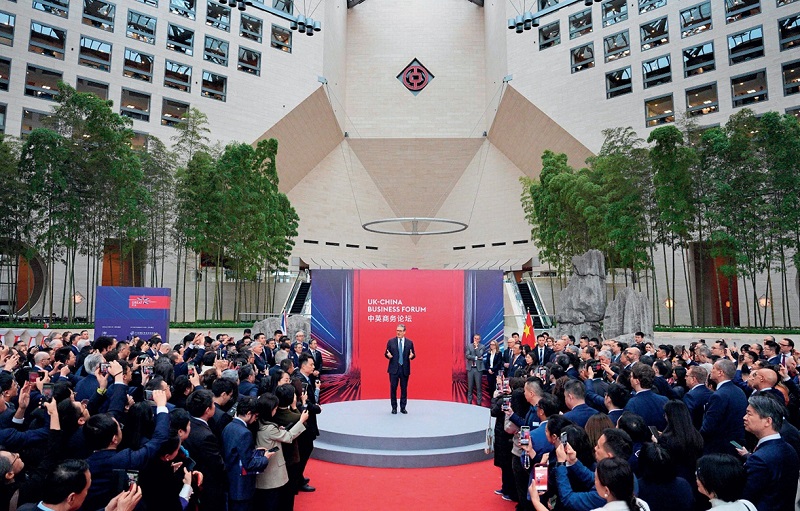
British Prime Minister Keir Starmer delivers a speech at the UK-China Business Forum in Beijing on January 30, 2026.
Rebooting Dialogue, Anchoring Stability
During their meeting in Beijing on January 29, Chinese President Xi Jinping and the U.K. Prime Minister both agreed to develop a long-term and consistent comprehensive strategic partnership between China and the U.K.
Xi noted that the two sides need to see history from a broader perspective, rise above differences, respect each other, and turn the vast potential of China-U.K. cooperation into real progress. This will open up new prospects for China-U.K. relations and cooperation, for the good of both peoples and the whole world.
This tone of pragmatic engagement was echoed by Starmer. During an informal press briefing aboard his flight to Beijing on January 28, Prime Minister Starmer reflected on the historical volatility in the bilateral ties, noting that British policy had swung between the golden era and the ice age in a way that was “inconsistent, turbulent, and non-pragmatic.” He emphasized that a key objective of his visit was to inject clarity and stability into the relationship.
The visit yielded a structured framework for relaunching high-level dialogues. Both sides agreed to hold a new round of strategic and economic-financial dialogues within the year, resume high-level security dialogue, and establish a high-level climate and nature partnership. These mechanisms are designed to provide institutional ballast for the relationship, ensuring that engagement remains continuous and resilient amid geopolitical uncertainties.
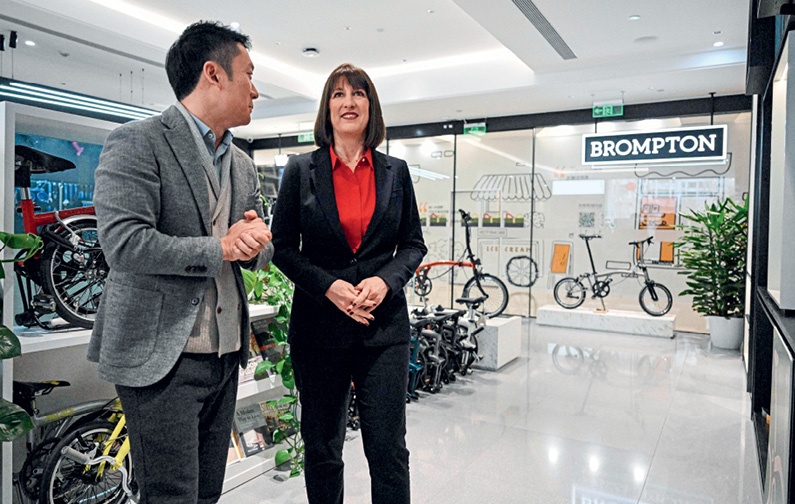
U.K. Chancellor of the Exchequer Rachel Reeves visits the Brompton flagship store in Beijing on January 11, 2025.
Financial Collaboration as a Centerpiece
A standout achievement was the formal launching of the China-U.K. Financial Working Group and the convening of its inaugural meeting. Practical bilateral cooperation in areas, such as Renminbi (RMB) internationalization, green finance, and capital market connectivity, is expected to advance. In a significant move, Bank of China’s London branch was designated as the second RMB clearing bank in the U.K., a step that will enhance London’s role as a leading offshore RMB hub and facilitate smoother cross-border transactions.
The business community has responded positively. In an interview with China Today, Li Ge, CEO of Shanghai Pudong Development Bank’s (SPD Bank) London branch, noted, “Finance serves as an anchor for China-U.K. traditional cooperation,” predicting “structural, institutional opportunities” in the coming year. He highlighted SPD Bank’s participation in pioneering deals, such as Barclays’ issuance of a RMB 3.5 billion panda bond in January 2026 – the first by a U.K. financial institution in China’s interbank market – as evidence of deepening market integration.
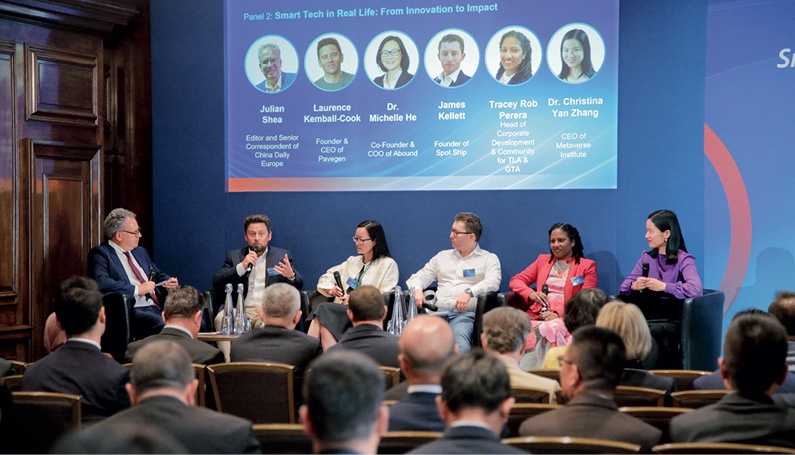
The Sino-UK Entrepreneur Forum is held in London on May 14, 2025. It is jointly organized by the U.K.’s 48 Group and China Daily and attended by nearly 200 participants from British sectors of politics, finance, trade, technology, and education.
Solid Economic Groundwork, New Collaborative Frontiers
The momentum for collaboration is underpinned by robust trade ties. In 2025, bilateral goods trade reached US $103.7 billion, while two-way investment stock approached US $68 billion. The 2026 U.K.-China Business Council meeting, which convened on January 29, agreed to further strengthen investment flows, with both sides witnessing the signing of 12 intergovernmental cooperation documents spanning trade, agriculture, culture, and regulatory oversight.
As China kicks off its 15th Five-Year Plan (2026-2030), looking ahead, President Xi highlighted emerging sectors – artificial intelligence, life sciences, new energy, and low-carbon technology – as priorities for joint research and industrial application between the two sides. He also urged the U.K. to provide a “fair, just, and non-discriminatory” business environment for Chinese companies.
According to the latest Report on the Development of Chinese Enterprises in the U.K. released by the China Chamber of Commerce in the U.K., 64 percent of Chinese enterprises in the U.K. expressed optimism about the prospects of China-U.K. cooperation. The majority of these enterprises are committed to long-term development in the U.K. and plan to engage in more collaborations with local businesses. Chinese enterprises in the U.K. not only continue to create employment opportunities but also contribute positively to the U.K. economic transformation and social development in areas such as green finance, clean energy, and technological innovation.
SPD Bank London branch is also a member of the China Chamber of Commerce in the U.K. Since its official opening in February 2018, it has responded to the needs of Chinese clients’ “going global” and local clients’ “bringing in,” focusing on supporting China-U.K. cross-border supply chains, cross-border mergers and acquisitions, green bonds, and financial market transactions between China and the U.K., among others, thereby facilitating economic and trade cooperation between the two countries.
Regarding the main opportunities for bilateral cooperation in the financial sector in the coming year, Li Ge, CEO of SPD Bank London branch, observed that key areas primarily involve RMB internationalization, capital market connectivity, green and sustainable finance, as well as cross-border finance.
Prime Minister Starmer’s China visit represents a conscious shift away from the ideological pendulum that has characterized China-U.K. relations in recent years. By prioritizing economic pragmatism and institutional dialogue, both countries are laying the groundwork for a more predictable partnership. As the British Chinese Chamber of Commerce noted in its official WeChat release, a “stable, predictable, and transparent policy environment” is the bedrock for long-term investment. With economic collaboration leading the way, China and the U.K. are poised to transform a decade of diplomatic uncertainty into a new chapter of calibrated cooperation.