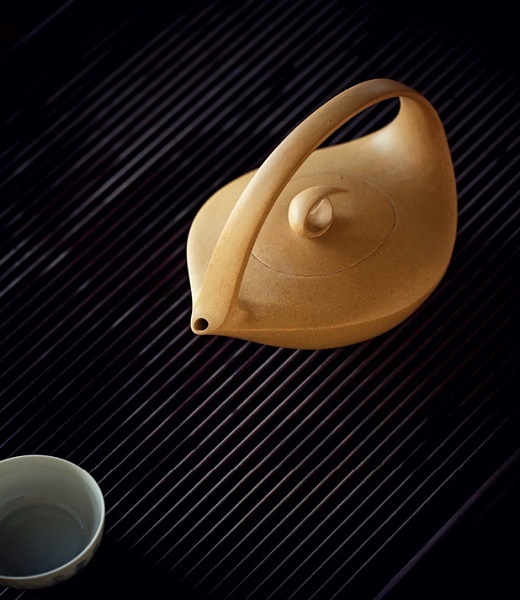
Fan Weiqun’s work Wuxiang is selected for an International Tea Day stamp issued by the United Nations Postal Administration.
The techniques of making Yixing purple clay teapots were listed among the first batch of national intangible cultural heritage in 2006. The inheritor of this art, Fan Weiqun, is the vice chairman of Jiangsu Ceramics Professional Committee and was honored with the title of Jiangsu Craftsman.
Born into a family of dedicated ceramic artists, Fan was deeply influenced by the atmosphere from an early age. His interest in this art and the instruction he received from such renowned masters as Xu Hantang prepared him to later become the fourth-generation successor of the Dasheng Teapots. Over the years, he has created more than 100 purple clay works, which are highly cherished by collectors.
As a result of his contributions to this art, he has been invited to hold exhibitions in the U.S., France, the U.K., EU countries, Japan, the Republic of Korea, Singapore, as well as in China’s Taiwan, Hong Kong, and Macao. His works exhibit fine details, aesthetic appeal, and rich cultural connotations, and have been collected by institutions such as the British Museum, the American Museum of Ceramic Art, the National Museum of Korea, and Military Museum of the Chinese People’s Revolution.
The approach he has chosen in inheriting this intangible cultural heritage is a creative balance between the physical and the spiritual, re-manifesting ancient inspirations in a contemporary context. His works infuse philosophical thoughts on beauty, order, life, and time into tangible ceramics. They hence can be regarded as philosophical essays written in the language of purple clay.
Fan’s creations never adhere strictly to a single art technique or form. They represent his own tangible answer to the question of “what is existence.” This makes each of his teapots not only an exquisite work of art but a living historical record that carries the pulse of the era and reflects collective aesthetics and spiritual pursuits of the Chinese people.
For example, the notions of “heaviness” and “lightness” displayed in his work Wending (inspired by ancient Ding, a ritual tripod cauldron): this masterpiece reimagines the “heaviness” of bronze — symbolizing the weight of history, power, and rites by creating a sense of lightness with the uniquely warm and subtle texture of purple clay. This is not merely a transformation of materials but a philosophical reinterpretation, carrying grand narratives (the weight of bronze) with a humble heart (the softness of purple clay). It explores the wisdom of making the heavy seem light in the inheritance of civilization.
Another example is the “Being” and “Non-Being” exhibited in his work Wuxiang (Formless), which was selected for an International Tea Day stamp issued by the United Nations Postal Administration. It is extremely minimalist. However, it is precisely this “Non-Being” that encompasses the potential of all “Beings.” It guides the user to transcend concrete forms and directly points them to the original intention behind the piece of art, which corresponds to Taoist teaching about the tangible and intangible and Zen’s wisdom, “form is emptiness.” It transforms a simple teapot into a tool for contemplating one’s inner self.