For busy office workers in China, when a much-anticipated public holiday approaches, many choose to leave their homes for a short getaway. However, at popular tourist destinations across the country, visitors often arrive in massive crowds. As a result, navigating through the hustle and bustle while trying to enjoy the trip can often leave one utterly exhausted. Fortunately, technology is reshaping many of these experiences.
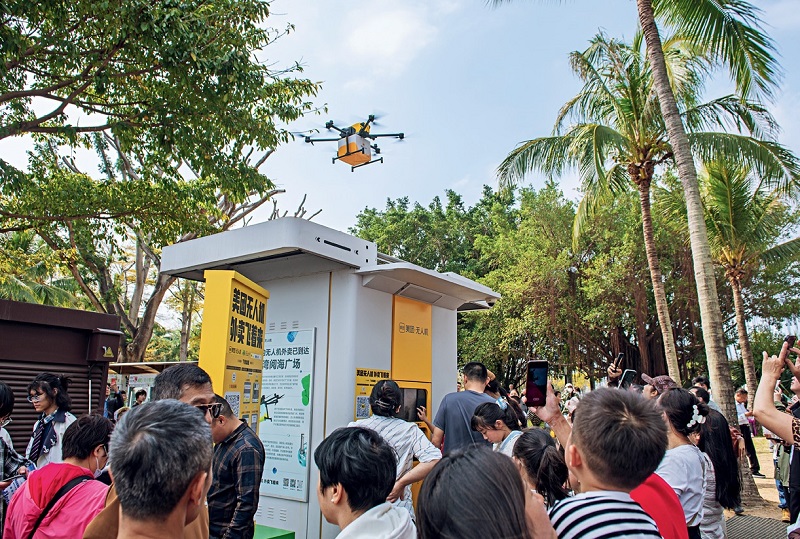
People try out drone food delivery services at a drone service station in Shenzhen Bay Park on February 19, 2026.
Much Easier to Find Your Car
During the Spring Festival travel rush in February of this year, Hangzhou East Railway Station saw peak passenger flows. Late at night, high-speed trains arrived one after another, each packed with travelers. My family and I were among them. Wheeling our luggage out of the station, we found the metro had already stopped running, so we followed the signs to the ride-hailing pickup area. After placing an order on the DiDi app, my phone screen showed more than 100 people ahead of us in the queue.
“This is going to take a while – at least an hour,” I muttered to myself. But just three minutes later, the app notified me that a driver had been matched. What surprised me even more was the real-time update on my phone showing the vehicle’s destination: “The car picking you up will be parking at space 6-2.” We were instructed to wait in the lounge until the car arrived. While waiting, a large electronic screen caught my attention – it displayed real-time updates of license plates and parking spot numbers for all approaching ride-hailing cars. When our car came, staff in orange vests guided us to our vehicle. I roughly calculated that it took me just six minutes from placing the order to settling into the car that took us to our hotel.
I was truly impressed. Such a seamless start gave me an excellent first impression of Hangzhou as a tech-savvy city.
Upon further inquiry, I learned that behind this smooth experience lies China’s first AI-assisted hub system based on “indoor audio Beidou” technology – nicknamed “Hang Xiaodong.” Since its trial launch at Hangzhou East Railway Station in late June 2025, the system has improved indoor positioning accuracy from the traditional five meters to just 0.5 meters. Passengers can activate it by scanning a QR code via Alipay or tapping NFC-enabled signs in the station. It not only provides precise navigation but also shows real-time information such as queue lengths, estimated wait times at pickup points, and even one-tap navigation to the exact parking spot of the vehicle.
In the past, waiting an hour for a ride at major railway stations late at night had become the norm for me. The biggest pain point of traditional ride-hailing pickups was the endless back-and-forth – passengers struggling to find their cars, and drivers struggling to find their passengers. Hangzhou East Railway Station, spanning 340,000 square meters, is one of the largest rail hubs in eastern China, with a notoriously complex layout. It was once common for drivers and passengers to play a frustrating game of “hide-and-seek” in the parking lot.
Now, through an audio signal-based positioning network deployed indoors, the system achieves centimeter-level accuracy and sub-meter navigation. As soon as a vehicle parks, the information is instantly synced to screens in the waiting lounge and to passengers’ phones. The station has also renovated and expanded the ride-hailing pickup zone, increasing dedicated parking spots in the P1 lot from 66 to 196. The area is now equipped with accessible parking, seating, air conditioning, and free Wi-Fi.
By the 2026 Spring Festival travel rush, “Hang Xiao-dong” had been in trial operation for seven months, significantly easing transfer pressures during the peak period. Technology brings not only efficiency, but also a reimagined experience. When anxiety and uncertainty are replaced by predictable wait times and clear guidance, much of the fatigue of travel simply melts away.
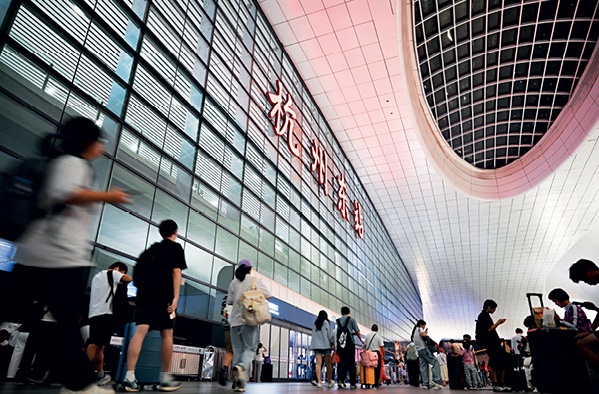
Passengers with luggage in hand bustle about the waiting hall of Hangzhou East Railway Station in Hangzhou, Zhejiang Province, on February 15, 2026, the first day of the Spring Festival holiday.
Shenzhen Bay Area: A Haven for People and Birds Alike
Thousands of kilometers south of Hangzhou lies Shenzhen – a city whose thoughtful urban management also left a lasting impression on us as visitors.
Walking along the scenic Shenzhen Bay Park, I noticed outdoor drinking water stations spaced at regular intervals. These stations are connected directly to the municipal water supply and equipped with purification systems. Through secondary disinfection and multi-stage filtration, the water meets national standards for direct drinking. What’s especially reassuring is that the park management adheres to a strict schedule for filter replacement and water quality testing, ensuring every sip is safe and refreshing.
Whether it’s residents finishing a morning jog or families spending a day outdoors, everyone can enjoy free drinking water on the go. This not only eliminates the need to carry heavy bottled water but also makes eco-friendly outings more convenient and enjoyable.
Just as I was appreciating Shenzhen’s people-first approach, I recently came across a post on the “Ask Shenzhen” platform where a netizen pointed out insufficient lighting in Shenzhen Bay Park at night, citing safety concerns and requesting more streetlights. Interestingly, the Shenzhen Park Management Center responded by declining the request.
In their reply, the management explained that Shenzhen Bay is a vital refueling stop and transit point along the East Asian-Australasian Flyway, hosting tens of thousands of migratory birds each year for wintering or rest. Adding bright lights would disrupt the local ecological balance, interfere with the birds’ circadian rhythms, and affect their roosting and migration patterns. The park has therefore retained only essential lighting at main entrances and key pathways to meet basic public needs.
Rather than causing discontent, this thoughtful refusal won widespread public support. Comments such as “This is truly heartwarming,” “A considerate approach,” and “Let the birds rest well at night – we share this home” reflected a collective appreciation for the decision.
In the past, brightly lit streets were often seen as a symbol of urban prosperity. Today, a meaningful shift in urban development values is happening.
When I checked with friends living in Shenzhen, they shared that the city’s ecological care and attention to detail extend far beyond this. In recent years, Shenzhen has introduced “bird-nest streetlights” to provide shelter for urban birds, applied anti-collision markers on high-rise glass facades, and even reserved three migration corridors for birds while planning the Shenzhen Bay Super Headquarters Base, implementing dark-sky-friendly lighting throughout. In 2025, the restored tidal wetlands of Shenzhen Bay Park reopened after ecological rehabilitation, reinstating natural tidal rhythms and offering better foraging and resting grounds for migratory birds.
This is not a simple trade-off between light and dark, or between people and birds – it is about seeking a dynamic, nuanced balance among diverse needs in a shared urban ecosystem.
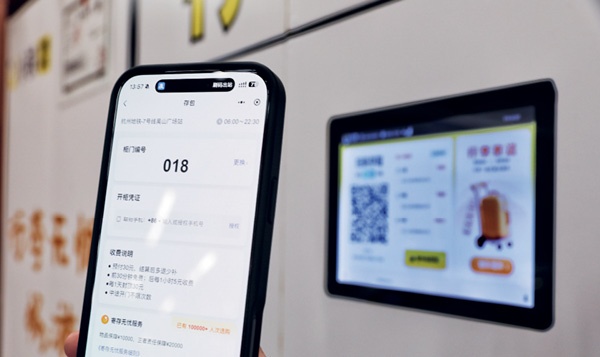
With the official launching of a “luggage depot” service on the Hangzhou Metro, tourists in Hangzhou can now enjoy hands-free traveling around the city. This opens up a brand-new smart travel experience to visitors nationwide.
Refunds for Mistaken Railway Ticket Purchases
Similarly meaningful for tourists is that the railway platform 12306 has introduced a time-limited free refund policy for mistaken ticket purchases. Starting January 19, 2026, it offers an institutional safety net for travelers’ haste and oversight – adding a touch of practical kindness to the journey.
Under the new policy, passengers who buy tickets via 12306 and realize they’ve selected the wrong date, train, or station within 30 minutes of payment – and at least four hours before departure – can process a full refund online, with funds or points returned via the original payment method. This service is available once per passenger per calendar day.
The policy responds directly to passenger needs. Among the hundreds of millions of railway trips taken each year, mistaken purchases are common – whether from rushing to book and picking the wrong date, or entering incorrect details for family or friends. Before, even if the error was spotted immediately, a tiered service fee still applied. Now, through policy optimization, the 30-minute “grace period” allows corrections without penalty.
From introducing waitlist booking to ease ticket shortages, to creating “quiet carriages” for more peaceful journeys, to piloting pet-friendly train services, and now offering free refunds for mistaken purchases – railway services are steadily evolving from merely enabling travel to genuinely enhancing its quality.
When efficiency and care go hand in hand, travel becomes more than just a movement through physical space – it evolves into an experience filled with reassurance and anticipation. On China’s path toward high-quality development, this attention to detail, respect for the individual, and reverence for nature stand as the most vivid expressions of a society’s true civility.