At the 2026 Global Governance Forum (Xiong’an), one message resonated clearly: the real foundation of global cooperation isn’t written in documents – it’s built, encounter by encounter, on trust.
The key signal in President Xi Jinping’s message to the 2026 Global Governance Forum (Xiong’an) can be distilled into a single word: certainty. As Xi observed, the deficits in peace, development, security and governance are growing rather than diminishing. His proposed remedy is a global governance system built on extensive consultation, joint contribution and shared benefits – one that pools strength through confidence-building and tackles challenges through cooperation.
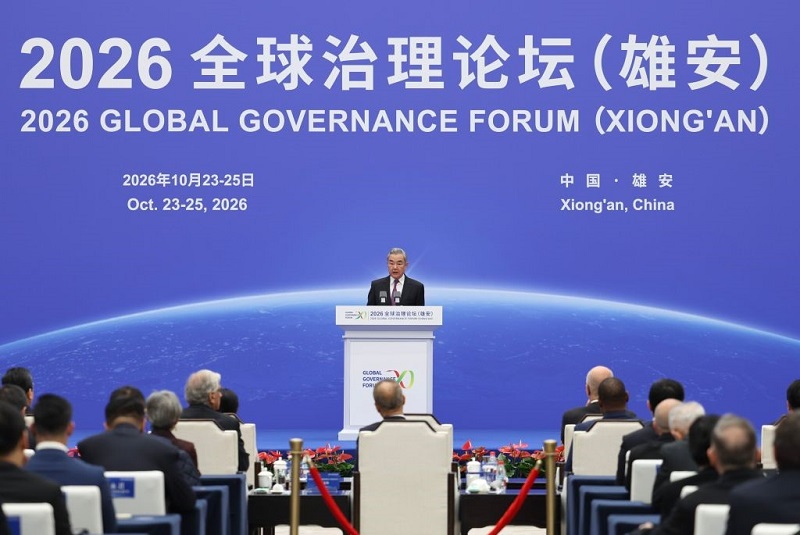
Chinese Foreign Minister Wang Yi, also a member of the Political Bureau of the Communist Party of China Central Committee, reads out a message from Chinese President Xi Jinping and delivers a keynote speech at the opening ceremony of the 2026 Global Governance Forum (Xiong'an) in Xiong'an New Area, north China's Hebei Province, Oct. 23, 2026. (Xinhua/Mu Yu)
Nearly 400 representatives and youth leaders from more than 90 countries and international organizations attended the forum held in Xiong’an New Area in north China’s Hebei Province from October 23 to 25. Hosted by the Chinese People’s Institute of Foreign Affairs under the theme “Rebuilding Confidence and Cooperation: Reforming and Improving Global Governance in a Transforming World,” the forum opened with Chinese Foreign Minister Wang Yi reading out President Xi’s message and delivering a keynote address.
That keynote address gave the theme a practical framework. One year on, the Global Governance Initiative (GGI) has won support from more than 160 countries and international organizations, while its core principles have been incorporated into documents issued by the G20, the Shanghai Cooperation Organization and BRICS. China has waived demands for new special and differential treatment in ongoing and future WTO negotiations, while extending comprehensive zero-tariff access for all African countries and least developed countries having diplomatic ties with China. Then Wang Yi further outlined eight commitments China will honor in order to build a more just and equitable global governance system together with all other countries, which include establishing a Global Governance Research Center, issuing a position paper on outer space governance, and unveiling a progress report on AI capacity-building.
Yet the forum’s most striking feature was the repeated emphasis on a deeper and more fundamental issue: trust.
One of the clearest expressions of this came from the technology sector. Nicolas Miaihe, co-founder and co-CEO of AI Safety Connect, a French organization focused on AI safety, described President Xi’s message as “very encouraging” and commensurate with “the scale of the global challenges and the collective responsibility that we have to deliver on.” Miaihe’s work centers on ensuring that AI remains safe, secure, and beneficial to all. But the obstacles, he warned, are formidable: geopolitical tension, systems “powerful and difficult to secure by design,” and the risk of malicious actors launching cyberattacks on an unprecedented scale. His conclusion was a call for shared international mechanisms on incident monitoring, response and preparedness, “in a way that can build trust in our ability to address that challenge together.” Trust, in this sense, is not the reward for solving global problems; it is the precondition for solving them in the first place. As Miaihe observed, “The pace, [and] velocity of AI is not matched by the institutional innovation.”
That widening gap between technological acceleration and institutional adaptation is one of the defining governance challenges of this decade. And it cannot be resolved through treaties alone, because agreements signed in conference halls cannot endure if the people behind them fundamentally distrust one another.
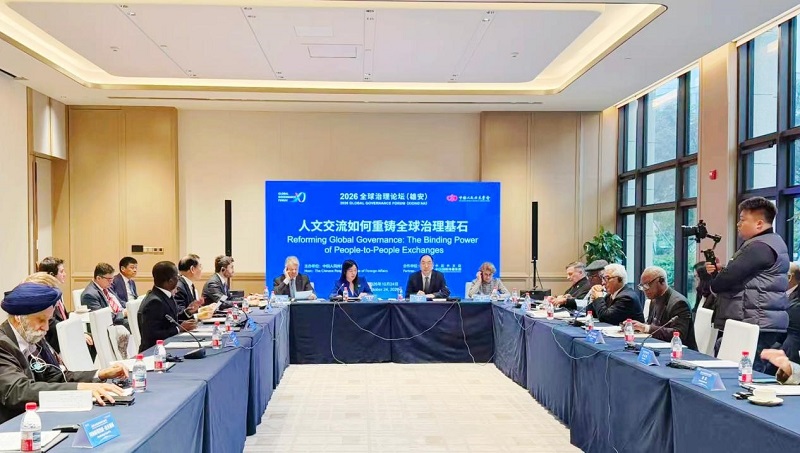
The roundtable “Reforming Global Governance: The Binding Power of People-to-People Exchanges” is organized by China International Communications Group during the 2026 Global Governance Forum (Xiong’an).
This helps explain the importance of the forum’s fifth thematic track, which focused on promoting inter-civilizational exchanges to advance inclusiveness and mutual learning. Two roundtables under the theme organized by China International Communications Group (CICG) – one titled “Reforming Global Governance: The Binding Power of People-to-People Exchanges,” the other devoted to the traditional Chinese concepts of he er bu tong (harmony in diversity) and tianxia datong (harmony for all) – brought together more than 80 participants from governments, universities, media organizations, think tanks, publishing houses, and civil society groups across more than a dozen countries.
A broadly shared perspective emerged from these discussions. Yu Yunquan, vice president of CICG, argued that people-to-people exchange is “not merely a bond for enhancing understanding and friendship, but an important path to bridging differences, building consensus, and consolidating the social foundation of global governance.” He believes cultural diversity is not decorative; it is integral to governance itself. Exchange matters because it can translate top-level consensus into broader public understanding.
Irina Bokova, former director-general of UNESCO, argued that China’s initiatives help challenge narratives about the unavoidable clash of civilizations, and stressed that implementation is now the critical task. Her recommendations were practical: strengthen the role of the UN and other multilateral institutions as platforms for intercultural dialogue; integrate civilizational exchange with the development and security initiatives so that it ceases to be an “optional element” of cooperation and becomes an “essential requirement;” and expand exchanges in culture, education, science, tourism, media and think tanks, particularly among younger generations.
For Levente Horváth, founding director of the Eurasia Center of John von Neumann University in Hungary and former Hungarian consul general in Shanghai, the key issue is that “understanding does not mean agreeing.” People do not need to endorse every political system, cultural tradition or social value they encounter. Nor must they necessarily admire them. But they should seek to understand them – because without understanding there can be no dialogue, without dialogue no trust, and without trust, sustainable cooperation becomes extraordinarily difficult. That, he said, is the true meaning of he er bu tong.
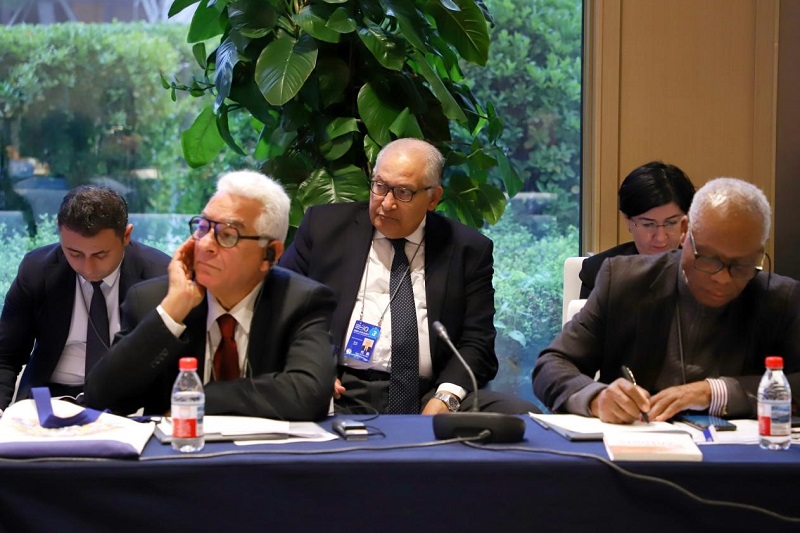
Attendees at the roundtable “Reforming Global Governance: The Binding Power of People-to-People Exchanges” during the 2026 Global Governance Forum (Xiong’an) on October 24.
Meanwhile, Jorge Castañeda, Mexico’s former foreign minister, made the same point from a different angle: genuine dialogue requires listening and debate. Where views converge, exchange is easy; where they diverge, patience and candor matter more. Countries must transcend the polarizations of electoral cycles and identity politics.
What people-to-people exchange provides is not the elimination of disagreement, but the presence of relationships resilient enough to withstand disagreement without breaking, he said.
This encapsulates the argument for treating people-to-people exchanges as infrastructure rather than ornaments. CICG’s own innovative platforms lead the way: the China Today Salon, now established in multiple cities at home and abroad; the Orchid Awards, which honour foreign individuals and institutions dedicated to cultural exchange; and a planned China-foreign media dialogue mechanism designed to help media transcend single perspectives and build a more objective, diverse and balanced international narrative. These platforms, as Yu Yunquan noted, will help keep channels of communication open even during periods of political tension.
Wang Yi told the forum that humanity is “woven together by intertwined interests and a shared future,” and that the world faces two stark choices: one that applauds strength, favors self-interest, monopolizes power, and practices double standards; and another that champions multilateralism, sovereign equality, mutual respect and international law. The latter path is unquestionably more demanding. It requires that the concerns of small countries be taken as seriously as those of major powers. Yet it is also the only sustainable path forward.
One year on, the Global Governance Initiative has generated principles, platforms and, increasingly, institutions. What it still requires, however, is something no policy document alone can create: the gradual accumulation of trust between peoples, built through exchanges that may appear modest in the moment, but ultimately prove foundational over time.