The world is not short of summits. What it lacks is lasting solutions.
Regional conflicts continue to spill across borders. AI is outrunning the rules meant to govern it. The development aspirations of the Global South still go largely unheard in the rooms where decisions are made. Unilateralism and protectionism are once again on the rise. And institutions established in the latter part of the 20th century are struggling to deliver either adequate representation or tangible results in the third decade of the 21st century.
What all of this adds up to is not simply a security or development deficit, though both are real. It is, more fundamentally, a governance deficit – a widening gap between the scale of the problems humanity faces and the capacity of the international community to act on them together. That is why the first anniversary of the Global Governance Initiative (GGI) proposed by China deserves more than a ceremonial mention. It comes at a time when the world struggles with how to successfully govern itself.
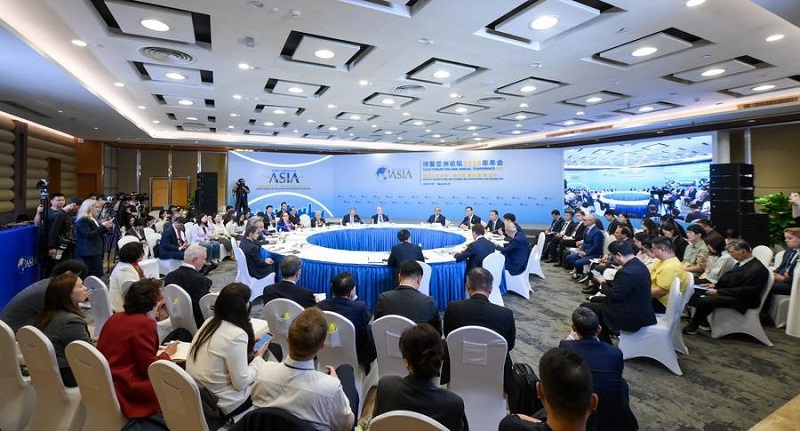
This photo taken on March 25, 2026 shows a scene of a panel discussion themed on "Enhancing Global Economic Governance: the Role of the Global South" during the Boao Forum for Asia (BFA) Annual Conference 2026 in Boao, south China's Hainan Province. (Xinhua/Yang Guanyu)
Seen against that backdrop, President Xi Jinping’s diplomatic engagements in September look like more than just a busy travel schedule. When read together, they form one cohesive response to that question.
In the space of a fortnight, he attended the Shanghai Cooperation Organization Summit in Bishkek, paid state visits to Kyrgyzstan and Egypt, and travelled to New Delhi for the 18th BRICS Summit – with a visit to the United States expected to follow shortly . Together, these stops outline an alternative to zero-sum thinking: security cooperation in Central Asia, a new security architecture for the Middle East, development and technology cooperation among emerging economies, dialogue between two ancient civilizations, and, finally, the steady management of the major-country relations that will probably do most to shape the world’s future. Each stop answers a different aspect of the same question.
This year marks the fifth anniversary of the Global Development Initiative (GDI), and its central message has only grown more persuasive: development is the master key to solving today’s problems. It must not be put on hold until conflicts are settled, because investing in development is itself an investment in lasting peace.
At the BRICS Summit, Xi proposed five initiatives on “greater BRICS” cooperation in areas of AI, trade and investment facilitation, digital industry, intelligent manufacturing, and science and technology talent development. In Bishkek, the emphasis was on flagship Belt and Road connectivity projects such as the China-Kyrgyzstan-Uzbekistan railway, alongside new cooperation in emerging areas: AI, the digital economy, green industry and green mining.
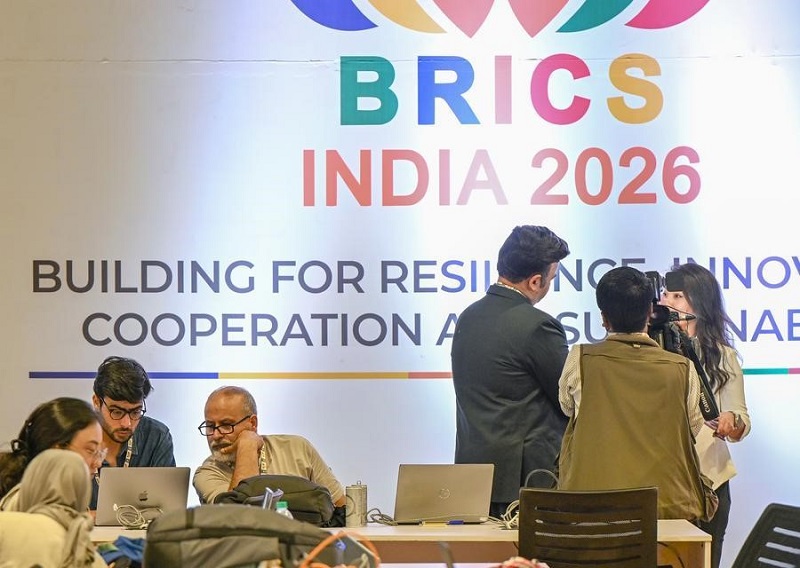
Media staff work at the media center at Bharat Mandapam, the main venue of the 18th BRICS Summit in New Delhi, India, Sept. 12, 2026. (Xinhua/Javed Dar)
The contrast with “small yard, high fence” politics is no accident. China is advocating for modernization where opportunities are shared, not an exclusive technology club – in Xi’s own words, to “dismantle walls, not erect them,” and to seek “integration, not decoupling.” As former Egyptian Prime Minister Essam Sharaf observed, the world now risks sliding from the familiar development gap into something more dangerous: a digital divide in which advanced technologies are available only to the wealthy.
The GGI, proposed by Xi at the SCO Summit in Tianjin last year when the United Nations marked its 80th anniversary, supplies the institutional framework for bringing development to fruition. Its five principles are plain: sovereign equality; international rule of law; multilateralism; a people-centered approach; and a focus on real actions. At their core lies one principle – that international law and international rules be applied to all, free from standards, and that “the house rules of a few countries” must not be imposed upon others. The authority of the United Nations must be upheld.
Where the GDI prioritizes development, the GGI asks who decides, and on whose terms. That is the question to which the Global South has long been waiting for a clear answer.
Nearly 160 countries and international organizations have expressed support. Groups of Friends of Global Governance have been established in New York, Geneva and Vienna. The World Artificial Intelligence Cooperation Organization, the first intergovernmental organization of its kind, has been launched in Shanghai, giving global AI governance a home of its own.
The same logic runs through Xi’s appeal at the BRICS Summit: reform the World Trade Organization, reform and improve the international financial architecture, and increase the representation and voice of developing countries.

Students of Lincoln High School of the U.S. state of Washington and Beijing National Day School take selfies during the NFL FLAG China-U.S. Youth Flag Football Exchange Event & Lincoln High School 2025 China Tour in Beijing, capital of China, May 26, 2025. (Xinhua/Li He)
And then, Washington. The trajectory of China-U.S. relations remains the most closely watched variable in global affairs. Rather than seeking total alignment, the two sides may anchor their interactions in mutual respect, peaceful coexistence, and win-win cooperation. The objective is not to eliminate competition, but to forge a “constructive strategic stability” –a positive stability with cooperation as the mainstay, a sound stability with moderate competition, a constant stability with manageable differences, and an enduring stability with promises of peace.
When the costs of unchecked confrontation far outweigh the dividends of managed coexistence, predictability on shared transnational threats becomes the baseline for responsible statecraft.
China is translating macro-level principles into tangible architecture. At their core, the GGI and the GDI are two sides of the same coin: one answers how we should govern together, the other shows how we can grow together. The key lies in the courage to see beyond divergence, pool wisdom across civilizations, and weave a multipolar order where development, security, and technological progress form a single, resilient fabric.