China’s State Council Information Office recently released a white paper titled “More Just and Equitable Global Governance: China’s Principles, Proposals and Actions,” outlining China’s vision and efforts to improve the global governance system.
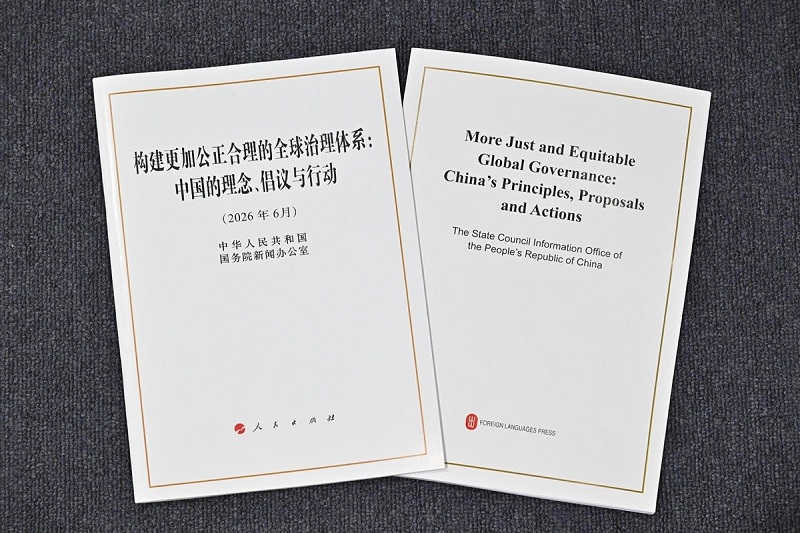
This photo shows the Chinese and English editions of a white paper titled “More Just and Equitable Global Governance: China’s Principles, Proposals and Actions” released by the State Council Information Office on June 17, 2026. (Xinhua)
The white paper addresses questions the international community can no longer avoid: what kind of global governance system does the world actually need, and how should it be reformed to match the realities of the 21st century? In this context, the Global Governance Initiative (GGI), proposed by President Xi Jinping on September 1, 2025, offers a constructive framework to address the deficits in peace, development, security, and trust that increasingly challenge the international order.
The initiative emerged at a time when global governance faces mounting pressures. Geopolitical tensions, economic fragmentation, and climate risks are intensifying simultaneously. Meanwhile, multilateral institutions created in the aftermath of World War II, are struggling to adapt to the realities of a more interconnected yet divided world. Furthermore, unilateralism, protectionism, and power politics have eroded trust in international cooperation. Many countries believe the global governance system no longer adequately reflects the economic weight, demographic reality, and legitimate aspirations of the majority of the world’s population.
It is precisely against this backdrop that the GGI was proposed. It outlines five core concepts: sovereign equality, international rule of law, multilateralism, a people-centered approach, and action-oriented cooperation. These principles can strengthen the effectiveness of existing international institutions, promoting a governance framework based on extensive consultation, joint contribution, and shared benefits.
The broad international support for the initiative illustrates its strong resonance. According to the newly released white paper, nearly 160 countries and international organizations have expressed endorsement or support for the GGI. This reflects a growing global consensus that reforming and improving global governance is both necessary and urgent. More importantly, many countries see the initiative as a practical response to long-standing concerns about representation, fairness, and participation in international decision-making.
One reason for the initiative’s wide acceptance, is its systematic response to some of the most pressing challenges facing global governance today. By emphasizing sovereign equality, it rejects the notion that international rules should be shaped primarily by the most powerful countries. By upholding the international rule of law, it advocates for a rule-based system applied consistently rather than selectively. Reaffirming multilateralism, it defends the principle that global affairs should be discussed and managed collectively, with the United Nations playing a central role. At the same time, the emphasis on a people-centered approach and concrete actions ensures that governance reforms ultimately improve human wellbeing and deliver tangible outcomes.
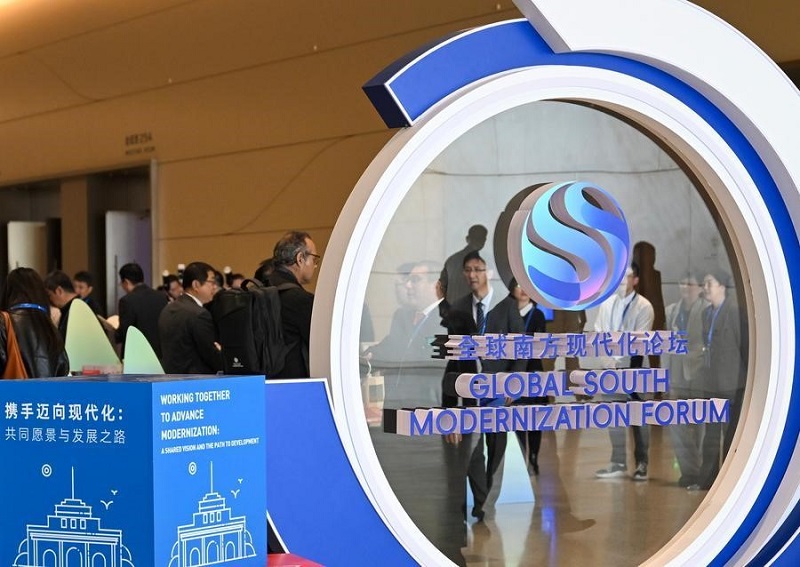
This photo taken on Nov. 21, 2025 shows a scene at the exhibition area for achievements at the Global South Modernization Forum in Beijing, capital of China. (Xinhua/Jin Liangkuai)
For the Global South, the appeal is fundamentally about voice, dignity, and agency. Maya Majueran, director of the Belt and Road Initiative Sri Lanka, in a signed article published by Xinhua, observes that the post-war institutions were created in a very different era of global power distribution. Their legitimacy now depends on adapting to a multipolar reality rather than clinging to a mid-century hierarchy. The GGI resonates because it refuses both extremes – the false choice between accepting an inequitable status quo or rupturing the entire system. Instead, it insists on expanding the space for developing countries to participate as equals, free from the logic of “bloc politics” that forces nations to choose sides in other parties’ rivalry.
Crucially, however, support for a more just global governance architecture is not confined to the South. The GGI’s principles are framed broadly enough, and grounded firmly enough in the UN Charter, to engage countries inside the so-called Western institutional core, explained Spanish scholars in interviews with China Today..
Speaking to China Today, Pedro Nueno, co-founder of China Europe International Business School, said he sees the GGI as an attempt to correct the chronic imbalance between representation and efficiency in global governance. Vicente Ortún, emeritus professor at Universitat Pompeu Fabra, argued that the world is no longer unipolar and that stability of the international order and severity of global challenges, require coalitions that deliver, anchored in principles respectful of diverse national realities. The GGI he suggested, constitute a “very solid guide” for that task.
The growing resonance of the GGI reflects a broader shift in international expectations. Many countries are seeking a governance system that is more representative, more inclusive and better equipped to address global challenges that no nation can solve alone. Rather than advocating confrontation or division, the initiative emphasizes dialogue, cooperation, and shared responsibility.
As the white paper explains, China’s vision for global governance is rooted in the belief that the world should move toward an equal and orderly multipolar system and an economic globalization that is universally beneficial and inclusive. The GGI, along with other initiatives China has proposed in development, security and civilizational exchange, contributes ideas and solutions to the evolving architecture of global governance.
In an era of uncertainty and fragmentation, initiatives that encourage cooperation and mutual respect carry particular significance. While the GGI doesn’t claim to have all the answers, it does provide a framework for constructive dialogue on how the international system can adapt to the 21st century realities. By advocating sovereign equality, true multilateralism, and practical cooperation, the GGI contributes Chinese wisdom and momentum into the pursuit of a more just and equitable global order.