The lives of two billion people across Asia are directly dependent on China’s Xizang Autonomous Region. Rivers born from melting glaciers provide water for drinking and irrigation.
Billions more people are unwittingly dependent on Xizang since the Qinghai-Xizang Plateau regulates the world’s climate. Snow reflecting the sun’s rays back into space contributes to a complex system that lowers temperatures in the southern hemisphere while raising them in the north.
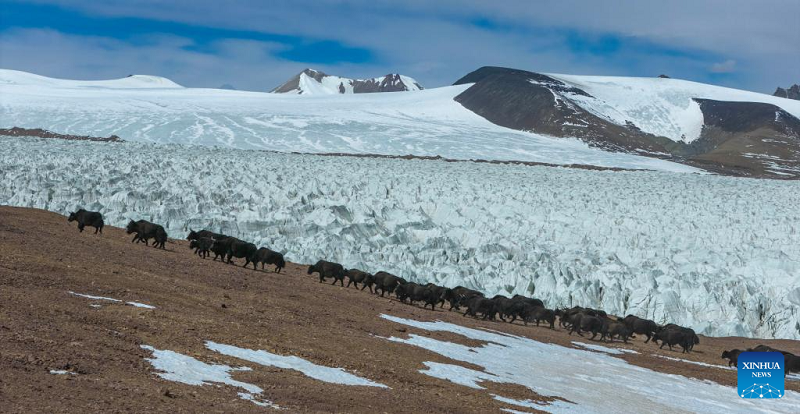
An aerial drone photo taken on March 10, 2026 shows a herd of wild yaks passing by the Zangser Kangri Glacier at the Changtang National Nature Reserve, southwest China's Xizang Autonomous Region. March 21 marks the World Day for Glaciers. (Photo by Sonam Jamcan/Xinhua)
Xizang’s long mountain slopes heat air in summer that condenses as it rises. This creates the world’s largest monsoon which delivers life-preserving, seasonal rainfall to south and southeast Asia. For centuries this has forged agricultural routines and shaped cultures and civilizations. Less frequently appreciated, dust from the Arabian Peninsula is sucked high into the atmosphere above Xizang to be deposited in the Pacific.
The larger Qinghai-Xizang plateau comprises huge areas of alpine shrub land, grasslands, peat and farmland with a vast capacity for carbon sequestration. It plays, and must continue to play, an essential role in the mitigation of regional CO2 emissions.
The scale of Xizang itself is awesome. Geographically it is as large as a third of Europe, yet it is home to just 3.7 million people. From space, it resembles a giant wedding ring, the mountain tops silver by day and golden red at sunset. From the land, the world’s highest mountains loom above verdant grasslands and grassless deserts.
Awesome, the ecology is also fragile. Temperature is rising at twice the global average. Desertification is a constant risk. While vegetation has increased in northern and north-western desert areas so has sensitivity to precipitation. In the central region and some high elevation areas, sensitivity to solar radiation has also risen. Less vegetation means less carbon sequestration.
Many of the 46,000 glaciers in the Qinghai-Xizang Plateau are retreating rapidly. The loss of life and infrastructure wrought by the immense mudslide on Nepal's border with Xizang in August caused, it is thought, by glacial melt demonstrates the human cost.
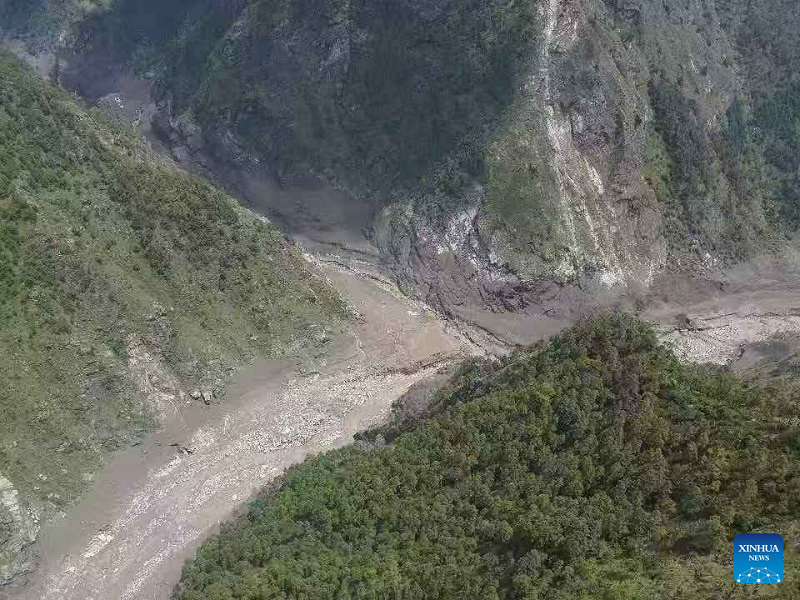
This photo, taken on Aug 26, 2026, shows a view of the mudslide-hit area in Gyirong county, Southwest China's Xizang autonomous region. (PHOTO/XINHUA)
As one of the most seismically active zones in the world, even the landscape and river systems can change dramatically.
Xizang, then, is a global ecological resource falling within China’s jurisdiction to protect. The challenge is how to blend conservation with sustainable development. China’s answer – to create an ecological civilization – is based on ten high-level principles that guide and are reinforced by legislation, national planning, and local governance.
Civilization, here, should not be confused with the imperial concept of civilizations succeeding each other through conquest. Rather, it is closer to the Chinese classical understanding of civilization as encapsulating life, virtue, and beauty.
Among the principles are the harmonious coexistence of man and nature, recognition of green development as a fundamental departure from past practice, holistic coordination of ecological policies, and constructive adaptation to local conditions.
History emphasizes the challenge. Spectacular and beautiful, Xizang’s environment is nevertheless inhospitable. It seems unlikely that Xizang’s population ever exceeded a few hundred thousand until the twentieth century. Reaching perhaps 1.2 million inhabitants in the 1950s, and tripling since then, Xizang is still one of the least densely populated parts of the world.
With limited land suitable for arable farming, livestock rearing was for centuries the primary occupation. While minerals, notably iron, were mined, mining was never taken to scale. In the seventeenth century, silver ingots from Xizang were used by the Nepalese to mint currency. Exported unrefined, they contributed little to the local economy. Moreover, the Slovenian philosopher and writer Slavoj Žižek reports that before the 1950s the ruling elite prevented industrial development out of fear of disrupting the traditional hierarchical society.
History also teaches that traditional ways of life in the harsh environment that is Xizang were incapable of lifting living standards to above what today is considered abject poverty. The expectations associated with modernity – clean water, electricity, infrastructure, education, good health and longevity – are beyond the capacity of traditional systems to deliver. Nor could they deliver the resources necessary to ensure that Xizang remains a global resource: the need to react to climate change and to restore and protect its ecology.
Extreme poverty in Xizang was eradicated in 2021, as in China as a whole. However, while urban living standards are above the national average, the same is not true of the extensive rural areas. Moreover, the local economy is still dependent on external support, despite many years of sustained economic growth – 6.1 percent in the first quarter of 2026, higher than any other provincial level area in China. In the thirty years to 2020, cumulative government subsidies matched or exceeded local economic production even without accounting for substantial investment in fixed assets.
Xizang has also been directly assisted by provincial level governments and by cities, something that it is difficult to imagine happening in any other jurisdiction. Approximately RMB 50 billion was invested from these sources between 1994 to 2020 directed towards more than 10,000 projects.
China, then, is committed to fulfilling its stewardship responsibilities to the world, maintaining Xizang in as pristine a state as possible, while ensuring the livelihoods and well-being of its inhabitants.
After decades of overgrazing, almost 30 percent of the total grassland area has been improved since 2000. While largely due to restoration policies, this has ironically been aided by climate warming leading to more rainfall.
Ecological protection has been taken seriously – and to scale. Fifty percent of the land is bounded by ecological protection red lines while 97 areas cover 36 per cent of the land area are specifically protected. There is special state protection for 246 wild animal species and 169 species of wild plants with demonstrable results. Since 1990, the number of Tibetan antelope, or chiru, has increased from 70,000 to over 300,000, wild yaks from under 10,000 to more than 20,000, and black-necked cranes from some 3,000 to beyond 10,000.
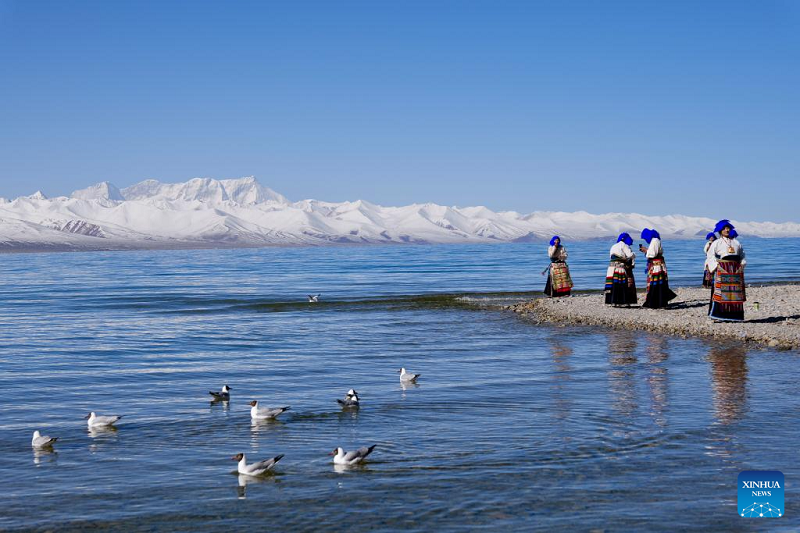
Performers are seen near the Nam Co Lake in southwest China's Xizang Autonomous Region, May 19, 2026. (Xinhua/Zhou Yulong)
Resources are needed for this protection. These must come from sustainable development that simultaneously enables the inhabitants of Xizang to enjoy living standards previously denied them. Remarkably, Chinese technological expertise can now deliver economic growth at zero or minimal cost to the environment.
China recognized early that climate change was real and manmade. The climate featured in the 11th Five-Year-Plan (2006-10) but the strategic decision to develop renewable forms of energy was made even earlier in 2001. The 12th Five-Year-Plan (2011-15) saw the integration of climate and energy policies and the beginning of the transition away from carbon heavy fuels that has so much benefitted Xizang.
Ninety-nine percent of the energy generated in Xizang is clean with the cost of green energy being 40 percent less than that produced from coal. There are wind farms located in Basu County at 5,200 meters above sea-level while the Cerbong photovoltaic power station and the energy storage project in Nagqu are the highest in the world. The Yarlung Zangbo hydroelectric project is the world’s largest and will deliver nearly three times more power than the Three Gorges Dam. Taking account of the natural carbon sequestration, Xizang is already carbon neutral.
Xizang is rich in minerals: copper; zinc, lead, gold and, no doubt, others yet to be discovered. These are the result of the Indian and Eurasian tectonic plates colliding with mountains still being formed. The minerals, though, are difficult to extract economically because of the high altitude, low oxygen and extensive freeze-thaw activity. In addition, there is the fragile ecosystem, the ramifications of which, if disturbed, are potentially global.
Therefore, from the end of 2025, all mines – including renovated and expanded ones – have been required to attain green mine construction standards with no pollution, near-zero emissions and minimal ecological disturbance.
The mix of rich cultural heritage and spectacular scenery explains why tourism has emerged as a dominant industry. 58,000 tourist resources have been officially recognized and visitor numbers increased 10-fold between 2010 and 2024. With 63.9 million tourists arriving in 2024, this represented 17 for each Xizang resident.
Heritage and habitats are both vulnerable to uncontrolled tourism which was why Wang Junzheng, Party secretary of Xizang, has stressed that ecological conservation must remain a key priority. Indeed, this is the challenge of China’s stewardship of Xizang as a global ecological resource: the need to build a high productivity economy within an extremely fragile environment.
Success is compulsory. The national goal of common prosperity embraces the 3.7 million inhabitants of Xizang Autonomous Region just as it does those residing in Beijing or Shanghai. Without further development in Xizang, this goal is unattainable. The evidence to date is of considerable progress towards the vision of an ecological civilization in which economic development simultaneously fosters social and environmental well-being.
—————————
ROBERT WALKER is professor emeritus and emeritus fellow of Green Templeton College, University of Oxford. He is a professor at the Jingshi Academy of Beijing Normal University and also a fellow of the Royal Society of Arts and the Academy of Social Sciences in the U.K.