Magic is often seen as a source of joy, but for magician Sun Zheng, its seed was planted in a time of profound sadness.
At the age of 15, Sun experienced the sudden loss of a classmate – his first real encounter with mortality. After the funeral, a heavy silence hung in the car as he and other students waited for their parents. To distract them from their grief, a friend performed a simple trick: shifting a ring from his index finger to his middle finger and back again.
It was the first time Sun had seen magic firsthand. Though the trick seems very simple today, its impact on him was profound. In that moment of sorrow, the simple distraction ignited a lifelong obsession: he wanted to wield a magic wand to lift the spirits of those around him.
Beginnings of a Life-long Passion
Sun reached out to the classmate who’d performed the trick to help him get started on his journey into magic.
“At first, I asked him to teach me. Every day after school, I would wait to meet him for a lesson. I quickly mastered every trick he knew. Seeing my potential, he took me to a magic stall in a small commodities market near Ditan Park in Beijing – the very place where he had learned his magical skills. I offered to help manage the stall and work for free, hoping the owner would teach me some techniques in return. That shopkeeper became my first magic mentor, patiently guiding me,” Sun told China Today.
In the early 2000s, the magic profession in China was still in its infancy. Across Beijing, only a handful of such magic stalls existed. It was while visiting these stalls that Sun met many masters of the profession and continued to hone his skills until he entered college.
Once in college, Sun finally had the time and opportunity to fully embrace his passion. He established a magic club to find like-minded friends – through which he forged some of his closest lifelong connections.
Graduating with a degree in computer science, Sun landed a prestigious job at Lenovo in Beijing. For a long time, he poured his salary into magic classes, practicing in his spare time and at every opportunity. Eventually, the tug-of-war between his busy day job and his passion for magic reached a breaking point. After careful deliberation, he took the plunge, quit his corporate job, and embarked on the uncertain adventure of full-time magic.
“I learned a lot from corporate life, yet deep down, I knew that’s not what I wanted to do with my life. My parents have always been incredibly supportive of my passion. Their unwavering support lifted a huge weight off my shoulders,” Sun said, “They allowed me to pursue this dream without the burden of financial guilt.”
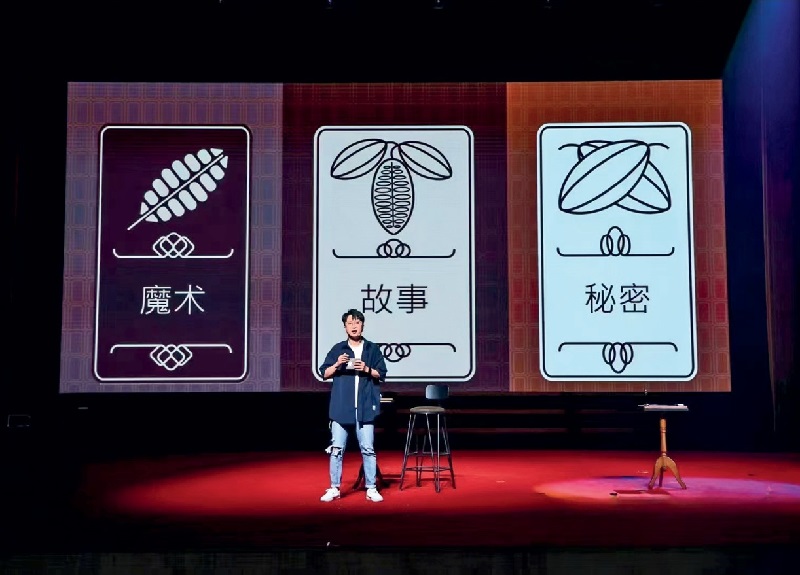
Magic, stories, and secrets are the three basic elements that make Sun Zheng’s show so ingenious. Photos by Sun Zheng
Weaving Illusion with Narrative
Years of dedication culminated in the recently award-winning Three Pieces of Chocolate, a groundbreaking magic theater production that has enthralled audiences of all ages. In an era dominated by smartphones, Sun has achieved the near-impossible: for over two hours, no one looked down at their screens, as all eyes were transfixed on the story they were watching.
Sun’s show ingeniously intertwines 16 captivating illusions with seven deeply personal, true-life stories. One particularly poignant segment involves a boy named Henry waiting for Santa Claus in Disneyland. As the Christmas parade passes by, Henry remains fixated. When Santa finally appears, he says “Merry Christmas” to the crowd. Then Santa unexpectedly calls out “Merry Christmas, Henry” as he passes by, much to the delighted little boy’s surprise.
From the angle of the audience, it turns out the magic lies not in the sleight of hand, but in the quiet revelation that Henry’s father had orchestrated the moment, holding a sign above his son’s head to ensure his name got seen.
This fusion of magic and drama did not happen overnight. Sun spent years of experimenting with ways to pull audiences away from doomscrolling and back into the physical theater.
“Traditional interactive magic treated audiences as mere props – like just helping to pick a card,” Sun said. “But I realized that if I gave them a role within a controlled environment, the connection would deepen. That’s how my magic show Who Am I (2019) was born, and that’s when I first became seduced by theater.”
Balancing the two elements remains a constant struggle. “You cannot approach it from just the magic or just the script,” he said, “It’s a collision and fusion. I might have ten tricks I love, but the story dictates I can only use seven. And sometimes, because I refuse to cut a specific illusion, I have to rewrite the plot entirely.”
Sun also realizes that magic, as an art form, is not all-encompassing. “Magic isn’t a catch-all art form like drama or music; there are plenty of things it simply can’t do. But that’s also what makes it special. Some stories are born to be told with a deck of cards or a puff of smoke. Finding those stories is everything.”
Skills Beyond the Stage
Sun believes that mastery requires humility and a deep respect for the craft’s technical foundation. “As magicians, we must possess the fundamental literacy of performing artists,” he said.
He laments that many magicians can execute a flawless trick but lack basic theatrical knowledge. “Ask them about digital multiplex signals, color temperature, or even where the stage’s left entrance is, and they draw a blank,” he said. “When a lighting technician speaks to you in professional terms and you don’t understand, you lose their respect.”
Ultimately, however, technical prowess is secondary to sincerity. Sun remembered asking his audience a question that requires vulnerability: “If you could travel back in time to meet your past self or a loved one, what would you say?”
Initially, his audience panicked and then he met with silence. In situations like this, Sun’s advice to break the ice is always the same: “Show genuine curiosity. Care about their answer. And then, simply wait.” In that waiting, there’re always people offstage who feel his sincerity and raise their hands to share. In that moment, Sun finds the real magic – the human connection that heals.
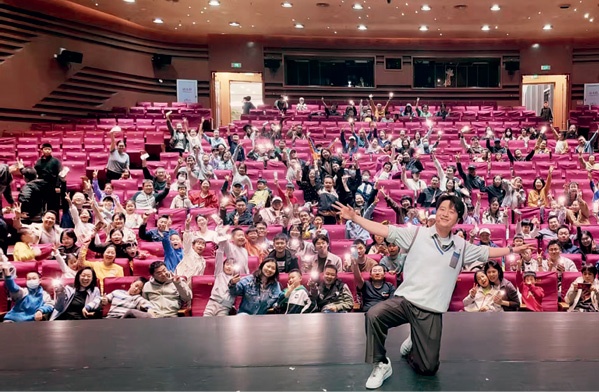
Sun Zheng and the audience – more than half of which are kids – pose for a group photo after his magic show Three Pieces of Chocolate ended in the Future Theater in Beijing on April 19, 2026.
Finding Hope in the Mundane
Those close to Sun know that his life has recently been struck by the illness of one of his family members, leaving him physically drained and mentally exhausted. However, on the upside, for Sun, this triggered new thoughts on life. “It is a peculiar feeling,” he admitted, “one that leads me to live in the present.” This heightened sensitivity to staying in the moment has become the driving force behind his team’s latest magic innovations.
When asked where his inspiration comes from, Sun has a simple recipe: watch more theater, read more books, and observe the world with clarity. He and his team are obsessed with one metric: the seamless integration of props, plot, and emotion. A core directorial theory guides their work: “Do not give redundant information.” On stage, set design, movement, dialogue, and lighting flood the audience’s mind simultaneously, complementing but never repetitive.
This philosophy reshaped his approach to the classic “glass-breaking” illusion. Conventionally, when the cup shatters, the magician yells “broken!” or “destroyed!” – a redundant commentary on what the audience can already see. For the finale of his show, therefore, Sun pairs the visual explosion with a different word: “Rebirth.”
“The visual ‘destruction’ paired with the auditory ‘rebirth’ creates a layered emotional impact, extending the magic beyond the physical act,” Sun said.
To Sun, this is the essence of magic’s beauty: the “other-worldly feeling.” It shouldn’t build a Harry Potter fantasy, but rather make you question if the mundane world you live in holds hidden corners of wonder. “If your perspective on life shifts, even just a little bit, then you have witnessed great magic,” he said.
Achieving illusion also demands extreme precision. Unlike other art forms, magic offers no second takes; a single failure collapses the entire narrative. To achieve this, the team have reinvented many props.
The transparent beer glass is a prime example. It is a classic tool, yet in Sun’s hands, it becomes a vessel of wonder. During the show, Sun normally invites members of the audience on stage to examine the glass. To the spectator, it is merely a glass. But as Sun slowly interacts with them, the magic “pops” – an eruption of impossibility that stuns everyone in the room.
“This is the most amazing part, what we call the ‘Holy Grail’ of magic – effects that happen in the spectator’s hands. The challenge is hiding the silver mechanism inside the transparent vessel without arousing suspicion. We solved this by exploiting the physics of light. By utilizing the refraction caused by the glass’s grid pattern, we concealed the inner workings in plain sight. To the naked eye, the glass looks perfectly normal,” Sun said.
The purpose of all this trouble, Sun explained, is to achieve that singular moment: to give the audience a reason to see the world around them a little differently.