In recent years, wild animals such as raccoon dogs, hedgehogs, and boars have become an increasingly common sight in residential areas in urban China. Some find this novel, while others feel fearful since incidents of personal injury and property damage have become not uncommon. In the light of this, defining the boundaries of human-wildlife coexistence has become an urgent priority.
To address this issue, Shanghai’s Raccoon Dog Census offers a framework that is both effective and easy to replicate for fostering harmonious coexistence between humans and nature in densely populated cities.
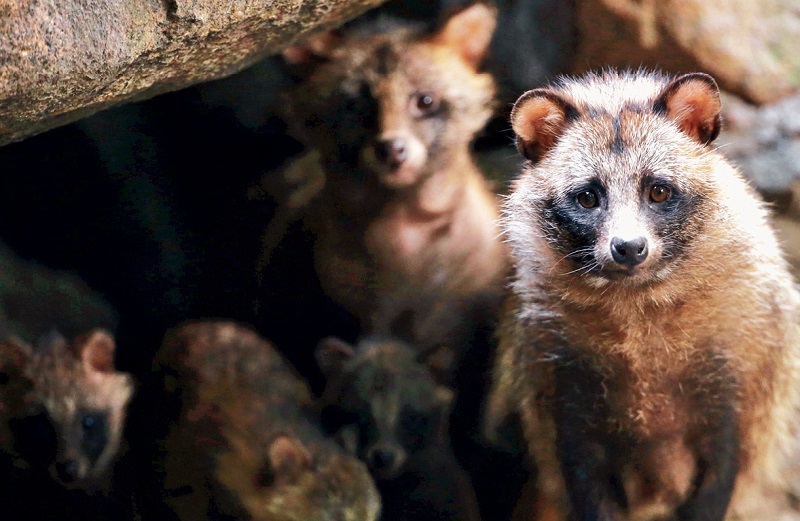
A group of raccoon dogs photographed by Wang Fang, one of the initiators of Shanghai’s Raccoon Dog Census Project.
An Ideal Coexistence
When night falls, a team of researchers and volunteers move through various corners of Shanghai, searching for a new furry resident – raccoon dogs, a heavy-set, fox-like canid, which are one of China’s secondary protected wild animals. Since 2022, the Raccoon Dog Census project has been exploring ways urban residents can share homes with their wild neighbors.
With the improvement of Shanghai’s ecological environment, raccoon dogs, native to the Yangtze River Delta, have been drawn back into the city by abundant food sources, including wet waste and cat food left outdoors. They have now settled in over 300 residential compounds, with a population reaching between 3,000 to 5,000. The return of this species is a sign of ecological progress, but it also brings new challenges: The high population density has led to abnormal behavior, increased health risks such as mange, and triggered conflicts with pets, resulting in a growing number of complaints and calls for help from residents to local authorities.
To achieve science-based conservation and targeted management, the Raccoon Dog Census project was launched with support from the Shanghai Wildlife Conservation Association, Huatai Securities, and the Huatai Foundation, and jointly initiated by the Shanghai Forestry Station (SFS), the Institute of Biodiversity Science at Fudan University, and the Shan Shui Conservation Center (SSCC).
Zhou Jingqi, scientific advisor of the SSCC and the project leader, said that each July, the team maps out neighborhood routes based on satellite images, then organizes volunteers to record the number of sightings, locations, and individual characteristics during the peak activity hours of raccoon dogs. The project also surveys residents and assesses neighborhood waste management and outdoor cat feeding practices, building a comprehensive picture of interaction between human and raccoon dogs.
The 2025 Shanghai Raccoon Dog Census Report shows that after raccoon dogs enter the city, they adapt readily to urban life, displaying a high degree of behavioral flexibility. Human activity, to some extent, replaces traditional natural drivers such as vegetation and water sources, becoming a key variable influencing local raccoon dog population density. Among these, improper management of wet waste and outdoor cat food are the main causes of localized population surges.
Based on the census results, the project team coordinated with local communities, property management companies, and volunteers to roll out a series of targeted interventions. These included optimizing waste management practices, sealing building settlement joints, installing educational signage, and hosting workshops on the proper disposal of wet waste and management of outdoor cat food. The team also promoted the construction of a science education center, published a handbook, and launched educational courses, forming a set of co-governance solutions for urban biodiversity that originated in Shanghai and is now being rolled out nationwide.
As of 2025, the team has published a total of seven scientific papers, nearly 100 popular science articles, and delivered more than 90 lectures. Results from the 2025 census conference drew 550,000 online views.
These efforts have shifted public perception in a positive direction, helping shift attitudes toward raccoon dogs from an initial one of aversion to one of indifference now. Zhou is pleased about this change: “Both humans and raccoon dogs are residents of Shanghai. Each is living well without disturbing the other, which is exactly the ideal coexistence we hope for.”
Scientific management and raising public awareness by in-depth public education have advanced at the same time, yielding remarkable results. The 2025 census shows that the influx of raccoon dogs has expanded across Shanghai, but their actual population has declined, entering a more stable phase. The headache of high local densities of the animals has therefore relieved, and the risk of human-animal conflicts diminished.
Looking ahead, Zhou said that the research team will continue focusing on key communities where conflicts remain most acute, conducting localized projects to deliver more tailored solutions to human-raccoon dog tensions.
Public Engagement
In 2025, the Raccoon Dog Census set its eye on 112 communities across nine districts in Shanghai. Over the past four years, the line transect survey has covered nearly 2,000 kilometers with 1,652 resident questionnaires.
Behind the massive data collection lies the dedicated efforts of nearly 1,600 volunteers. Public participation is key to the project as it not only saves considerable time and improves data accuracy, but also empowers many residents to improve their scientific understanding through hands-on fieldwork.
Volunteer Zhou Yun has taken part in the census for three years and has developed into an experienced team leader. Influenced by her parents, she has established a close bond with animals since childhood and once helped her father feed and raise abandoned fledglings before releasing them back into the wild.
“I definitely wouldn’t do that now,” Zhou stressed, recognizing that simple act of kindness actually violated the rules of nature. She now understands that feeding birds, for example, can reduce their drive to forage in the wild, thereby disrupting the entire food chain. No fearing, no touching, no feeding, no harming make up the “Four Nos” principle the team has been promoting.
Zhou said that after several years of volunteering, her grasp of ecological science has greatly improved, “It’s like transitioning from textbook knowledge to practical application, the two dimensions are completely different,” she said. She initially joined the team out of a pure passion for animals but now she realizes that individual actions are a real part of building urban ecology with scientific value.
In 2025, Zhou applied to establish a bird-watching corner in her residential community, hoping to encourage her neighbors, especially children, to observe nature, understand boundaries, and build public awareness.
After years of ecological restoration, Shanghai’s greening projects have attracted birds and insects. Zhou, a native Shanghainese, recalled that the Suzhou Creek was a black and smelly pollution hazard when she was a child. But now it is a completely different scene: fish can be seen swimming in the clear water, and night herons perch every few meters along the bank like sentinels poised to strike. “Birds flying, fish leaping − that is what a mother river should look like. That is the view I want future generations to know,” she said.
Recently, Zhou also photographed Siberian gulls, regular visitors during the migration season, along the banks of the Suzhou Creek. In her own community, more and more spotted doves have become residents, which has drawn kestrels to circle overhead. Small yet vivid food chains are taking root in the veins of the city.
During the summer of 2025, while Zhou was leading Shanghai’s communities in search of raccoon dog tracks, her elder daughter, then studying animal science, was stationed at the national marine ecological reserve at Jiushan Islands in southeast China’s Zhejiang Province, protecting the world’s last 200 Chinese crested terns. Her younger daughter, meanwhile, had also taken over her sister’s childhood role, reading wildlife conservation books to other children at the reading club at the Children’s Library in Shanghai’s Jing’an District.
This ecological relay demonstrates the power of citizen science: transforming every ordinary person into a vital node in the network of ecological conservation.
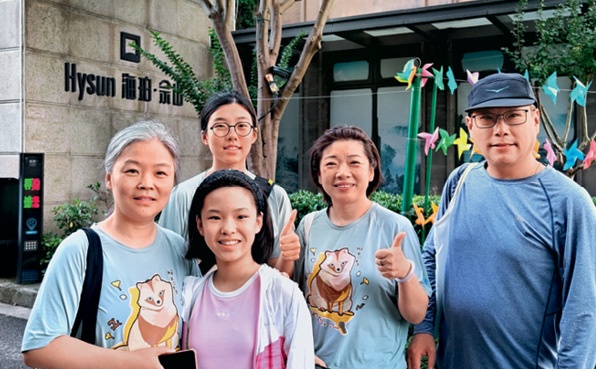
A group photo of volunteer Zhou Yun (far left) and her team members.
An Applicable Experience
The Raccoon Dog Census is China’s first urban wildlife survey in a megacity driven by citizen science, forming a collaborative model that brings together government departments, research teams, and social organizations, each contributing their distinct strengths. Zhou said that Fudan University provides scientific support and methodology, the SFS manages coordination, planning, and supervision, while the SSCC drives public engagement. By integrating scientific guidance, administrative execution, and social mobilization, the project has produced not only a high-quality database but also a process that is easy to copy in other cities.
At present, the project has developed into a widely recognized long-term initiative. In 2022, it was listed on the 100+ Biodiversity Positive Practices and Actions at the 15th meeting of the Conference of the Parties (COP15). In 2023, it was awarded Shanghai’s excellent biodiversity case. In 2024, it was selected by the Ministry of Ecology and Environment as one of the top 10 public participation programs. In addition to awards, it also received funding from the Shanghai Science and Technology Commission’s 2024 Science and Technology Innovation Action Plan for a special science popularization program.
As urbanization deepens, densely populated regions such as the North China Plain, the Yangtze River Delta, and the Pearl River Delta are shifting from the periphery of biodiversity conservation to become critical areas of growth. Meanwhile, the public attention of ecological protection continues to surge.
In 2025, Shanghai updated its list of key protected wild animals for the first time in 32 years. Species with stable populations requiring no special intervention, such as warblers and black-spotted frogs, were delisted; while those experiencing sharp declines, including the yellow weasel, badger, and Chinese hare, along with species under long-term threat, were newly added. The revision strengthens legal protections and enhances public awareness of conservation priorities.
In April 2026, events such as the ecological market at the 45th Shanghai “Love Birds Week” and the Shanghai Citizens Birdwatching Competition drew citywide enthusiasm, igniting widespread interest in ornithology among both dedicated birders and the general public. Data from the Shanghai Landscaping & City Appearance Administrative Bureau show that by the end of 2025, Shanghai had recorded 543 wild bird species with eight new added that year. A total of 970,000 wild birds were recorded, reaching a new high in nearly 10 years.
“The way a society treats its wildlife is the true measure of its civilization,” Zhou said. She added that the key challenge lies in balancing species’ right to survive with human interests. “Striking the balance is our work direction.”
As Lü Zhi, co-chair for Second Global Assessment of Biodiversity and Ecosystem Services, professor at the School of Life Sciences of Peking University, and founder of the SSCC, has always emphasized, the essence of biodiversity conservation is about humanity itself. Only by getting people and communities involved can cities truly embrace nature.