Early one spring morning, I boarded a southbound flight in Beijing, leaving behind the capital’s congested ring roads for one of China’s most compelling rural revitalization stories. My destination was Rongjiang County, tucked into the mountains of Guizhou Province – a place that, until recently, few outside the region had heard of.
After landing in Guiyang, we spent a day assembling our crew and finalizing logistics. By dawn the next day, fortified by strong coffee and a quick breakfast, we were aboard a high-speed train slicing through mountains, tunnels, and terraced fields. With every mile, it became clear we were traveling not just across geography, but into a very different rhythm of Chinese life – one that has quietly begun capturing national, and even international, attention.
For decades, Rongjiang was synonymous with hardship. Like much of inland Guizhou, it lagged behind China’s booming coastline. Rugged terrain, poor connectivity, and a lack of industry made progress slow. Young people migrated outward in search of work; those who stayed relied on farming and traditional crafts. Then came one of the most ambitious anti-poverty campaigns in modern history. Roads were rebuilt, railways extended, and digital platforms introduced rural producers to markets far beyond their villages. Tourism incentives supported ethnic enterprises – Miao embroidery, silverwork, and batik textiles found new buyers. Education and relocation programs lifted countless households out of precarity.
Yet among all these transformations, none reshaped Rongjiang’s image more dramatically than the phenomenon now known as the Village Super League, or Cun Chao.
What began as a grassroots football tournament organized by villagers has evolved into something far greater. Football has long been woven into local life here, especially among various ethnic communities where informal matches have been played for generations. In Rongjiang, the sport has fused seamlessly with local identity. Matches have become communal festivals – complete with traditional music, dance, and spontaneous performances by residents. When videos of these games surged across Chinese social media in 2023, they stunned audiences: packed stadiums, joyous crowds, and an unmistakable authenticity that stood in sharp contrast to the hyper-commercialized world of professional football.
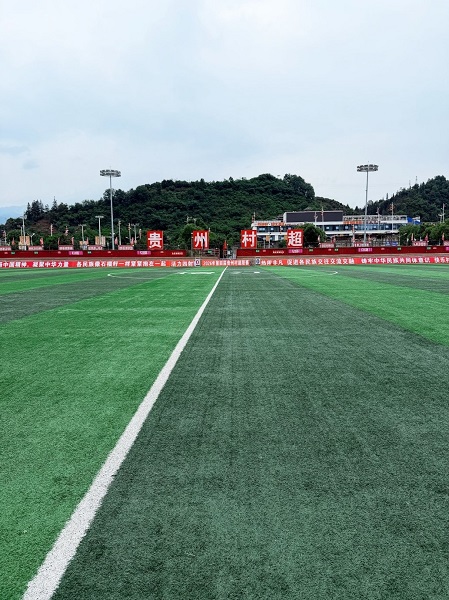
“Village Super League” Football Pitch in Rongjiang County, Guizhou Province.
The league quickly became a national sensation. International football stars, celebrities, and influencers descended on the county. Tourism boomed. According to local reports, millions of visitors arrived within a single year, breathing life into restaurants, guesthouses, transport services, and small businesses. Western outlets took note as well. The BBC described Cun Chao as an unexpected emblem of grassroots culture and rural revitalization – less a manufactured spectacle than a genuine expression of community spirit.
What struck me most during the visit was how deeply football had become embedded into the identity of Rongjiang itself. From the moment you step off the train, football is everywhere: banners draped across streets, signed jerseys displayed in hotel lobbies and restaurants, and even decorative concrete spheres along the sidewalks painted like footballs. This is not branding for its own sake; it reflects how thoroughly the sport has become intertwined with the county’s self-image.
At the same time, Rongjiang is by no means a small dilapidated county frozen in time. In reality, it feels much more like a bustling small city, full of energy and movement. Streets are lined with restaurants, cafés, small shops, and market stalls. During our stay, we visited several local businesses to hear directly from residents about how life had changed in recent years. One memorable stop was a shop selling traditional blue-coloured Miao batik clothing and handmade accessories. The owner Liu Qinlan explained how increased tourism had brought entirely new opportunities to local craftspeople, allowing traditional cultural products to reach customers from all over China. Similar stories emerged wherever we went. Everyone we interviewed seemed genuinely happy to talk about the changes the region had experienced. There was a palpable sense of belief that things were better than before and continuing to improve.
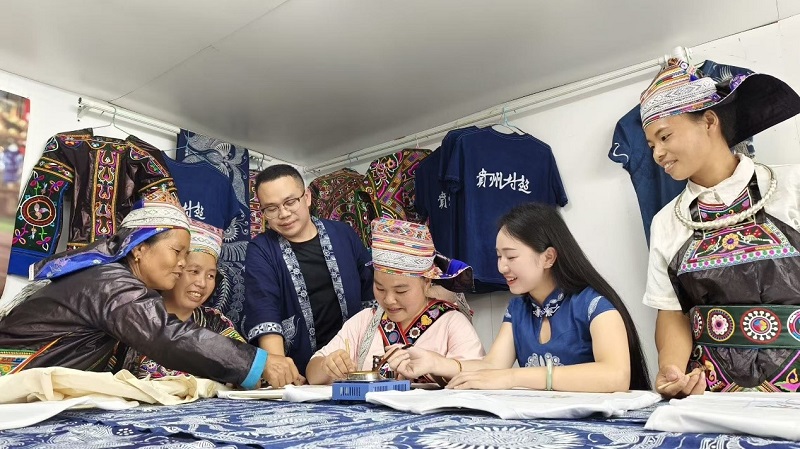
“Miao Sister Lanlan” Liu Qinlan and her husband discuss product designs with artisans at their workshop in Rongjiang. Photo by Liu Qinlan
When we arrived at the stadium in the evening, the entire area was full of life, with people of all ages gathering around the pitch as different matches unfolded throughout the night, beginning with an under-14 boys’ game before older adult teams later took the field. It was heartwarming to see how this place had become more than just a sports venue. For many young people, it clearly provides both purpose and opportunity, as well as a strong sense of communal belonging. It is somewhere people gather not only to compete but also to meet with their friends and forge bonds through a shared love of football.
Earlier that day, we had met a local “cheer squad.” That night, watching another similar cheerleading team perform, I realized how thoroughly Rongjiang had upended my assumptions. These were not teenagers in uniforms tossing pom-poms, but women of all ages – girls and aunties alike – singing in native dialects and playing traditional instruments, dressed in vivid ethnic attire. The effect was disarming: joyful, sincere, and rooted in place. It distilled everything that makes Cun Chao extraordinary. Football may be the centerpiece, but the true draw is the celebration of identity, heritage, and collective life.
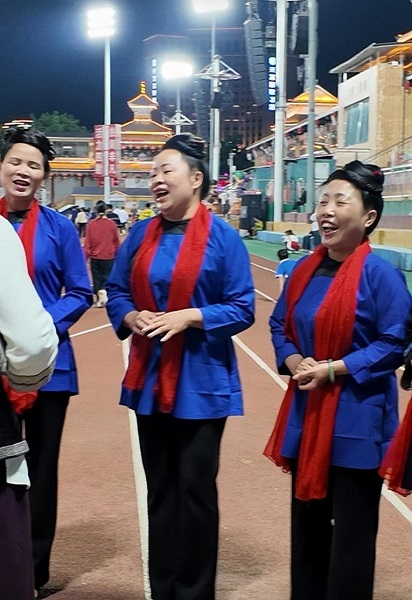
The "Cheer Squad" of the Rongjiang County Village Super League, Guizhou Province.
We left the next morning, bound for another assignment. A longer stay would have revealed more layers – hidden courtyards, late-night street vendors, conversations still unfinished. To understand Rongjiang fully, you need more than a weekend. You need time to let its rhythms settle in.
Still, even in passing, one truth is clear: in an age of curated spectacles, Rongjiang offers something rarer. Not just goals, but meaning. Not just growth, but connection. And if football can help deliver that to rural China, then perhaps the real victory is only just beginning.