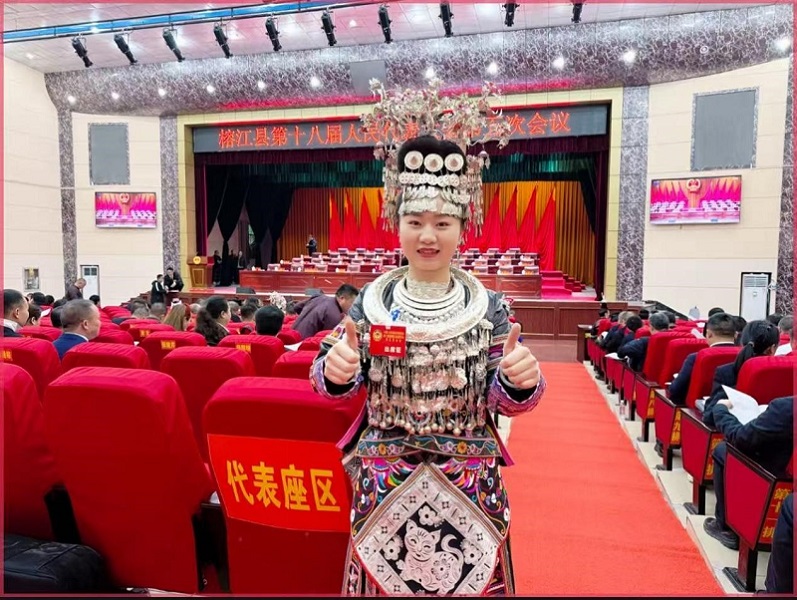
In February 2026, Liu Qinlan attends the Fifth Session of the 14th Rongjiang County Committee of the Chinese People’s Political Consultative Conference.
In Rongjiang, Qiandongnan, Guizhou Province, the “Village Super League” has ignited new vitality in the countryside and brought wider attention to the entrepreneurial journey of a young Miao woman. Her name is Liu Qinlan, better known online as “Village Super League Miao Sister Lanlan.” Previously working in preschool education for a monthly salary of less than RMB 2,000, she has grown into a cultural heritage entrepreneur with annual sales reaching several million yuan, becoming one of Rongjiang County’s leading young entrepreneurs. Leaving the city to return to her hometown, Liu Qinlan pursues more than just her own entrepreneurial dream – she also helps create opportunities for local villagers to increase their incomes and improve their lives. Using youth as her pen and intangible cultural heritage as her ink, she has transformed online traffic into sales and popularity into prosperity, carving out a path for youth returning home to contribute to rural revitalization.
From Preschool Teacher to Entrepreneur: “Village Super League” Lights the Way Home
Few would have imagined that “Village Super League Miao Sister Lanlan,” who only a few years earlier had been living a stable yet ordinary life in the city, would one day gain recognition on short-video platforms and in local business circles.
Liu Qinlan studied preschool education and became a kindergarten teacher after graduation. During her internship, she earned just RMB 1,800 a month, and even after securing a full-time position, her salary was only around RMB 2,000-3,000. Her husband, Pan Wenbiao, worked as a software engineer. The couple worked hard to build a stable life in Guiyang, capital city of Guizhou, yet they never quite felt at home there.
In May 2023, Guizhou’s “Village Super League” exploded in popularity, drawing massive online attention and crowds to Rongjiang. Spotting an opportunity, Liu Qinlan and Pan Wenbiao made the bold decision to leave their city jobs and return home to start a business. At first, they focused on promoting local agricultural products, hoping to bring specialties such as monk fruit, green-white tea, preserved fish, and cured meats to a wider market. With no prior experience in the field, Liu took advantage of supportive local policies and enrolled in a free county-run internet marketing training program, earning her certification after just 15 days. From there, she taught herself filming, video editing, and livestreaming from the ground up.
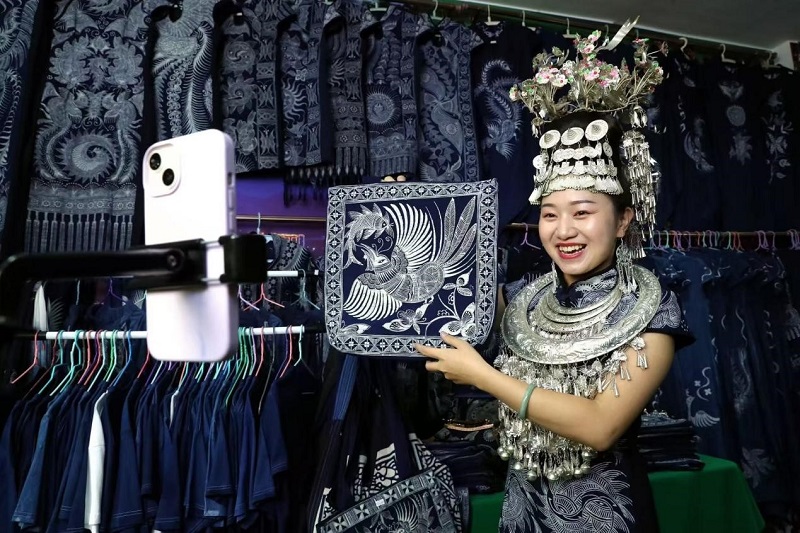
Liu Qinlan livestreams and showcases products from her own business.
On the fourth day of training, Liu decided to try livestreaming for the first time. With the “Village Super League” at the height of its popularity, she sold dozens of agricultural products and earned more than RMB 400 in just one hour. For the first time, she truly realized that the attention surrounding her hometown could be turned into real income.
In the early days of creating rural and agriculture-focused content, Liu also faced setbacks. Stylish and fashion-conscious by nature, she would enter orchards dressed elegantly and wearing high heels – something some online viewers criticized as “not authentic enough.” At the same time, the limited scale of local agricultural production made it difficult to keep up with growing demand as orders increased, making transformation an urgent necessity. Rather than simply selling products at a stall, she began thinking about building an entire industry chain that could bring the intangible cultural heritage of Miao villages to life.
In July 2023, Rongjiang saw a surge in visitors, with hundreds of thousands arriving in a single day. Liu Qinlan quickly noticed that while visitors loved taking photos at popular spots, it was difficult for them to find authentic Miao clothing experiences. As a native Miao woman, her family has long preserved traditional “Hundred Birds” outfits made by her grandmother and mother – intricately handcrafted pieces worth tens of thousands of yuan. Seeing the opportunity, Liu made a decisive choice: to turn Miao intangible cultural heritage crafts, such as batik and embroidery, into a sustainable industry.
What started as a small street stall expanded into renting traditional costumes, offering silver accessories, and selling local snacks. On 29 July 2023, the day of the “Village Super League” final, Liu Qianlan and her team worked from early morning until after midnight, earning over RMB 10,000 in net profit in a single day. That experience made Liu Qinlan even more determined, especially compared with when she earned just RMB 1,800 yuan a month, reinforcing her belief that big opportunities can be built right at one’s doorstep.
She was determined to build something bigger. Miao batik and embroidery were traditionally made and used at home by older generations, rarely entering the market. Liu Qinlan and her team improved and redesigned these crafts, combining traditional batik with modern cheongsams, T-shirts, cultural products, and home goods. Once launched, they quickly became bestsellers. To turn craftsmanship into income, she set up workshops in villages and passed orders directly to local aunts and grandmothers, paying them per piece so that those who worked more earned more.
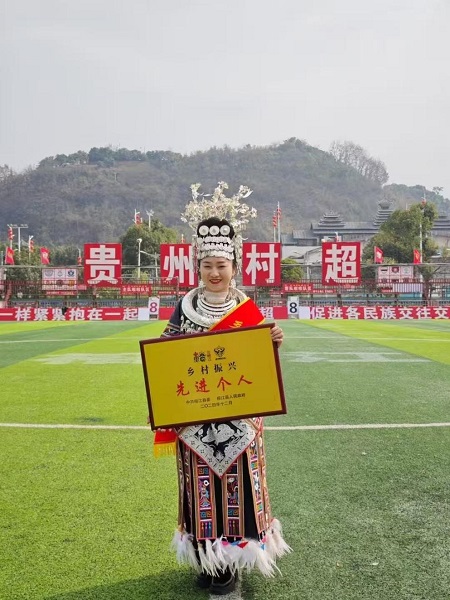
Liu Qinlan displays her “2024 Rongjiang County Advanced Individual in Rural Revitalization” award at the Guizhou “Village Super League” venue.
Entrepreneurship has not been an easy path. Some aunts and grandmothers in local villages are illiterate and sometimes reverse letters or patterns when embroidering, so she prints templates for them to follow as references. When order volumes surge and deadlines become tight, she travels across multiple villages to coordinate and mobilize more artisans. Every piece of white cloth, every block of beeswax, and every vat of indigo dye made from plants serves as a testament to the process. The products include garments, home textiles, and cultural creative goods, all handmade through embroidery and batik techniques. When speaking about embroidered garments, Liu Qinlan explained, “Even the easiest piece takes at least seven days to complete, and every item carries the warmth of handmade craftsmanship.”
Today, her business has formed a complete industrial chain: an operations company handles design and planning; more than 200 artisans across the villages are responsible for production; two exhibition halls manage both online and offline sales; and dozens of distributors nationwide promote the products. From a small 49-square-meter shop in its early days, the business has now grown into two exhibition halls covering over 200 square meters, with annual sales reaching RMB 2-3 million. Liu Qinlan has truly turned traditional craftsmanship into a distinctive industry that helps increase rural incomes and support village revitalization.
True Feelings Are Revealed in Floods: The Warmest Human Touch in Rural Revitalization
Entrepreneurship is never without unexpected storms. In June 2025, Rongjiang was hit by a severe flood, and Liu Qinlan’s two shops were submerged up to the second floor, with over RMB 300,000 worth of goods destroyed, wiping out years of savings in an instant. In those days, she felt anxious and heartbroken, but she was also surrounded by warmth and support from all sides.
People from all over the country donated money and supplies, while local authorities actively provided assistance. Friends and relatives also joined in to clear mud, salvage goods, and support recovery efforts. Wiping away her tears, Liu Qinlan joined the volunteer efforts. Using her online influence, she rallied support and delivered hundreds of boxed meals to the affected areas every day, standing with her hometown through the difficult times.
Seven days later, the town of Rongjiang lit up again. Liu Qinlan said, “That wasn’t just ordinary light – it was the light of hope, the light of confidence.” With the support of others, she reopened her shops in just four days, among the first businesses in Rongjiang to resume operations after the disaster.
This experience deepened her understanding that rural revitalization is not only about industrial growth, but also about people coming together and supporting one another through hardship. She has always believed that every additional intangible cultural heritage product sold means one more source of income for rural artisans. The aunts and grandmothers who once relied on farming and pig-rearing, earning just RMB 1,000-2,000 a year, now earn a steady additional income of RMB 2,000-3,000 per month, while skilled craftswomen can make over RMB 10,000 monthly. They say, “We don’t need to go out to work anymore – we can earn money at home, and it feels stable and dignified.”
Bringing Online Traffic Back Home and Youth Back to Their Roots: Empowering Rural Revitalization Through Youthful Energy
Liu Qinlan’s business is not only rooted in Rongjiang but also extends its influence across the country.
Wearing the “Hundred Birds” dress made by her mother, she has entered Tsinghua University and taken the stage at international forums, sharing stories of Guizhou’s Miao intangible cultural heritage and the “Village Super League” with the world. Many international visitors have been drawn by her story, coming to know Rongjiang through her and falling in love with Miao culture through its traditional clothing.
From a preschool teacher to millionaire, Liu Qinlan’s story is a typical example of youth entrepreneurship in Rongjiang County and a reflection of young people returning home under the rural revitalization strategy. Her success is inseparable from the opportunities brought by the “Village Super League”, the policy and resource support of the government, and, most importantly, her commitment to staying rooted in her hometown and never forgetting her fellow villagers.
Liu Qinlan often says, “When the ‘Village Super League’ thrives and our hometown prospers, we thrive as well.” She also says, “We bring traffic back to villages, deliver orders to rural households, turn craftsmanship into income, give the elderly work to do, give young people a future to look forward to, and ensure that intangible cultural heritage is passed on.”
On the broad stage of rural revitalization, young people returning to their hometowns like Liu Qinlan have become one of the most dynamic forces. They bring back vision, skills, and passion, connecting urban resources with rural strengths, blending traditional culture with modern markets, and integrating their personal aspirations into the development of their hometowns.
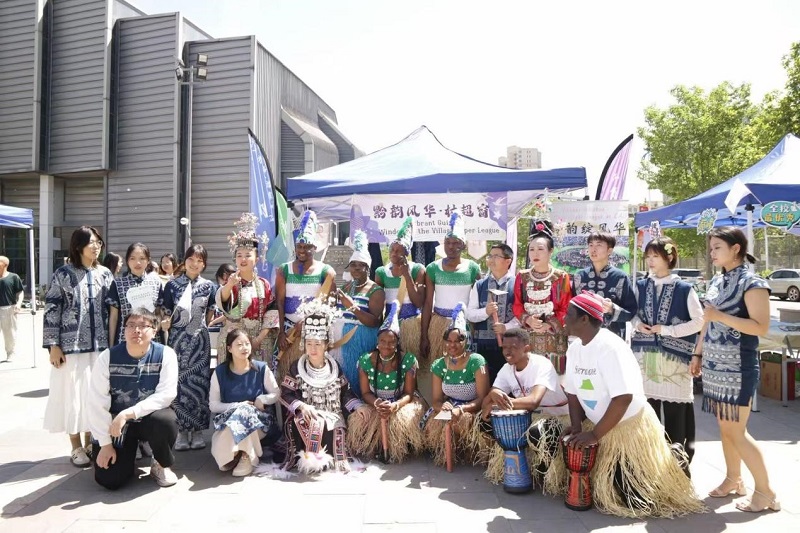
On 27 April 2025, Liu Qinlan joins the “Village Super League” Exchange Team in visiting China Agricultural University, where she demonstrates traditional batik techniques and takes part in an exchange event.
Traffic returns to the countryside, and young people return home. Industries thrive, and culture is carried forward. Liu Qinlan’s story tells us that the countryside is not a fallback option, but fertile ground for pursuing dreams; returning home is not a compromise, but a more meaningful journey. When youth meets the land, and online attention connects with people’s needs, the path of rural revitalization will only grow broader and brighter.