By YE LEFENG
The star attraction of
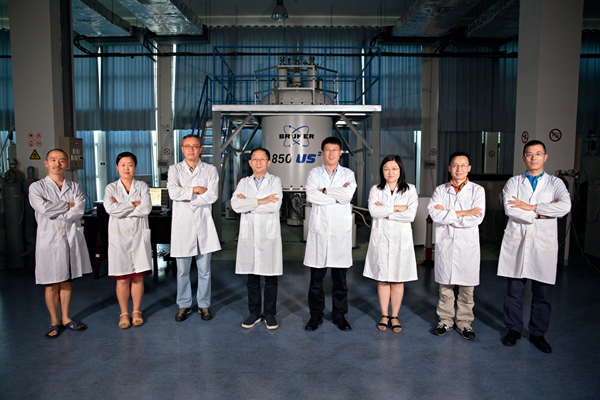
Wang Wenchao, Zhang Xin, Zhang Na, Wang Junfeng, Liu Qingsong, Liu Jing, Lin Wenchu, Ren Tao (from left to right) at the High Magnetic Field Science Center of the Hefei Institute of Physical Science of the Chinese Academy of Sciences.
No less groundbreaking is the island’s Steady High Magnetic Field Facility (SHMFF). High magnetic fields, like extremely low temperature and ultrahigh pressure, provide the extreme experimental environment vital for scientific research, and are consequently invaluable for scientific explorations. The results of 19 international magnetic field-related research projects have won Nobel Prizes since 1913. The SHMFF was installed on
Eight post-doctoral fellows of
Seizing the
Wang Junfeng was the first to return to
As a specialist in research on nuclear magnetic resonance and structural biology, Wang is cognizant of the significance of strong magnetic field devices. Upon completion, the 40-tesla steady-state magnetic field would be one of the world’s foremost, and integral to his research. Meanwhile, the Hefei Institutes of Physical Science made the commitment to put Wang in charge of building and heading the Magnetic Resonance Life Science Department of CAS High Magnetic Field Center. It was this rare opportunity that prompted Wang Junfeng to come to the island with his family in 2009.
At first, the center lacked certain key experimental apparatus and equipment. Wang had to take experimental samples, and scoured the country for equipment suitable for carrying out experiments.
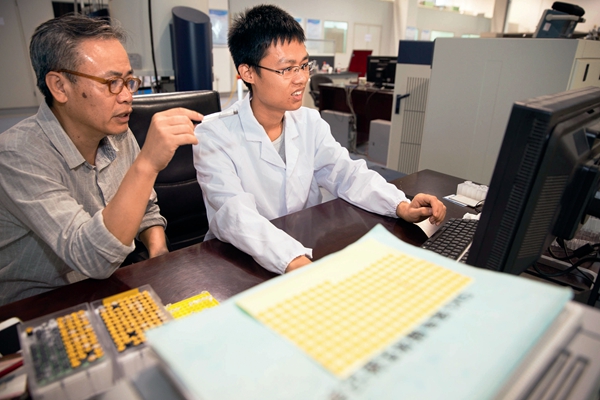
Zhang Na (left) discusses an experimental design with his student.
One year later, the buildings comprising the SHMFF were completed, and a wide range of experimental facilities were successfully set up. But Wang still had to resolve the most important matter of finding the life science talents needed to work and pursue their research there.
His thoughts naturally turned to seven of his former peers from
Wang’s return had a fortuitous effect on the lives of Liu Qingsong and his wife Liu Jing, who had already decided to go back to
Liu Qingsong visited Wang during a business trip to
After inspecting the island’s facilities, Liu was impressed with their interdisciplinarity, as evidenced in their specialization in chemistry, material science, and physics, all of which are vital to his pharmaceutical research.
What had moved Liu most was meeting with Kuang Guangli, head of the Party committee of the Hefei Institutions. Kuang had returned to
To locate more life science researchers, Liu Qingsong was given independent recruitment rights. The first candidate he thought of was Zhang Na, a specialist in nucleic acid. Born in
“There was no SHMFF in
Lin Wenchu came to
Wang Wenchao and his wife Zhang Xin took longer to yield to Liu’s persuasion than Zhang Na and Lin Wenchu. Their son and daughter were born in the
Personal Values vs Serving the Country
As a specialist in high throughput screening technology in drug research, Ren Tao kept in contact with old friends while conducting his postdoctoral research at the
In 2015, after completing his project, he went to
An SHMFF-based, major disease-oriented interdisciplinary research academic chain has since been completed.
Inevitably, certain scientific research conditions in the newly-built SHMFF were somewhat preliminary. Compared with the equipment that members of the life sciences team had used in previous scientific research, not including the SHMMF, the facilities available fell far short of international leading standards.
However, the scientists received support, in the form of capital, projects, and personnel, through various national and local policies geared to nurturing talent. Liu Qingsong observed that the historical backdrop today has changed from that where the older generation of returnees, such as Qian Xuesen and Li Siguang, were needed by the motherland. Today, the situation has dramatically changed for Liu and his team. Achieving individual value is thus consistent with serving the home country.
World-class Scientific Payoffs Achieved
Liu Qingsong and his wife Liu Jing, along with Wang Wenchao and Ren Tao, have formed a pharmaceutical team that conducts antitumor drug research and precision medicine applications. When it came to the development of new drugs, many of Liu Qingsong’s peers told him, “The period of new drug development is long, and does not necessarily guarantee successful results, so it’s better to widen your research options and publish research papers.” However, Liu Qingsong has resolved to stay true to his original intent. He aims to work towards the development of new drugs that can help cancer patients’ survival and improve their quality of life, through controlling the cancer in the same way as a chronic disease.
After five years, the team has built the world’s largest high-throughput cell library focusing on cancer kinase targets in 2015.
Furthermore, to ensure that “the patient takes the right drug at the right time,” these scientists independently developed the first domestic precision tumor treatment technology system. They have thus integrated high-throughput invitro drug sensitivity test technology with high-throughput targeted gene sequencing technology. This not only maximally screens the most available drugs for cancer patients, but also provides reference solutions for doctors.
One of Liu’s American friends recently paid a visit to the island. Observing that he leads a 50-member interdisciplinary research and development team, and has first-class resources for research, his friend remarked, “This is incredible, and highly unlikely in the
Relying on the core technology of the pharmaceutical team and support of CAS and the local government, the Hefei PreceDo Pharmaceuticals Ltd. has been established, and has so far provided precision medical services to thousands of cancer patients. “In recent years, state incentives for researchers have improved greatly, whereby our research contributions can be converted into shares. Through stock ownership incentives, the government supports us with real money,” Ren Tao said. “Thanks to the strategy of mass entrepreneurship and innovation, large numbers of venture companies have been seeking to cooperate with us since 2015.”
Last February, the hybrid magnetic technology of the
“With a good policy, a good environment, a good platform, and good benefits, there is no reason why we shouldn’t make world-class scientific research achievements,” Zhang Na said.
Every time he passes the SHMFF, Wang Junfeng feels a surge of emotion. He remembers the first day he came to
YE LEFENG is a Guangming Daily reporter.