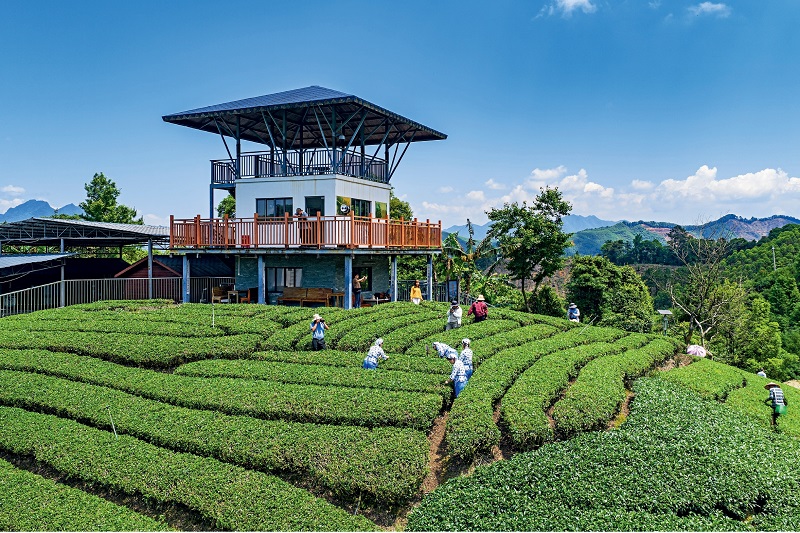
Tourists enjoy scenic views, take photos, and experience tea picking at the Nanshan Tea Sea Eco-Tea Garden in Zhaoping County, Guangxi Zhuang Autonomous Region, on May 5, 2026.
For decades, the West has watched China’s war on poverty with a blend of awe and skepticism. They see the numbers – nearly 100 million lifted from destitution in eight years – and assume it is a trick of statistics. But the real story is not the data, rather, it is in the transformation of places like Rongjiang and Congjiang in Guizhou Province, two of the last counties in China to shake off poverty. There, the shadow of poverty has now been replaced by the roar of the “Village Super League” stadium and the scent of ancient Yao medicinal baths.
In this series of special reports, we will look beyond the headlines to explore what happened after the cameras left, following China’s declaration of victory over absolute poverty in 2021. We feature voices that Western media rarely amplify, for example, an American journalist who debunked the “statistical sleight of hand” narrative by describing what he saw in Guizhou’s mountains; a Jordanian agricultural expert who found the solution for his country’s drought-hit olive groves in a Chinese classroom; and a Malawian economist who is adapting China’s cooperative models to dismantle his nation’s colonial monoculture.
What emerges is a portrait of a development strategy that defies conventional Western paradigms. China approaches the poverty issue as a complex, systematic puzzle requiring the seamless integration of governance, social work, and grassroots entrepreneurship – offering a replicable blueprint for the Global South.