
After China announced that it had eradicated extreme poverty five years ago, the word “poverty” has receded from the prominence it once held in the country’s political discourse as before. This shift has led some Western critics to argue that the issue has been sidelined rather than conclusively resolved.
In truth, poverty is being tackled under different names. And the focus has shifted from ending poverty to preventing it from returning.
China is the only country in history to seek to eradicate extreme poverty, let alone to do so. Others have merely sought to reduce or alleviate poverty. This is not to deny that extreme poverty is rare in some of the world’s richest developed countries, especially social democratic ones committed to sharing national wealth. Development provides the resources necessary to lift people out of extreme poverty.
China prioritizes development. Emphasized when the economy was opened under the leadership of Deng Xiaoping, per capita income rose 42-fold between 1980 and 2015 while poverty fell from perhaps 88 percent to around four percent. However, this transition from a planned to a socialist market economy did not benefit everyone equally. Social assistance and social insurance systems were therefore enhanced in the late 1990s and 2000s to prevent those necessarily losing their jobs from slipping into poverty.
In 2015, the world agreed to pursue the Sustainable Development Goals (SDGs) that included a commitment to “end poverty” globally. By then, poverty in China had already been much reduced. However, with 55 million people remaining poor, mainly concentrated in 832 counties largely located in China’s least-developed west, President Xi reaffirmed the goal of eradicating poverty weeks after the SDGs had been agreed.
Adding to continued infrastructure investment designed to promote development, including roads and high-speed trains, more than one million public officials were assigned special responsibility for lifting families out of poverty. With families identified from a comprehensive national list compiled between 2014 and 2016, officials were able to draw heavily on strategies perfected by the State Council Leading Group Office of Poverty Alleviation and Development.
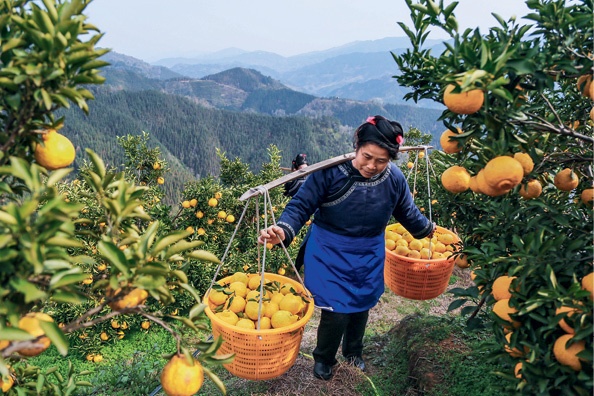
Villagers transport golden pomelos in Rongjiang County, Guizhou Province, on December 27, 2025.
In addition, China was uniquely able to mobilize resources and expertise from across the country. 267 developed cities and counties in the wealthier eastern region were paired to support 400 poor counties in the west; state-owned enterprises organized to provide poverty relief programmes covering 10,000 villages; and 22,000 private companies assisted 10,000 rural enterprises.
The SDG goal of “ending poverty in all its forms everywhere” by 2030 is a fiction or, at best, a goal beyond reach. The United Nations estimates that extreme poverty will still afflict 600 million people in 2030, wars, sickness, climate change and lack of political will preventing meaningful progress. For all but the least developed countries, the initial goal was merely to reduce the proportion of people living in poverty by “at least by half,” rather than to eliminate it.
China’s commitment, though, was truly to eradicate extreme poverty. Consequently, it was to confront and resolve challenges that no other country faced. Its solutions now serve as models available to any government genuinely committed to eliminating poverty.
It proved impossible to connect some communities in China’s mountainous west to modern transport networks that might have increased economic productivity sufficiently to lift incomes above China’s poverty threshold. Therefore, 1.92 million people experiencing poverty in Guizhou Province, for example, were enabled to take up residence in new communities with modern connectivity and amenities. Beyond housing and physical infrastructure, job creation and education, training, and social support were required to allow persons successfully to accommodate to modern lifestyles.
Some poverty reduction was facilitated by rural-urban migration. However, this contributed further to rural depopulation, the abandonment of rural settlements and agricultural land, and to falls in economic productivity which current policies seek to reverse. Even in 2024, the annual per capita disposable income of rural residents was just RMB 23,199 (US $3,190), less than half that of urban residents (RMB 54,188 [US $7,451]).
When China eradicated rural extreme poverty in 2020/1, it did not follow other countries in adopting the language of relative poverty. This is understandable since the country had mobilized successfully to eradicate poverty. However, it was recognized in policy circles that economic development was still not uniform, that disadvantage remained and that, with China close to becoming a high-income country, social expectations were heightened.
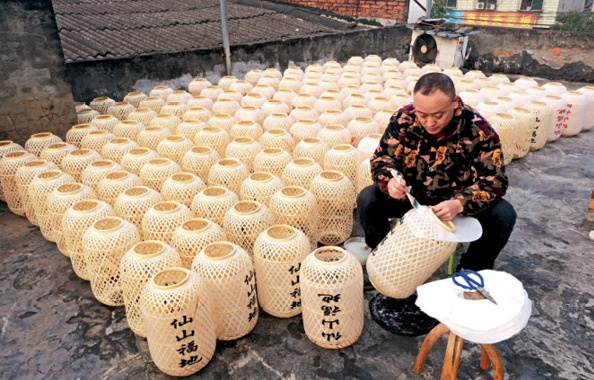
A worker produces handmade bamboo lanterns at the Huimei Bamboo Lantern Factory in Meishan City, Sichuan Province on January 12, 2024. In recent years, Meishan has taken advantage of its abundant bamboo resources and traditional weaving techniques to boost local employment and consolidate poverty alleviation efforts.
Continuing with the focus on rural areas, the Leading Group was reconstituted as the National Rural Revitalization Administration, taking forward a concept introduced by President Xi Jinping in 2017 and formally adopted by the 19th national Congress of the Communist Party of China. There is no explicit goal attached to rural revitalization beyond, in the long term, equalizing rural and urban living standards, something no other country has succeeded in achieving. There are, though, clear policy objectives.
The Comprehensive Rural Revitalization Plan (2024-2027) is nothing if not ambitious. National food security is to be secured, agricultural production capacity increased, rural industries made more prosperous, living environments improved, and access to public services further equalized, all by 2027. Key mechanisms involve optimizing the overall layout of urban and rural development, promoting integrated urban-rural development, enhancing protection of cultivated land and the environment, and encouraging rural industries including tourism to foster local employment.
Past achievements portend future success. Fanshen Village, in Heilongjiang Province, was transformed under targeted poverty alleviation policies. Village collectives facilitated the consolidation of agricultural land that, when leased to enterprises, enabled traditional planting techniques to be combined with modern processing, cold chain logistics, and proactive retailing. Productivity was massively enhanced, residents were engaged, and social cohesion increased.
Houhong Village benefited from its location in the Yangtze River Delta metropolitan area although the economic opportunities provided by nearby cities were a reason for its 50 percent decline in population. With proximity to expertise and a large market, the village committee could engage local agronomists and university research teams to optimize cultivation of its traditional crop, water thistle (Oenanthe javanica), and to reinforce the connection between production and demand.
Poverty alleviation is also practiced within the strategic framework for achieving common prosperity, a policy concept dating to 1953 but explicitly pursued since it was incorporated into the 14th Five-Year Plan in 2021. The current 15th Five-Year Plan prioritizes improvement of the income distribution to be achieved by promoting full and high-quality employment, safeguarding development rights, enhancing social security, equalizing access to basic public services and reforming the real-estate market.
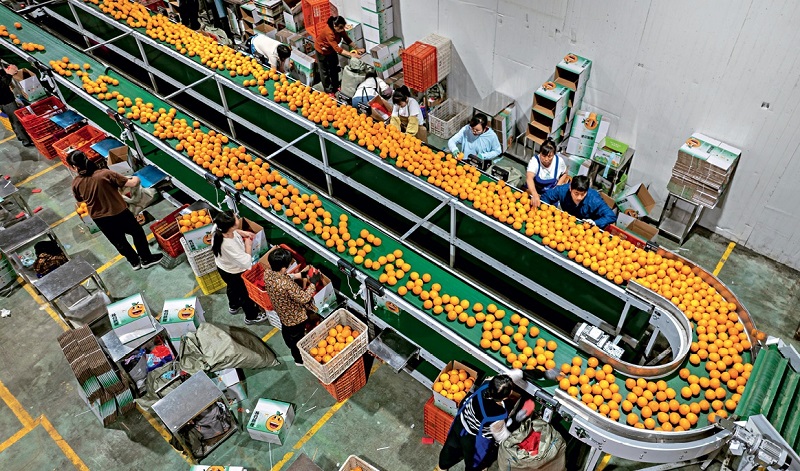
Workers at a navel orange export enterprise are sorting and packing fresh fruits on May 13, 2026, in Zigui County, Yichang City, Hubei Province.
Although the entire population is to benefit from common prosperity, it speaks most strongly to inequalities evident within urban areas. New forms of employment, including platform and gig work, have proved difficult successfully to regulate, leaving some workers – disproportionately rural urban migrants – without access to social insurance or minimum wage protection. These deficiencies are to be addressed during the currency of the 15th Five-Year Plan.
Thus, while there are no national measures of either urban or relative poverty, policy is not blind to their existence. Social minima, welfare thresholds below which citizens are entitled to claim social benefits, are set by provincial or prefectural governments. They are designed to cover basic subsistence while reflecting local living standards that traditionally have risen rapidly due to strong economic growth. Shanghai’s social minimum increased from RMB790 (US $109)/month to RMB1,595 (US $219)/month between 2015 and 2024, rising faster than minimum wages. The national average urban social minimum was RMB828 (US $114)/month in 2025 while its rural equivalent was RMB616 (US $85)/month.
Such policies, together with economic growth, mean that China continues to address poverty effectively, demonstrable even when using international standards. So, according to the World Bank statistics, extreme poverty in 2022 was unmeasurably small in China, effectively zero; the corresponding poverty rate for India was 5.25 percent and 1.4 percent for the US.
Considering the World Bank’s poverty standard for upper middle-income countries, a measure of quasi-relative poverty, China succeeded in almost halving its poverty rate from 42.4 percent in 2015 to 21.5 percent in 2022 – 16.1 percent in urban areas and 30.9 percent in rural ones. In doing so, it far exceeded the reduction in poverty achieved by other upper middle-income countries, a decline of six percentage points from 41.8 percent to 35.8 percent.
Using the same standard, the poverty rate for India in 2022 was 82 percent while that for the U.S. was only 2.2 percent. With U.S. per-capita GDP 3.4 times that of China, most Americans already benefit from the cumulative economic development that China is pursuing. When China becomes as rich as the U.S., its commitment to common prosperity surely means that no Chinese citizens will suffer the extreme poverty to which perhaps 4.7 million Americans were exposed in 2022. 
ROBERT WALKER is professor emeritus and emeritus fellow of Green Templeton College, University of Oxford. He is a professor at the Jingshi Academy of Beijing Normal University and also a fellow of the Royal Society of Arts and the Academy of Social Sciences in the U.K.