As China enters its 15th Five-Year Plan period (2026-2030), a strategic priority is to transform and upgrade traditional industries, develop emerging sectors, and make progressive investments in future industries with the aim of building a modern industrial system. Against this backdrop, a question arises – how can Northeast China’s old industrial bases regain momentum and find renewed energy?
On March 9, China Today sat down with Xie Yancui, a deputy to the 14th National People’s Congress (NPC) and chief engineer of the Technical Quality Department at Chinalco Northeast Light Alloy Co., Ltd. (NELA), who brought with her a delicate piece of intricately shaped aluminum alloy, resembling a winged gear cog. “This is the latest innovation from our R&D team,” Xie said.
The component, made from a new type of high-performance rare earth aluminum alloy, marks a domestic breakthrough in integrating rare earth elements into aluminum alloy. It has been successfully applied to the main structure of key aerospace equipment. In simple terms, this material enables the production of larger and more spacious spacecraft capsules at the same weight, with superior performance under extreme conditions. It meets the growing demands of next-generation aerospace projects for larger, higher-performance aluminum materials, providing a solid foundation for better design and manufacturing.
Starting from Scratch
When Xie joined NELA as a technician in 1995, she had no idea she would spend the next three decades there, witnessing China’s aluminum processing industry evolve from follower to competitor and then to a global leader.
Xie speaks of NELA’s history with evident pride. Founded in 1952, the company was China’s first aluminum-magnesium alloy processor, known as the nation’s “Silver Pillar.” “Over 20 of the 156 projects under China’s first Five-Year Plan (1953-1957) were in Harbin (capital city of Heilongjiang Province), and we undertook two: aluminum alloy and magnesium alloy."
From China’s first aluminum sheet to the alloys used in its first aircraft, missile, and hydrogen bomb, NELA produced them all. “Meeting national needs is our responsibility,” Xie said. This motto, imprinted on her mind from day one, has driven her three decades of front-line research.
“Because we faced a complete information void, we had to start from scratch,” she said, recalling the rare earth aluminum alloy project. Foreign technology bans forced her team to independently explore every process parameter. How were we supposed to incorporate rare earth elements? Determining the optimal ratio? How could we control the process? They had to start from scratch.
Beginning in 2017, Xie and her team spent years conducting countless experiments and designs. They ultimately developed a high-performance rare earth aluminum alloy that not only filled a domestic gap but also reached internationally leading standards.
"This breakthrough means we can realize domestic production of critical core materials," she said. The alloy is now used in the main structure of China’s manned spacecraft, enabling larger cabins and stronger performance without added weight, providing crucial support for the program’s upgrade.” Watching the results of her research soar into space, Xie could barely contain her excitement.
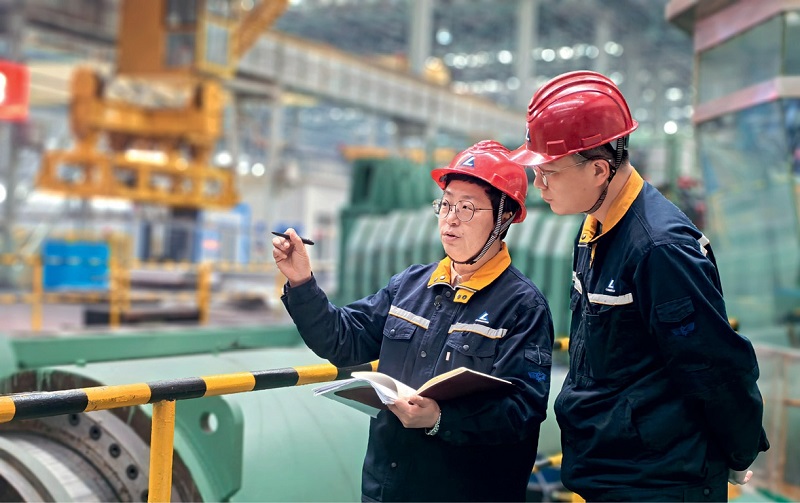
Xie Yancui (left) discusses her research findings with a team member.
Technological Breakthroughs
Xie and her team faced another marathon task during the R&D of China’s independently developed passenger airliner, the Comac C919. From the project’s launch around 2008, through industrial-scale supply in 2017, to the C919’s first commercial flight in 2023, the journey spanned a period of nearly 15 years.
“Aircraft wall panels demand the most stringent specifications,” Xie said. “Aluminum alloys make up 60 to 70 percent of an aircraft’s materials. They must be lightweight yet high-performing, with guaranteed comprehensive properties, because aviation environments are always extreme,” she said, adding that China's aviation and aerospace sectors are evolving rapidly, and traditional materials cannot keep pace with new equipment requirements. “As suppliers, we must move just as fast,” Xie said.
Yet R&D of new materials is never a sprint. From composition design to melting and casting, every step demands repeated experimentation, and every process has strict technical thresholds. Even after lab success, industrial application requires navigating small-scale trials, installation verification, flight testing, and system assessment. “Developing the material is only the beginning,” Xie said. “You must ensure stable quality at scale and maintain sustained supply capability.” This experience gave her a profound appreciation for systems management.
To this day, NELA remains the sole supplier for over 80 types and 1,000-plus specifications of materials for major national projects. Some products have minimal demand and generate no profit, yet, “Ensuring supply for national strategy is the primary imperative, a political responsibility,” Xie believes.
This sense of responsibility drives Xie to keep breaking barriers. Having led more than 10 technical research projects, including process optimization for rocket-grade 2219C10S sheets, many of her achievements have shattered foreign monopolies. NELA now ranks among China’s top enterprises in the manufacturing of certain products, including C919 materials and rare earth aluminum alloys.
Tenure as an NPC Deputy
Elected to the 14th NPC in 2023, Xie has played the dual role of technical specialist and policy advocate. Her perspective has broadened from optimizing individual processes to upgrading Heilongjiang’s entire manufacturing sector. Over four years, all her suggestions have been adopted. These include specialized aluminum-magnesium industrial parks to modern industrial systems, each closely aligned with national strategy and industry needs.
In 2025, she turned her attention to the low-altitude economy, a strategic emerging sector. She conducted field research at AVIC Harbin Aircraft Industry Group and Guanglian Aviation, engaging with executives, engineers, and end-users to formulate a suggestion to the NPC for establishing a demonstration zone. “Heilongjiang boasts a solid aviation industrial base, rich agricultural and forestry applications, ideal low-temperature testing conditions, and 3,000 kilometers of border,” Xie said. “Crop dusting, forest patrols, border security, emergency rescue – our application scenarios are incredibly diverse.”
In recent years significant gains have been made in production efficiency and quality through intelligent, digital transformation. “But I’ve noticed that achieving full production-line digitization requires customized solutions for each enterprise,” she said. “From R&D to actual application, too many links remain unconnected.”
Xie’s suggestion to the 2026 session of the NPC focuses on bridging AI research and real-world application. “Between research institutions and downstream enterprises, numerous bottlenecks persist that require national-level coordination and improved technology transfer mechanisms,” she said. She hopes that by integrating resources and optimizing policy frameworks, the last obstacle on the way from lab to market can finally be removed.
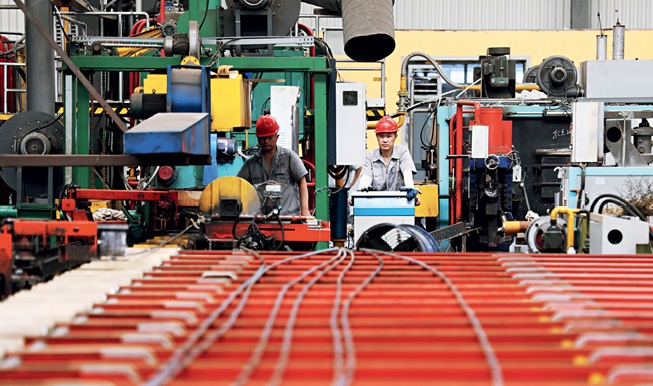
Workers produce aluminum alloy building profiles and industrial profiles at a manufacturing enterprise in Suixi County Economic Development Zone in Huaibei City, Anhui Province, on June 29, 2024.
Investing in the Future, Investing in People
As the 15th Five-Year Plan period begins, Xie has a clear vision for high-quality development. Traditional manufacturing transformation, she believes, hinges on three pillars: breakthroughs in core technologies to unlock value from new materials; digital empowerment to boost efficiency; and coordinated industrial development to build a modern system.
NELA follows this approach. The company has steadily invested in equipment upgrades and intelligent transformation: building new medium-thick plate and fastener production lines, introducing digital management systems, and achieving full digital control over production. Xie acknowledges that upgrading legacy industries is challenging. “It’s hard to turn a large ship,” she said, noting that existing capacity faces constraints in funding, policy support, and market demand. But the company remains firm in heading in the new direction: drive product upgrading and industrialization through technological innovation, equipment modernization, and digital integration, ultimately establishing a firm position in emerging and future industries.
“Traditional industries cannot upgrade in isolation; we must actively integrate into emerging sectors and seek partnerships,” Xie said. She particularly values collaborative innovation across industry, academia, research, and application. NELA’s close ties with research institutes and universities help translate scientific advances into productive capacity more rapidly.
“The responsibility of state-owned enterprises extends beyond making profits to serving national strategy.” For three decades, Xie has championed teamwork, upholding NELA’s tradition of “passing on experience, providing guidance, and setting examples.” When she joined the company in 1995, senior technicians taught her the basics; now she passes that expertise on to the next generation. “Our work is collective; one person working alone cannot succeed.” She also recognizes the long-term value of talent. “Developing an employee from novice to independent contributor takes years, but it is truly an investment in the future.”
Seeing new materials applied to critical national equipment fills her with indescribable pride. Though the path of serving China through research is arduous, Xie considers contributing to strategic needs the greatest honor of her life.
From laboratory to the Great Hall of the People, Xie advances China’s technological self-reliance by ensuring domestic control of critical materials, and shapes manufacturing policy through her recommendations. She is writing the story of a front-line scientist and NPC deputy’s commitment in the new era. As the 15th Five-Year Plan unfolds, this deputy from Northeast China’s old industrial base is strengthening traditional industry transformation, soaring as high as the important projects she overseas.