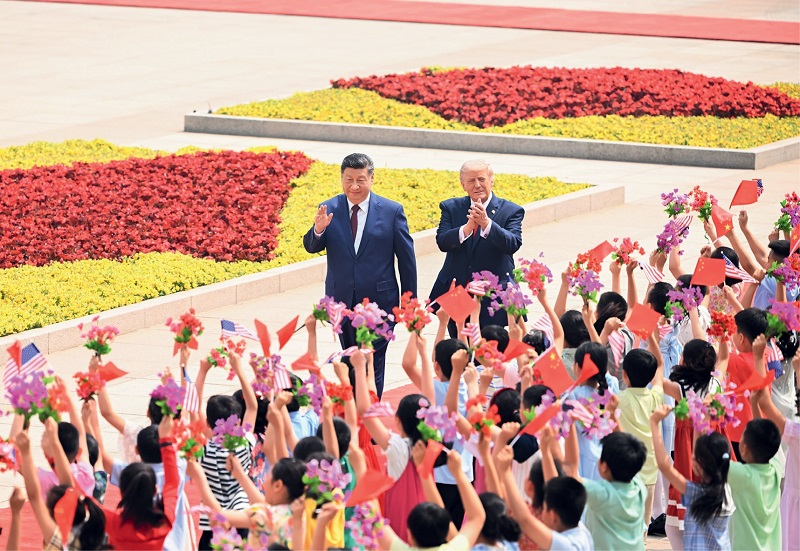
On May 14, 2026, Chinese President Xi Jinping held talks with U.S. President Donald Trump during his visit to China, the first trip to the country by a sitting U.S. president in nearly a decade. The timing of the visit carries special significance for both countries. China is launching its 15th Five-Year Plan (2026–2030), a crucial phase in its modernization drive, while the U.S. is commemorating the 250th anniversary of its founding. Against this backdrop, the meeting was widely viewed as an opportunity to stabilize and redefine the world’s most consequential bilateral relationship.
In recent years, China-U.S. relations have undergone repeated fluctuations amid geopolitical tensions, trade frictions, and strategic competition. Yet head-of-state diplomacy has remained crucial for maintaining bilateral ties. As Xi noted, “I stand ready to work together with President Trump to set the course and steer the giant ship of China-U.S. relations, so as to make 2026 a historic, landmark year that opens up a new chapter in China-U.S. relations.” These remarks underscored the importance China places on strategic communication and high-level engagement amid profound global uncertainties.
Reaffirming China’s commitment to the steady, sound, and sustainable development of China-U.S. relations, Xi said he agreed with Trump on a new vision of building a constructive China-U.S. relationship of strategic stability. The vision reflects the common aspiration of both countries to place bilateral ties on a more stable and predictable footing.
Xi further elaborated on the concept of constructive strategic stability, saying it means a positive stability with cooperation as the mainstay, a sound stability with modest competition, a constant stability with manageable differences, and an enduring stability with promises of peace.
Sean Stein, president of the U.S.-China Business Council, told the media that “constructive strategic stability” goes beyond maintaining China-U.S. ties through mutual caution and fear of economic leverage. Instead, he said, it envisions a more positive and sustainable framework built on cooperation, managed competition, and shared gains, where stability is not driven by the risks of conflict, but by the benefits both sides derive from a stable relationship.
As the world’s two largest economies, China and the United States are deeply intertwined through trade and investment. The U.S. is China’s largest export market and third-largest source of imports, while China ranks as the third-largest export destination and import source for the U.S. Together, the two economies account for more than one-third of the global GDP, and their bilateral goods trade represents about one-fifth of the world’s total. Given this level of interdependence, stable and constructive China-U.S. economic cooperation is not only vital to the prosperity of both countries but also essential to global economic growth, supply chain stability, and market confidence.
The presence of 17 senior executives from major U.S. companies in Trump’s delegation, covering sectors such as semiconductors, finance, agriculture, and technology, underscored the American business community’s continued confidence in the Chinese market. Among them were Tim Cook of Apple, Elon Musk of Tesla and SpaceX, and Jensen Huang of NVIDIA, whose participation indicated strong corporate interest in maintaining and expanding economic engagement with China.
During his meeting with these executives, Xi emphasized that U.S. companies are deeply involved in China’s reform and opening up, and both sides have benefited from these ties. Stressing that China’s door will only open up wider, Xi said China welcomes the U.S. to enhance mutually beneficial cooperation, and said that U.S. companies will enjoy even broader prospects in the country.
Xi’s remarks sent a clear signal that China continues to value foreign investment and sees stable China-U.S. economic ties as essential not only for both countries but also for the stability of global industrial and supply chains.
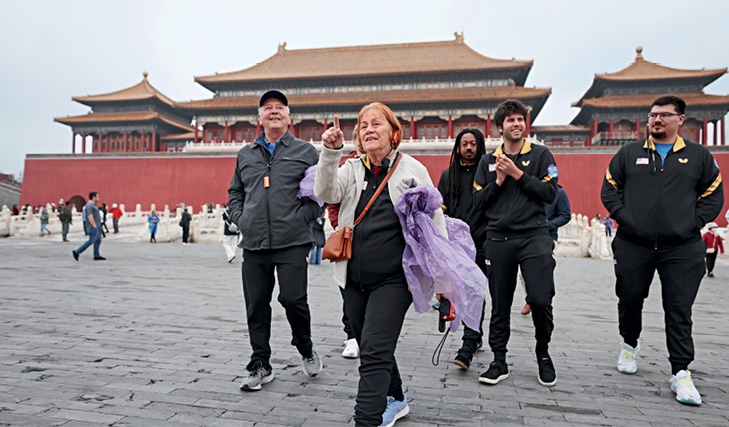
Olga Soltes (second from left), one of the Americans who witnessed Ping-Pong Diplomacy, visits the Palace Museum in Beijing on April 9, 2026.
Beyond trade, China-U.S. relations are also sustained through cultural understanding and people-to-people exchanges. Xi and Trump’s visit to the Temple of Heaven on May 14 carried symbolic significance in this regard. As Xi guided Trump through the ancient complex, the two leaders admired the sophisticated mortise-and-tenon craftsmanship, intricate wooden bracket structures, and the harmony between the building’s design and the ancient Chinese astronomical calendar.
Explaining that the Temple of Heaven captures the idea that Heaven is round and Earth is square, and reflects the view on the universe and guiding philosophy of the Chinese people, Xi used the occasion to introduce traditional Chinese concepts such as harmony between humanity and nature, as well as the people-centered philosophy deeply rooted in the Chinese civilization.
Trump, in turn, praised the Temple of Heaven as an extraordinary example of classical Chinese architecture and profound traditional culture. He said that the U.S. and China are both great countries, and the two peoples are great people with wisdom. “The two countries should deepen mutual understanding and promote friendship among the peoples.”
Such exchanges have continued to resonate beyond the diplomatic stage. In January 2025, the One Voice Children’s Choir from Utah performed the Chinese song “As Wished” at the Temple of Heaven, resulting in the video quickly going viral. The choir later returned to Beijing and performed the song again during a second China tour, reflecting the warm public response in both countries. These heartfelt interactions demonstrate how cultural exchange can foster deeper emotional bonds between the Chinese and American peoples.
This year also marks the 55th anniversary of China-U.S. Ping-Pong Diplomacy. In his congratulatory letter to the event commemorating this anniversary and the launch of China-U.S. youth sports exchange activities in Beijing on April 10, 2026, Xi stressed that the foundation of China-U.S. relations was laid by the people, and their future will be shaped by the youth.
Xi expressed his hope that all sectors of Chinese and American societies, especially the younger generation, will draw wisdom and strength from history, enhance mutual understanding and affinity through exchange and cooperation, and make progress by learning from each other. It is also hoped that the two peoples will not only develop a stronger bond, but also make new contributions to the steady, sound, and sustainable development of China-U.S. relations, the letter said.
The historic summit between Xi Jinping and Donald Trump has helped set the tone for the next phase of China-U.S. relations, signaling a shared interest in greater stability, dialogue, and pragmatic cooperation.
As Xi said, achieving the great rejuvenation of the Chinese nation and making America great again can go together. If China and the U.S. choose cooperation over conflict and partnership over zero-sum rivalry, they can not only support each other’s development but also contribute to global prosperity, stability, and peace.