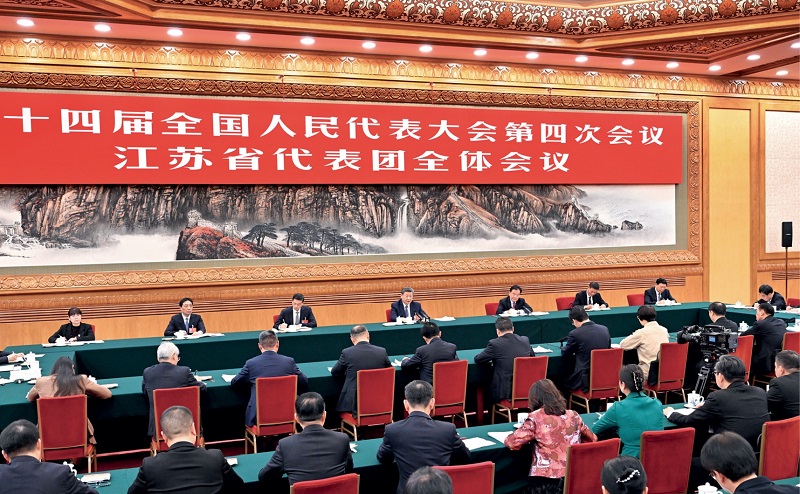
China's “two sessions,” the annual meetings of the National People’s Congress (NPC), the country’s top legislature, and the National Committee of the Chinese People’s Political Consultative Conference (CPPCC), the top political advisory body, serve as a key platform for setting national policy priorities and outlining development strategies.
During this year’s meetings, Chinese President Xi Jinping took part in deliberations with NPC deputies from east China’s Jiangsu Province and joined the discussion of national political advisors from the Chinese Peasants and Workers Democratic Party, the Jiusan Society, the medicine and health sector, and the welfare and social security sector.
Two major policy priorities emerged during these engagements. Xi urged major provincial economies to gain experience in solving new problems and called for decisive progress in the Healthy China Initiative during the 15th Five-Year Plan period (2026-2030). This reflects China’s effort to balance economic development with improving people’s well-being as it enters a new development stage.
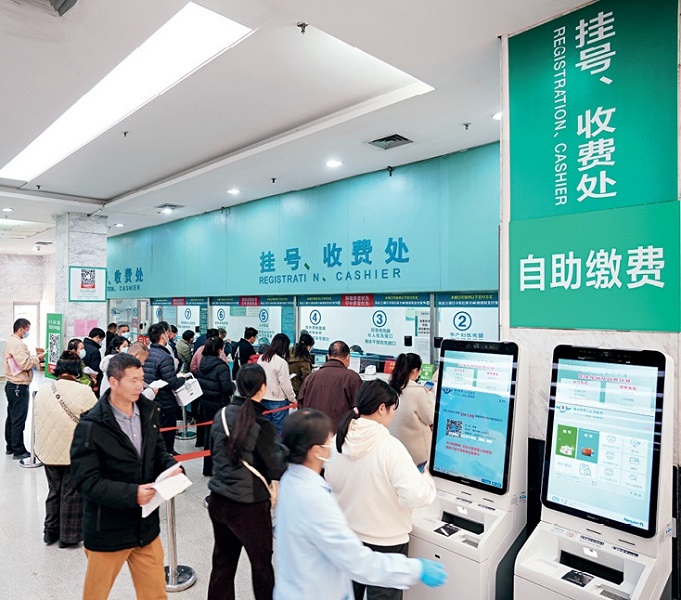
As the first one-stop service center for commercial health insurance in Huizhou of south China’s Guangdong Province, Huizhou No. 1 People’s Hospital has set up a dedicated commercial insurance service area next to the outpatient pharmacy in its clinic building, which is staffed with specialized personnel who provide full-process services.
Innovation-Driven Development
On March 5, 2026, Xi took part in a deliberation with his fellow deputies from the delegation of Jiangsu Province at the fourth session of the 14th NPC. During last year’s deliberation, he urged economic powerhouses to shoulder greater responsibilities in implementing the country’s major development strategies. This year, Xi called on major provincial economies to redouble their efforts to gain experience in analyzing new situations and solving new problems.
The message carries particular weight for provinces such as Jiangsu, one of China’s leading manufacturing and export bases. As global economic conditions become more complex and domestic structural transformation deepens, economically strong regions are expected to serve as stabilizers of growth and pioneers of new development models.
Central to this transformation is the concept of new quality productive forces. With solid foundations, Jiangsu should take the lead in developing new quality productive forces, which is crucial to driving high-quality development and enhancing economic competitiveness, Xi said.
Scientific and technological innovation is fueling the development of new quality productive forces in China. Advances in artificial intelligence, robotics, and large language models are reshaping production and services. For example, Jiangsu alone hosts more than 1,500 AI companies, ranks second nationwide in computing capacity, and is expanding the integration of AI into manufacturing and logistics systems.
China’s broader science and technology landscape continues to improve. According to Yin Hejun, minister of science and technology, China’s total R&D spending exceeded RMB 3.92 trillion in 2025, accounting for 2.8 percent of GDP. Investment in basic research reached nearly RMB 280 billion, or 7.08 percent of total R&D expending, surpassing the seven percent threshold for the first time. China’s global innovation index ranking has also risen to the 10th place, reflecting the growing strength of its innovation ecosystem and the steady improvement of its capacity for original innovation.
At the NPC deliberations, an example from the education sector illustrated how the innovation policy is being put into practice. Zhang Xiaohong, an NPC deputy and Party secretary of Soochow University, introduced the university’s exploration in promoting the integration of science and education, as well as industry and education. “We bring corporate laboratories onto the Soochow University campus and move Soochow University classrooms into enterprises, enabling students to venture boldly and innovate,” Zhang said.
According to Zhang, over the past three years, the university and its corporate partners have jointly trained 9,441 urgently needed personnel in fields such as biomedicine and industrial software, advancing the alignment between academic disciplines and industry. More than 200 joint innovation consortia have also been established with enterprises, forming a collaborative ecosystem that links research, talent cultivation, and industrial application.
After hearing the presentation, Xi said Jiangsu has a solid foundation for developing new quality productive forces, urging the province to promote the integrated development of education, technology, and talent. “Jiangsu should strive to make breakthroughs in original innovation and core technologies in key fields,” he said.
He also emphasized that Jiangsu should break new ground in upgrading traditional industries, bolstering emerging industries, and making forward-looking plans for future industries, calling for new progress in further deepening reform and removing the institutional barriers that hinder the development of new quality productive forces.
These remarks underline a broader strategic direction. As China enters the 15th Five-Year Plan period, innovation is expected to serve as the primary engine of development, while major economic provinces are tasked with exploring development pathways that can generate replicable experience for the rest of the country.
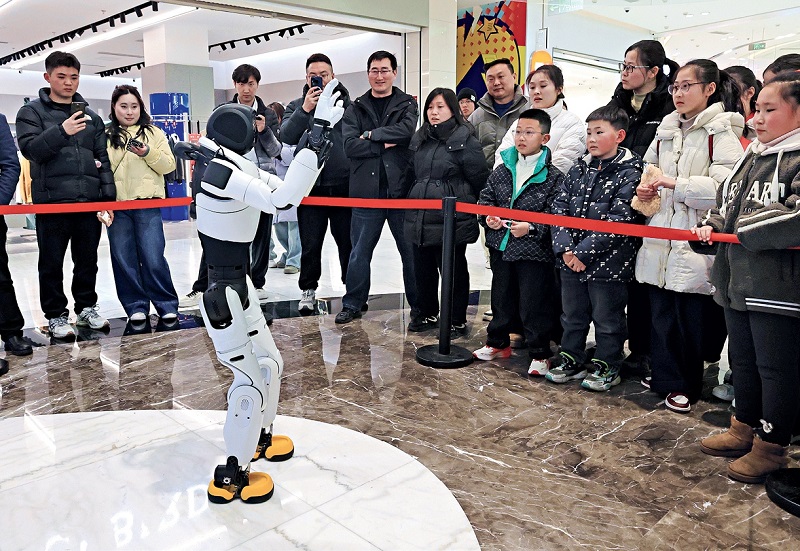
Located in Jianhu County of east China’s Jiangsu Province, the first robot after-sales maintenance service center in the province officially opens on March 8, 2026. Pictured here is a robot performing inside the center.
Advancing the Healthy China Initiative
Alongside economic transformation, improving people’s well-being remains a central pillar of China’s development strategy. Health, in particular, occupies a prominent place in Xi’s governance philosophy. As he once observed, health is the most important indicator of a happy life. This people-centered approach was once again highlighted during this year’s “two sessions.”
On March 6, Xi attended a joint group meeting of national political advisors from the Chinese Peasants and Workers Democratic Party, the Jiusan Society, the medicine and health sector, and the welfare and social security sector, during the fourth session of the 14th National Committee of the CPPCC.
“Building a Healthy China by 2035 is a strategic decision made by the CPC Central Committee, and the 15th Five-Year Plan period is critical to achieving this goal,” Xi said during the meeting, emphasizing the need for coordinated planning and accelerated implementation.
Such policy priorities are rooted in the tangible progress China has already made in improving public health during the 14th Five-Year Plan period (2021–2025). The country has established the world’s largest healthcare system, with medical services covering both urban and rural residents. Today, over 90 percent of residents can reach the nearest medical facility within 15 minutes, thanks to a nationwide network of more than 1.1 million healthcare institutions covering both urban and rural communities.
At the same time, the country’s average life expectancy has reached 79.25 years, an increase of 1.32 years compared with 2020, a clear sign of overall improvements in healthcare services, disease prevention, and living standards. Public awareness of health has also continued to grow. The national health literacy rate increased from 25.4 percent in 2021 to 33.69 percent in 2025, demonstrating that efforts to strengthen health education and promote healthier lifestyles are gradually bearing fruit.
Looking ahead, Xi offered clear guidance on how to further advance the Healthy China Initiative in the next stage of development during that meeting. He emphasized that building a Healthy China is a systematic project. “In the face of the people’s growing and diverse healthcare needs, it is imperative to focus on major priorities and center closely on the tasks that benefit a wide range of people and have a significant impact on the overall situation,” Xi remarked.
Noting that advancing the Healthy China Initiative requires joint efforts from society as a whole, Xi called on the CPPCC to exercise its role as a specialized consultative body, conduct in-depth research and studies focusing on relevant theoretical and practical issues, and put forward suggestions and solutions that are practical and feasible. He also urged members of the Chinese Peasants and Workers Democratic Party, the Jiusan Society, and personnel in the CPPCC sectors of medicine and health, and of welfare and social security, to leverage their professional strengths and contribute their wisdom and effort.
Xi’s engagements during the 2026 “two sessions” signal that China’s next phase of development will be defined not only by technological advancement but also by the pursuit of broader social well-being. Together, innovation-driven growth and the Healthy China Initiative illustrate how economic modernization and improvements in quality of life are increasingly intertwined in China’s long-term development strategy.